


Hermeticists: Difference between revisions
imported>Slate Vesper No edit summary |
|||
| Line 23: | Line 23: | ||
{{quote|We hold the key to life's mysteries.|The staff speaking to Pythagoras.|Assassin's Creed: Project Legacy}} | {{quote|We hold the key to life's mysteries.|The staff speaking to Pythagoras.|Assassin's Creed: Project Legacy}} | ||
The Cult of Hermes had its origins in the sixth century | The Cult of Hermes had its origins in the sixth century BC, when [[Pythagoras]] and his disciple [[Kyros of Zarax]] traveled through the deserts of ancient [[Greece]] to find [[Hermes Trismegistus]]. After long days of travel, they happened upon a man bearing a winged staff, twined with two serpents.<ref name="Project Legacy - Kyros of Zarax">''[[Assassin's Creed: Project Legacy]]'' - ''[[Chapter 2 - Kyros of Zarax|Divine Science: Chapter 2 - Kyros of Zarax]]''</ref> | ||
[[File:PL-Agnus Dei.png|thumb|200px|left|The staff and snakes of Hermes.]] | [[File:PL-Agnus Dei.png|thumb|200px|left|The staff and snakes of Hermes.]] | ||
| Line 35: | Line 35: | ||
===Renaissance=== | ===Renaissance=== | ||
{{quote|Why seek knowledge without putting it to use? We have the chance to fashion a better world, one in which we have the freedom to shape our own destiny.|Ercole Massimo, a leader of the Hermeticists.|Assassin's Creed: Brotherhood}} | {{quote|Why seek knowledge without putting it to use? We have the chance to fashion a better world, one in which we have the freedom to shape our own destiny.|Ercole Massimo, a leader of the Hermeticists.|Assassin's Creed: Brotherhood}} | ||
Sometime before 1506, several Hermeticists pursued the [[Assassins|Assassin]] [[Ezio Auditore da Firenze]], in order to obtain the [[Ezio's Apple|Apple of Eden]] he had in his possession. They were unsuccessful, however, and the [[Piece of Eden]] was sealed away.<ref name="The Da Vinci Disappearance">''[[Assassin's Creed: Brotherhood]]'' - ''[[The Da Vinci Disappearance]]''</ref> | Sometime before 1506 AD, several Hermeticists pursued the [[Assassins|Assassin]] [[Ezio Auditore da Firenze]], in order to obtain the [[Ezio's Apple|Apple of Eden]] he had in his possession. They were unsuccessful, however, and the [[Piece of Eden]] was sealed away.<ref name="The Da Vinci Disappearance">''[[Assassin's Creed: Brotherhood]]'' - ''[[The Da Vinci Disappearance]]''</ref> | ||
[[File:ACB_PC_SP_09_SalaiAndEzioFightingHermetecist.jpg|thumb|250px|right|Hermeticists fighting Ezio and Salaì.]] | [[File:ACB_PC_SP_09_SalaiAndEzioFightingHermetecist.jpg|thumb|250px|right|Hermeticists fighting Ezio and Salaì.]] | ||
As of 1506, after the [[Liberation of Rome|fall]] of the [[House of Borgia|Borgia]] in Rome, the Hermeticists were led by [[Ercole Massimo]]. At his order, they captured [[Leonardo da Vinci]], a famed polymath, in order to discover the hidden entrance of the [[Temple of Pythagoras]].<ref name="The Da Vinci Disappearance" /> | As of 1506 AD, after the [[Liberation of Rome|fall]] of the [[House of Borgia|Borgia]] in Rome, the Hermeticists were led by [[Ercole Massimo]]. At his order, they captured [[Leonardo da Vinci]], a famed polymath, in order to discover the hidden entrance of the [[Temple of Pythagoras]].<ref name="The Da Vinci Disappearance" /> | ||
Soon afterwards, in front of [[La Volpe Addormentata]], another group of disciples attacked two of Leonardo's friends, Ezio Auditore, and his assistant [[Salaì]], though they were both able to defend themselves.<ref name="The Da Vinci Disappearance" /> | Soon afterwards, in front of [[La Volpe Addormentata]], another group of disciples attacked two of Leonardo's friends, Ezio Auditore, and his assistant [[Salaì]], though they were both able to defend themselves.<ref name="The Da Vinci Disappearance" /> | ||
Revision as of 00:38, 4 April 2012
- "As above, so below."
- ―The Hermetic vow.[src]
The Hermeticists were members of the Cult of Hermes, a group based on a set of philosophical and religious beliefs, who dedicated themselves to "transforming mankind."
History
Origins
- "We hold the key to life's mysteries."
- ―The staff speaking to Pythagoras.[src]
The Cult of Hermes had its origins in the sixth century BC, when Pythagoras and his disciple Kyros of Zarax traveled through the deserts of ancient Greece to find Hermes Trismegistus. After long days of travel, they happened upon a man bearing a winged staff, twined with two serpents.[1]

The man dressed in peasant's garb announced himself to be Hemes, and plunged his staff into the ground, causing the snakes to seemingly come alive, and the sands to shift.[1]
The snakes spoke to Pythagoras as a worthy successor, and he was handed the staff, the "key to life's mysteries" that had "been passed down since the dawn of time."[1]
At this, Pythagoras became one of the first known Hermeticists.[1]
Renaissance
- "Why seek knowledge without putting it to use? We have the chance to fashion a better world, one in which we have the freedom to shape our own destiny."
- ―Ercole Massimo, a leader of the Hermeticists.[src]
Sometime before 1506 AD, several Hermeticists pursued the Assassin Ezio Auditore da Firenze, in order to obtain the Apple of Eden he had in his possession. They were unsuccessful, however, and the Piece of Eden was sealed away.[2]
As of 1506 AD, after the fall of the Borgia in Rome, the Hermeticists were led by Ercole Massimo. At his order, they captured Leonardo da Vinci, a famed polymath, in order to discover the hidden entrance of the Temple of Pythagoras.[2]
Soon afterwards, in front of La Volpe Addormentata, another group of disciples attacked two of Leonardo's friends, Ezio Auditore, and his assistant Salaì, though they were both able to defend themselves.[2]
In order to delay their search for the entrance of the temple, Leonardo told Ercole of the clues hidden in several of his paintings. Ercole then sent his Hermeticists throughout Italy to seek the lost paintings, though all of these were intercepted and reclaimed by Ezio.[2]
In the chambers of the Temple of Pythagoras, a large number of disciples, including Ercole, were killed while attempting to keep Ezio from rescuing Leonardo.[2]
Modern times

In the late 19th century, the Hermetic Order was revived in London, England under the name Hermetic Order of the Golden Dawn. It was co-founded by William Robert Woodman, William Wynn Westcott, and Samuel Liddell Mathers.[3]
In the Victorian era, Hermetic practices were closely tied to the occult, and involved many rituals and ceremonies. However, these "black magic" practices were still frowned upon, and at one point, Westcott was forced to leave the Order upon his beliefs being revealed.[3]
With this necessity for secrecy, many members of the Order were known simply by titles; Westcott was the Praemonstrator, Mathers, the Evoker of Spirits (and later, the Imperator), and Moina, Mathers' wife, was the Seeress.[3]
Leadership

While all three were still alive, Woodman, Westcott and Mathers led the Hermetic Order in a "perfect partnership" they once defined as "Harmony." However, greed and ambition eventually took over, and in 1891, Westcott and Mathers had Woodman assassinated in his greenhouse.[3]
Additionally, following an argument over whether or not to publish the secrets and ancient formulas within the Book of Abraham, Westcott planned a coup to oust Mathers from the Order. However, in 1896, Mathers was a step ahead of him, and had a young adept of the Order plant evidence of Westcott's interest in black, ritualistic magic; forcing him to leave the Order.[3]
Subsequent to this, Mathers moved to Paris, and left his "Queen," Miss Farr, as his representative in London. It was there in Paris that the events that triggered the "beginning of the end for the Order" started.[3]
Aleister Crowley, who aptly called himself the Beast, was an initiate of Mathers' and an ambitious member of the Outer Order. He at first attempted to force himself into the Inner Order by assaulting Miss Farr, jumping on her desk and shrieking his demands. However, when this failed, he instead approached Mathers in Paris. Needing allies, Mathers accepted him.[3]
Some time later, in 1899, several members of the Order would revolt, and Mathers would be forced to resign. However, though the Seeress predicted that the Order would not endure, she also went on to say that "This is not the end. It is a new beginning."[3]
Secret chiefs
- "Little is known about the Secret Chiefs. Many believe them to be transcendent cosmic authorities, while others claim they are mere humans. Some say they do not even exist."
- ―Frater V.O.V.[src]

The foundation of the Golden Dawn was closely tied to a group called the "Secret Chiefs," who were only known to the knowledgeable members of the Inner Order, and who were said to possess "terrible supernatural powers."[3]
A little before 1900, Mathers was summoned by one of the Secret Chiefs, who he met with in a dark Parisian alley. Though the man wore a cloak, he clearly wore a ring marked with the red cross of the Templar Order.[3]
The man began to berate Mathers, saying that their partnership had ended, and that he had failed to heed their warnings. He remarked that Mathers' research was useless, but Mathers pleaded for more time, saying that he would have progressed more, had he still had the Book.[3]
However, the Templar only rebuked the statement, telling him that it had never been about the Book, but about Woodman, whose death he correctly blamed upon Mathers.[3]
Trivia

- The symbol of the Hermeticists is a "caduceus," a short staff entwined by two serpents, and sometimes surrounded by wings. In Greek Mythology, it was believed to be the staff wielded by Hermes, the messenger of the gods.
- Similarly to the Cento Occhi, in Assassin's Creed: Brotherhood, the Hermeticists carry several valuable items that are needed for Shop Quests.
- The Hermeticists wield daggers and other short blades, and fight much like Agile guards.
- During the restored memories, several Hermeticists can be found throughout Rome, actively fighting against Borgia guards.
- After the sequence is completed, Hermeticists no longer appear in-game.
Gallery
-
Three Hermeticists preparing to fight.
-
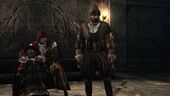 Leonardo, a Hermeticist and Ercole Massimo.
 -
A Hermeticist in La Volpe Addormentata.


References
- ↑ 1.0 1.1 1.2 1.3 Assassin's Creed: Project Legacy - Divine Science: Chapter 2 - Kyros of Zarax
- ↑ 2.0 2.1 2.2 2.3 2.4 Assassin's Creed: Brotherhood - The Da Vinci Disappearance
- ↑ 3.00 3.01 3.02 3.03 3.04 3.05 3.06 3.07 3.08 3.09 3.10 3.11 Assassin's Creed: Project Legacy - Divine Science: Chapter 4 - Frater V.O.V.
| |||||||||||||||||||||||||||||||||||||