

Donatien Alphonse François, Marquis de Sade: Difference between revisions
imported>Bovkaffe No edit summary |
imported>Kainzorus Prime No edit summary |
||
| Line 5: | Line 5: | ||
{{Character infobox | {{Character infobox | ||
|name = Marquis de Sade | |name = Marquis de Sade | ||
|image = ACU | |image = ACU De Sade Render.png | ||
|birth = 2 June 1740<br>[[Paris]], [[France|Kingdom of France]] | |birth = 2 June 1740<br>[[Paris]], [[France|Kingdom of France]] | ||
|death = 2 December 1814 (aged 74)<br>{{Wiki|Charento}}, [[French Empire]] | |death = 2 December 1814 (aged 74)<br>{{Wiki|Charento}}, [[French Empire]] | ||
Revision as of 18:54, 20 January 2015

- "Conspiracy! Intrigue! A rapidly thickening plot! Add some bestiality and a lecherous priest and I'd say you have the beginnings of a beautiful novel."
- ―The Marquis de Sade, 1791.[src]
Donatien Alphonse François, Marquis de Sade (2 June 1740 – 2 December 1814), commonly known as the Marquis de Sade, was a French aristocrat, revolutionary politician, philosopher and author famous for his libertine sexuality. He also became the new Roi des Thunes, after the former bearer of the title was assassinated by Arno Dorian in 1791.
He had been held prisoner in the Bastille for several years, but was transferred to another prison shortly before angry Parisians stormed the stronghold. Three years later, as Arno and Élise de la Serre hunted Louis-Michel le Peletier, the pair enlisted de Sade's knowledge of the Parisian politics to track le Peletier's wheraboutss.[1]
Personality and Characteristics
De Sade was a proponent of extreme freedom, unrestrained by morality, religion or law. He was a noticeably flamboyant, eccentric and hedonistic man. As a libertine, de Sade had no moral qualms, and hence embraced a criminal lifestyle. His time in prison did nothing to reform him, and even made a mockery of it by feigning insanity.
De Sade was also a passionate and gifted writer, philosopher, and spoke very eloquently and metaphorically. Despite his charm and charisma, his personality could be seen as lecherous and obnoxious, particularly to Arno Dorian and Élise de la Serre.
Trivia
- Alexandre Amancio described Unity's depiction of the Marquis de Sade as being based on Hannibal Lecter.[2]
Gallery
-
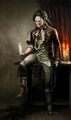 Concept artwork of de Sade
 -
 Development artwork of de Sade


References