

Damascus: Difference between revisions
imported>Darman36 m Profile pic has watermarks |
mNo edit summary |
||
| Line 35: | Line 35: | ||
[[File:Abul2.png|thumb|250px|Altaïr attending Abu'l's party]] | [[File:Abul2.png|thumb|250px|Altaïr attending Abu'l's party]] | ||
The Levantine Assassins' | The Levantine Assassins' Mentor, Al Mualim, surreptitiously collaborated with the Templars to recover the Apple, deploying Altaïr to terminate any connection between himself and the Order's leadership.<ref name="Assassination II"/> While Tamir inspected his collaborators at the [[Souk Al-Silaah]], the Templar was executed by Altaïr.<ref name="Assassination Tamir">''[[Assassin's Creed]]'' – [[Assassination (Tamir)]]</ref> Later, Abu'l organized a party at [[Merchant King's Palace|his palace]] and poisoned the wine to eliminate the nobles of the city who financed Saladin's army. While the last guests were being slaughtered by his archers, Abu'l was confronted and killed by Altaïr.<ref name="Assassination Abu'l">''[[Assassin's Creed]]'' – [[Assassination (Abu'l Nuqoud)]]</ref> | ||
Finally, Jubair | Finally, Jubair commanded his fellow scholars to seize the city's written records and destroy them in public pyres, based on the conviction that knowledge served only as a catalyst for civil discord. During one of the bonfires, the Chief Scholar was tracked and ultimately assassinated by Altaïr, effectively dismantling the Templar influence within Damascus.<ref name="Assassination Jubair">''[[Assassin's Creed]]'' – [[Assassination (Jubair al Hakim)]]</ref> | ||
===Mamluk Sultanate=== | ===Mamluk Sultanate=== | ||
| Line 51: | Line 51: | ||
==Districts== | ==Districts== | ||
===Poor District=== | ===Poor District=== | ||
The Poor District was considered to be a very busy section and constantly packed with [[civilian]]s. This | The Poor District was considered to be a very busy section and constantly packed with [[civilian]]s. This resulted in congested thoroughfares, as a constant flow of citizens moved through the district's narrow streets.<ref name="AC"/> | ||
[[File:AC1 Souk Al-Silaah.png|thumb|250px|left|The Souk Al-Silaah in the Poor District]] | [[File:AC1 Souk Al-Silaah.png|thumb|250px|left|The Souk Al-Silaah in the Poor District]] | ||
The district was home to the [[Sinan Pasha Mosque]] and the sprawling and very impressive [[Souk Al-Silaah]], which was a major trading point in Damascus and dominated the surrounding area. Due to its eloquent ceremonial courtyard, situated in the center, the Souk was the site where the Templar and arms dealer Tamir conducted his daily business. | The district was home to the [[Sinan Pasha Mosque]] and the sprawling and very impressive [[Souk Al-Silaah]], which was a major trading point in Damascus and dominated the surrounding area. Due to its eloquent ceremonial courtyard, situated in the center, the Souk was the site where the Templar and arms dealer Tamir conducted his daily business. Despite Tamir stationing guards within the surrounding passageways, the central area of the Souk remained relatively accessible to those capable of navigating the market unnoticed. Altaïr utilized this oversight to infiltrate the market and assassinate the Templar during his public display of authority.<ref name="Assassination Tamir"/> | ||
===Middle District=== | ===Middle District=== | ||
The Middle District contained schools and formal gardens. These featured larger east-west thoroughfares connecting the different areas. This section of Damascus included many places of learning, until Jubair al Hakim arrived and began a quest to destroy all written knowledge in the city. The central feature was Jubair's [[Madrasah Al-Kallāsah|Madrasah]], where he and his fellow scholars burnt all books and scrolls they had seized. | The Middle District contained schools and formal gardens. These featured larger east-west thoroughfares connecting the different areas. This section of Damascus included many places of learning, until Jubair al Hakim arrived and began a quest to destroy all written knowledge in the city. The central feature was Jubair's [[Madrasah Al-Kallāsah|Madrasah]], where he and his fellow scholars burnt all books and scrolls they had seized. By the time Altaïr arrived to confront Jubair, the city's defenses had been significantly bolstered in response to the recent assassinations of other Templars.<ref name="Assassination Jubair"/> | ||
===Rich District=== | ===Rich District=== | ||
[[File:AC1 Umayyad Mosque.png|thumb|250px|The Umayyad Mosque in the Rich District]] | [[File:AC1 Umayyad Mosque.png|thumb|250px|The Umayyad Mosque in the Rich District]] | ||
The Rich District stretched across almost half of Damascus, possessing many of the structural landmarks that attracted outsiders to the city. The partially rebuilt [[Citadel of Saladin]] | The Rich District stretched across almost half of Damascus, possessing many of the structural landmarks that attracted outsiders to the city. The partially rebuilt [[Citadel of Saladin]] served as a formidable fortification, its defenses necessitating careful strategy for any who sought entry. The most impressive feature of the district, and probably the entire city, was the [[Umayyad Mosque]]. Built by {{Wiki|Al-Walid I}} in 715 CE, the mosque sat atop the ruins of the Roman Temple of [[Jupiter]].<ref name="Knowledge Abu'l">''[[Assassin's Creed]]'' – [[Knowledge (Abu'l Nuqoud)]]</ref> | ||
Another renowned landmark in the district was the [[Merchant King's Palace]], the personal residence of the Templar Abu'l Nuqoud. | Another renowned landmark in the district was the [[Merchant King's Palace]], the personal residence of the Templar Abu'l Nuqoud. While the palace's interior was often accessible, its guard presence was significantly increased during the lavish parties hosted by Abu'l. The grounds surrounding the palace remained relatively quiet, a stark contrast to the city's more crowded quarters. Slightly north lay the [[Souk Sarouja|Sarouja Souk]] Market Quarter, an area characterized by steady activity and a visible presence of city guards. Sarouja Souk held the reputation of being the largest market in the [[Kingdom|Holy Land]]. It was split into two separate structures that ran from west to east and north to south.<ref name="Knowledge Abu'l"/> | ||
Though the Umayyad Mosque and Merchant King's Palace dominated the district, the Grand Courtyard north of the Mosque was equally an interesting place. Here, within the impressive district, Abu'l Nuqoud held immense power over the people. | Though the Umayyad Mosque and Merchant King's Palace dominated the district, the Grand Courtyard north of the Mosque was equally an interesting place. Here, within the impressive district, Abu'l Nuqoud held immense power over the people.<ref name="Knowledge Abu'l"/> | ||
==Industry== | ==Industry== | ||
| Line 107: | Line 107: | ||
==References== | ==References== | ||
{{Reflist}} | {{Reflist}} | ||
{{AC}} | |||
{{ACAC}} | {{ACAC}} | ||
{{ACFC}} | {{ACFC}} | ||
{{ACERPB}} | {{ACERPB}} | ||
[[de:Damaskus]] | <!--[[de:Damaskus]] | ||
[[es:Damasco]] | [[es:Damasco]] | ||
[[fr:Damas]] | [[fr:Damas]] | ||
| Line 120: | Line 120: | ||
[[ru:Дамаск]] | [[ru:Дамаск]] | ||
[[uk:Дамаск]] | [[uk:Дамаск]] | ||
[[zh:大马士革]] | [[zh:大马士革]]--> | ||
[[Category:Damascus| ]] | [[Category:Damascus| ]] | ||
[[Category:Capital cities]] | [[Category:Capital cities]] | ||
[[Category:Levant]] | [[Category:Levant]] | ||
[[Category:Cities in Ancient Rome]] | [[Category:Cities in Ancient Rome]] | ||
Revision as of 15:34, 5 May 2026
Damascus is the capital and largest city of Syria, believed to have been founded in the third millennium BCE. Damascus is located in the eastern foothills of the Eastern Lebanon Mountain Range, near the delta of the Barada River.
History
Middle Ages
Umayyad Caliphate
Between the 7th and the 8th centuries, Damascus was the capital of the Umayyad Caliphate where a great mosque was built in their honor. In 750, the Umayyads were overthrown by the Abbasid Revolution and Damascus lost its status of capital over the newly-founded Baghdad near the Tigris.[1]
Crusades
During the Second Crusade, around 1148, the city repelled multiple attacks until being acquired by Saladin in the year 1174. Upon gaining control of the city, he granted scholars from far and wide the chance to study in one of the many Madrasahs scattered throughout the city's neighborhoods. During the Third Crusade, it had an approximate population of 45,323. Since the city was virtually unaffected by the war, it remained an extremely clean and gorgeous site. During the same period, two factions brought their secret war to Damascus: the Templars, seeking to bring peace through total control; and the Assassins, defending the free will of the common people.[2]
In 1189, a Templar known as "the Hideout" was located in Damascus and safeguarded Vejovis' dagger, a Piece of Eden. The Levantine Assassin and Vejovis' Sage Faisal, seeking to recover the dagger, met with the Hideout and posed as a Templar to gain his trust. However, their meeting was interrupted by the Assassin Rafee, who believed that Faisal had betrayed the Brotherhood. Faisal was forced to kill Rafee but explained that his act would ultimately benefit the Assassins. He then took the dagger and left Damascus, delivering the artifact to Constantinople.[3]

In 1190, the Templar Tamir was based in Damascus, where he worked with the Order to find the Chalice, a mysterious artifact that could supposedly unify the Holy Land. The circus dancer Fajera also lived in the city and held one of the three keys of the Temple of Sand, where the Chalice was rumored to be located. Tasked with preventing the Templars from acquiring the artifact, the Master Assassin Altaïr Ibn-La'Ahad traveled to Damascus and tracked Tamir, who told him about the Temple and Fajera.[4]
After killing Tamir, Altaïr met Fajera, who asked him to assassinate a man named Alaat in exchange for her key. The Assassin did so, killing Alaat inside a public bathhouse, after which he received Fajera's key and left Damascus to continue his quest.[5]
By the summer of 1191, the city was still under the influence of three high-ranking Templars: the arms dealer Tamir; the merchant king Abu'l Nuqoud, who ruled Damascus in Saladin's absence; and the Chief Scholar Jubair al Hakim. Under the leadership of Grand Master Robert de Sablé, they worked to conquer the Holy Land for the Order. They planned to use an Apple of Eden to control a great army, with Tamir using his connections to supply weapons while Abu'l financed the operation.[6]

The Levantine Assassins' Mentor, Al Mualim, surreptitiously collaborated with the Templars to recover the Apple, deploying Altaïr to terminate any connection between himself and the Order's leadership.[6] While Tamir inspected his collaborators at the Souk Al-Silaah, the Templar was executed by Altaïr.[7] Later, Abu'l organized a party at his palace and poisoned the wine to eliminate the nobles of the city who financed Saladin's army. While the last guests were being slaughtered by his archers, Abu'l was confronted and killed by Altaïr.[8]
Finally, Jubair commanded his fellow scholars to seize the city's written records and destroy them in public pyres, based on the conviction that knowledge served only as a catalyst for civil discord. During one of the bonfires, the Chief Scholar was tracked and ultimately assassinated by Altaïr, effectively dismantling the Templar influence within Damascus.[9]
Mamluk Sultanate
By the 16th century, Damascus was controlled by the Mamluk Sultanate. Around 1511, the roads north of Damascus were blocked by Ottoman troops, crippling many of the city's northern trade routes. In spite of the Brotherhood's truce with the Ottoman Empire, the Italian Assassins' Mentor Ezio Auditore da Firenze sent Ottoman apprentices to draw the army away from their position by any means necessary.[10]
After the Assassins succeeded in their mission, a detachment of Safavid soldiers filled the power vacuum north of the city, the Mamluks Sultan Al-Ashraf Qansuh al-Ghawri making an alliance with them to attack Bursa. As they suspected an alliance between the two factions, the Assassins infiltrated the Safavid camp and discovered their plan.[11] After learning that the Safavid high command was stationed in Damascus as the personal guest of the Sultan, the Assassins eliminated the Safavid generals and crippled their command structure.[12]
As the Brotherhood's training facilities in Damascus were of middling quality, the Assassins stole Templar resources to upgrade their headquarters, increasing Assassin influence in the city while diminishing that of the Templars.[13]
Ottoman Empire
By the 18th century, Damascus was part of the Ottoman Empire. In 1757, the British Templar Haytham Kenway journeyed to Damascus to locate his half-sister Jennifer, who had been sold into slavery in the palace of governor As'ad Pasha al-Azm. Haytham and Jim Holden disguised themselves as eunuchs to infiltrate the palace and successfully rescued Jennifer, although Holden was captured while fending off incoming guards to buy the siblings time to escape.[14]
Districts
Poor District
The Poor District was considered to be a very busy section and constantly packed with civilians. This resulted in congested thoroughfares, as a constant flow of citizens moved through the district's narrow streets.[2]

The district was home to the Sinan Pasha Mosque and the sprawling and very impressive Souk Al-Silaah, which was a major trading point in Damascus and dominated the surrounding area. Due to its eloquent ceremonial courtyard, situated in the center, the Souk was the site where the Templar and arms dealer Tamir conducted his daily business. Despite Tamir stationing guards within the surrounding passageways, the central area of the Souk remained relatively accessible to those capable of navigating the market unnoticed. Altaïr utilized this oversight to infiltrate the market and assassinate the Templar during his public display of authority.[7]
Middle District
The Middle District contained schools and formal gardens. These featured larger east-west thoroughfares connecting the different areas. This section of Damascus included many places of learning, until Jubair al Hakim arrived and began a quest to destroy all written knowledge in the city. The central feature was Jubair's Madrasah, where he and his fellow scholars burnt all books and scrolls they had seized. By the time Altaïr arrived to confront Jubair, the city's defenses had been significantly bolstered in response to the recent assassinations of other Templars.[9]
Rich District

The Rich District stretched across almost half of Damascus, possessing many of the structural landmarks that attracted outsiders to the city. The partially rebuilt Citadel of Saladin served as a formidable fortification, its defenses necessitating careful strategy for any who sought entry. The most impressive feature of the district, and probably the entire city, was the Umayyad Mosque. Built by Al-Walid I in 715 CE, the mosque sat atop the ruins of the Roman Temple of Jupiter.[15]
Another renowned landmark in the district was the Merchant King's Palace, the personal residence of the Templar Abu'l Nuqoud. While the palace's interior was often accessible, its guard presence was significantly increased during the lavish parties hosted by Abu'l. The grounds surrounding the palace remained relatively quiet, a stark contrast to the city's more crowded quarters. Slightly north lay the Sarouja Souk Market Quarter, an area characterized by steady activity and a visible presence of city guards. Sarouja Souk held the reputation of being the largest market in the Holy Land. It was split into two separate structures that ran from west to east and north to south.[15]
Though the Umayyad Mosque and Merchant King's Palace dominated the district, the Grand Courtyard north of the Mosque was equally an interesting place. Here, within the impressive district, Abu'l Nuqoud held immense power over the people.[15]
Industry
Damascus was renowned for the forged steel produced there, which was accordingly known as Damascus steel and was characterized by its unique and distinctive wavy pattern reminiscent of flowing water.[16]
Animus simulated maps

|

|

|
| Rich District | Middle District | Poor District |
Gallery
-
 Concept art of Altaïr arriving in Damascus
 -
 Alternate concept art of Altaïr's arrival in Damascus
 -
 Concept art of Damascus' architecture
 -
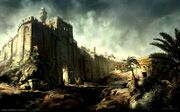 Damascus concept art by Sparth
 -
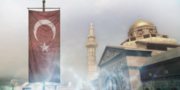 A view of Damascus and a Saracen flag
 -
 A map of Damascus


Appearances
- Assassin's Creed (first appearance)
- Assassin's Creed: Altaïr's Chronicles
- Assassin's Creed: The Secret Crusade
- Assassin's Creed: Revelations
- Assassin's Creed: Forsaken
- Assassin's Creed: Memories (mentioned only)
- Assassin's Creed: Rebellion (mentioned only)
- Assassin's Creed: Escape Room Puzzle Book
- Assassin's Creed: Mirage (mentioned in Database entry only)
- Echoes of History (mentioned only)
- Assassin's Creed: Mirage – Daughter of No One (mentioned only)
References
- ↑ Assassin's Creed: Mirage – Database: Founding of Baghdad
- ↑ 2.0 2.1 Assassin's Creed
- ↑ Assassin's Creed: Escape Room Puzzle Book – Chapter 4: Deceiving the Assassins
- ↑ Assassin's Creed: Altaïr's Chronicles – The Hunt Begins
- ↑ Assassin's Creed: Altaïr's Chronicles – The Dancer
- ↑ 6.0 6.1 Assassin's Creed – Assassination II (Robert de Sablé)
- ↑ 7.0 7.1 Assassin's Creed – Assassination (Tamir)
- ↑ Assassin's Creed – Assassination (Abu'l Nuqoud)
- ↑ 9.0 9.1 Assassin's Creed – Assassination (Jubair al Hakim)
- ↑ Assassin's Creed: Revelations – Mediterranean Defense: "The Hydra's Head, Part I"
- ↑ Assassin's Creed: Revelations – Mediterranean Defense: "The Hydra's Head, Part II"
- ↑ Assassin's Creed: Revelations – Mediterranean Defense: "The Hydra's Head, Part III"
- ↑ Assassin's Creed: Revelations – Mediterranean Defense: "Level Up"
- ↑ Assassin's Creed: Forsaken
- ↑ 15.0 15.1 15.2 Assassin's Creed – Knowledge (Abu'l Nuqoud)
- ↑ Assassin's Creed: Rebellion
| ||||||||||||||||||||||||||||
| ||||||||||||||||||||||||||||
| ||||||||||||||||||||||||||||
| ||||||||||||||||||||