

Rome: Difference between revisions
imported>Francesco75 |
imported>Francesco75 |
||
| Line 20: | Line 20: | ||
===Roman era=== | ===Roman era=== | ||
Archaeological evidence supports that Rome grew from pastoral settlements on [[Palatine Hill|Colle Palatino]], the future site of the [[Roman Forum]], upon which there are several caves. According to legends, the city of Rome was founded in 753 BCE by the king [[Romulus]], son of the god [[Mars (deity)|Mars]]. Eventually, the Republic of Rome was founded in c. 510 BCE, which eventually began to conquer territories through [[Mediterranean Sea]], having influence over [[France|Gaul]], [[Spain|Hispania]], [[Greece]], [[Egypt]] and Middle-East.<ref name="Database">''[[Assassin's Creed: Brotherhood]]'' – [[Database: Roma]]</ref> | Archaeological evidence supports that Rome grew from pastoral settlements on [[Palatine Hill|Colle Palatino]], the future site of the [[Roman Forum]], upon which there are several caves. According to legends, the city of Rome was founded in 753 BCE by the king [[Romulus]], son of the god [[Mars (deity)|Mars]] bred by a she-wolf on the [[Palatine Hill]], which became the place of the royal palace. Eventually, the Republic of Rome was founded in c. 510 BCE, which eventually began to conquer territories through [[Mediterranean Sea]], having influence over [[France|Gaul]], [[Spain|Hispania]], [[Greece]], [[Egypt]] and Middle-East.<ref name="Database">''[[Assassin's Creed: Brotherhood]]'' – [[Database: Roma]]</ref> | ||
In 49 BCE, a Civil War began between the consuls [[Pompey]] and [[Julius Caesar]]. In this conflict, Pompey died and Caesar became the dictator of the Republic. On 15 March 44 BCE, Caesar was stabbed and [[Assassination of Julius Caesar|killed]] in the [[Theatre of Pompey]] by fourty senators, calling themselves the "Liberatores", who secretly were [[Hidden Ones]]. These Liberatores were led by [[Marcus Junius Brutus]] and [[Gaius Cassius Longinus]], and helped by the Egyptian [[Hidden Ones|Hidden One]] [[Amunet|Aya]].<ref name="Project Legacy">''[[Assassin's Creed: Project Legacy]]''</ref><ref name="Origins">''[[Assassin's Creed: Origins]]''</ref> | In 49 BCE, a Civil War began between the consuls [[Pompey]] and [[Julius Caesar]]. In this conflict, Pompey died and Caesar became the dictator of the Republic. On 15 March 44 BCE, Caesar was stabbed and [[Assassination of Julius Caesar|killed]] in the [[Theatre of Pompey]] by fourty senators, calling themselves the "Liberatores", who secretly were [[Hidden Ones]]. These Liberatores were led by [[Marcus Junius Brutus]] and [[Gaius Cassius Longinus]], and helped by the Egyptian [[Hidden Ones|Hidden One]] [[Amunet|Aya]].<ref name="Project Legacy">''[[Assassin's Creed: Project Legacy]]''</ref><ref name="Origins">''[[Assassin's Creed: Origins]]''</ref> | ||
After Caesar's death, the Republic was led by [[Marcus Antonius]], Lepidus and [[Augustus|Octavianus]], Caesar's adoptive son. As Antonius committed suicide after being defeated by Octavianus in 30 BCE, Rome became an Empire in 27 BCE with Octavianus as his first emperor known as Augustus.<ref name="Brotherhood"/> | After Caesar's death, the Republic was led by [[Marcus Antonius]], Lepidus and [[Augustus|Octavianus]], Caesar's adoptive son. As Antonius committed suicide after being defeated by Octavianus in 30 BCE, Rome became an Empire in 27 BCE with Octavianus as his first emperor known as Augustus. Under his reign, he constructed many monument. He finished the [[Basilica Julia]] in honor of his adoptive father, ordered the construction of the [[Pantheon]] to celebrate the victory of [[Agrippa]] over Antonius, and the [[Mausoleum of Augustus]] where he was buried with other important persons.<ref name="Brotherhood"/> | ||
In the year 41 CE, the Hidden Ones [[Leonius]] assassinated the emperor and Templar puppet [[Caligula]] in Rome, whom he stabbed with a [[Short blades|dagger]].<ref name="AC2">''[[Assassin's Creed II]]''</ref> | In the year 41 CE, the Hidden Ones [[Leonius]] assassinated the emperor and Templar puppet [[Caligula]] in Rome, whom he stabbed with a [[Short blades|dagger]].<ref name="AC2">''[[Assassin's Creed II]]''</ref> | ||
Revision as of 16:11, 19 May 2019

|
Patience, brothers. Soon we will reveal the secrets of Assassin's Creed: Identity. This article has been identified as being out of date. Please update the article to reflect recent releases and then remove this template once done. |
- "Roma is the pillar that holds our entire enterprise aloft. She cannot waver; which means neither can you."
- ―Cesare Borgia to his allies.[src]
Rome (Latin and Italian: Roma) is the capital city of Italy. During the Renaissance, Rome was the capital of the Papal States and headquarters of the Roman Rite of the Templar Order. Also, as part of Rome's liberation, the city became the base for the Italian Brotherhood of the Assassins. During the Renaissance, Rome was divided in four districts: Antico District, Campagna District, Centro District and Vaticano District.
History
Isu era
During the Isu Era, the First Civilization built at least three sites near the future location of Rome. The Isu Jupiter, Minerva and Juno were remembered as the Capitoline Triad.[1]
Roman era
Archaeological evidence supports that Rome grew from pastoral settlements on Colle Palatino, the future site of the Roman Forum, upon which there are several caves. According to legends, the city of Rome was founded in 753 BCE by the king Romulus, son of the god Mars bred by a she-wolf on the Palatine Hill, which became the place of the royal palace. Eventually, the Republic of Rome was founded in c. 510 BCE, which eventually began to conquer territories through Mediterranean Sea, having influence over Gaul, Hispania, Greece, Egypt and Middle-East.[2]
In 49 BCE, a Civil War began between the consuls Pompey and Julius Caesar. In this conflict, Pompey died and Caesar became the dictator of the Republic. On 15 March 44 BCE, Caesar was stabbed and killed in the Theatre of Pompey by fourty senators, calling themselves the "Liberatores", who secretly were Hidden Ones. These Liberatores were led by Marcus Junius Brutus and Gaius Cassius Longinus, and helped by the Egyptian Hidden One Aya.[3][4]
After Caesar's death, the Republic was led by Marcus Antonius, Lepidus and Octavianus, Caesar's adoptive son. As Antonius committed suicide after being defeated by Octavianus in 30 BCE, Rome became an Empire in 27 BCE with Octavianus as his first emperor known as Augustus. Under his reign, he constructed many monument. He finished the Basilica Julia in honor of his adoptive father, ordered the construction of the Pantheon to celebrate the victory of Agrippa over Antonius, and the Mausoleum of Augustus where he was buried with other important persons.[1]
In the year 41 CE, the Hidden Ones Leonius assassinated the emperor and Templar puppet Caligula in Rome, whom he stabbed with a dagger.[5]
Saint Peter established the Church in Rome before his crucifixion in the Circus of Nero circa 68 CE.[5]
In 476, the Western Roman Empire fell, and the Roman Catholic Church managed to take power in 756. After that, Rome became an economic and cultural powerhouse in Europe, even though Florence surpassed Rome as the centre of the Italian Renaissance. Due to the rivalry between the two cities, the papacy spent vast amounts of money to create cultural masterworks.[2]
Renaissance
- "I say we work here. In Roma. Erode the Borgia’s influence while restoring our own. And in fact, I want to begin right now."
- ―Ezio to his allies, before beginning the liberation of Rome, 1501.[src]
In 1476, cardinal Rodrigo Borgia, Grand Master of the Italian Templars and a powerful figure in Vatican politics, briefly left the city to discuss his Order's plans, before returning to affirm Papal approval. Assent was given by Pope Sixtus IV, and the Templars were provided with military support for their endeavors.[6]
In 1492, Rodrigo became Pope Alexander VI, and head of the Papal States and Catholic Church. Ruling from Rome, he was left alone by the Assassins for the most part until 1499, when Ezio Auditore da Firenze learned that the Vatican Vault was located in Rome, beneath the Sistine Chapel.[5]
In 1500, following the Siege of Monteriggioni that was led by Cesare Borgia, Ezio returned to Rome to exact his revenge. At the time, the city had fallen far behind those of Florence and Venice, and had grown stagnant in terms of development, due to the influence of the Borgia.[1]
The Borgia maintained oppression over the city with towers located throughout Rome, which prevented shops from opening. In order to free Rome of the Borgia influence, Ezio killed the overlords of the towers and burned the structures themselves to the ground, taking them over for the Assassin Order afterwards.[1]
Additionally, due to the loss of Monteriggioni, Ezio established the Assassins Guild in Rome, and set up its headquarters on Tiber Island. By recruiting several Roman civilians as Assassin apprentices, the Brotherhood worked to free Rome of Templar control, which was accomplished by the death of Rodrigo in 1503 and the subsequent Pope Julius II having Cesare arrested.[1]
Three years later, the Hermeticists kidnapped Leonardo da Vinci to open the Temple of Pythagoras beneath Rome. Ezio rescued him, and the duo discovered the Pythagorean Vault inside the Temple, which gave the coordinates for the Grand Temple in North America.[7]
Modern times
In 2012, the Assassin Clay Kaczmarek was tasked to infiltrate the Abstergo laboratory in Rome, as Subject 16 of the Animus Project. Clay remained in the lab for the remainder of his physical life, until the consequences of the Bleeding Effect drove him insane and led him to commit suicide. Clay would then continue to provide assistance within the Animus to his successor, Desmond Miles, via an implanted digital consciousness.[5]
In September 2012, Desmond Miles was captured by the Templars and brought to the same facility in Rome. There, Desmond was marked Subject 17 of the Animus Project, in which Warren Vidic examined the genetic memories of Desmond's ancestor, Altaïr Ibn-La'Ahad, for a week.[8] Desmond subsequently escaped from the facility with the help of Lucy Stillman, who in reality was a Templar part of Project Siren. The pair then made their way to an Assassin hideout nearby, where Desmond relived Ezio's memories in order to gain his abilities through the Bleeding Effect.[5] Once Vidic and the Templars located the Assassins, Desmond and his team were forced to relocate to another safer location in Monteriggioni.[1]
On October 10, 2012, Desmond Miles, Lucy Stillman, Rebecca Crane and Shaun Hastings returned to Rome to retrieve the Apple of Eden, after Desmond had relived Ezio's memories in Rome and found that the Assassin had locked the Piece of Eden in the Colosseum Vault, as well as leaving the password to unlock the Vault on the wall of the Sanctuary, where they were stationed.[1]
On December 12, 2012, Desmond returned to Rome, to the same Abstergo laboratory he had been held in months before, to rescue his father who had been captured by the Templar organization. Desmond fought his way to Warren Vidic's office, killing Daniel Cross and many Abstergo guards along the way. There, Desmond managed to rescue his father and kill Vidic using his Apple of Eden, which he also used to escape the laboratory.[1]
As well as this, Abstergo Industries used Rome as a simulated training location in the primary and secondary stages of their Animi Training Program.
The simulation was set in the Centro District, depicting the market square, upon which a great many market stalls had been set up, located in front of the Pantheon and the surrounding residences. Although the Pantheon could be seen, its interior and exterior were inaccesible. The streets themselves were relatively spacious, but the many hidden alleyways allowed people to slip away from the masses with ease.
Rome, like most of the simulated locations in the first and second stage, had two aesthetic variations. As such, it could be utilized during the day or at dusk.
Layout
The city was divided into four districts: Centro, Antico, Campagna, and the Vaticano district. With the exception of the Vaticano district, these were also subdivided into 12 territories, each one controlled by a Borgia tower.[1]
Landmarks in Rome included the Pantheon, the Colosseum, the Passetto di Borgo, the Castel Sant'Angelo and the Sistine Chapel.[5][1]
Trivia
- In-game, the city was tilted roughly 15 degrees to the right from its real counterpart.
- While Rome and Florence's architecture were historically similar during the game's time period, the developers of Assassin's Creed: Brotherhood designed Rome with its later Baroque style to be more familiar to their audience.
- The area where Ezio climbed up to the Castel Sant'Angelo from the river in Assassin's Creed II was unreachable in Assassin's Creed: Brotherhood, with fencing and blockades along the Castello and Vaticano district.
- The buildings seen north of the Passetto di Borgo in Assassin's Creed II did not appear in Assassin's Creed: Brotherhood.
- In the Assassin's Creed series, there were two bridges that could clearly be seen that led into the Vaticano district of Rome: the Ponte Sant'Angelo, leading first into Castel Sant'Angelo, and the Ponte Vittorio Emanuele II, which lay west of the Ponte Sant'Angelo. While both bridges could be seen in Assassin's Creed II, the Ponte Vittorio Emauele II was missing in Assassin's Creed: Brotherhood.
- While the final memory of Assassin's Creed II took place in 1499, construction on the Ponte Emanuele did not begin until 1886. This is one of the largest anachronisms in the series to date, and an oversight of 387 years.
Gallery
-
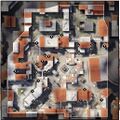 The map of Rome used for Abstergo Industries' Animi Training Program
 -
 Concept art of the Castel Sant'Angelo
 -
 Concept art of Rome
 -
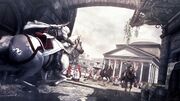 Ezio riding through the city towards the Pantheon
 -
 Antique District concept art
 -
 Medieval District concept art
 -
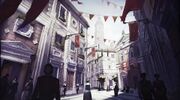 Renaissance District concept art
 -
 The Countryside of Rome concept art
 -
A wide view of the Centro district, seen from the Mercati di Traiano
-
 A bird's-eye view of Rome
 -
The centre of Borgia control, the Castel Sant'Angelo
-
 Rome at sunset
 -
 Panoramic view of Rome at night
 -
 Panoramic view of Rome at dusk
 -

-
 Database image of the Rome in Assassin's Creed: Identity


Appearances
- Assassin's Creed: Lineage (first appearance)
- Assassin's Creed II
- Assassin's Creed: Project Legacy
- Assassin's Creed: Brotherhood
- Assassin's Creed: Identity
- Assassin's Creed: Origins
- Assassin's Creed: Origins comic
References
- ↑ 1.00 1.01 1.02 1.03 1.04 1.05 1.06 1.07 1.08 1.09 Assassin's Creed: Brotherhood
- ↑ 2.0 2.1 Assassin's Creed: Brotherhood – Database: Roma
- ↑ Assassin's Creed: Project Legacy
- ↑ Assassin's Creed: Origins
- ↑ 5.0 5.1 5.2 5.3 5.4 5.5 Assassin's Creed II
- ↑ Assassin's Creed: Lineage
- ↑ Assassin's Creed: Brotherhood - The Da Vinci Disappearance
- ↑ Assassin's Creed
| ||||||||||||||||||||||||||||
| |||||||||||||||||||||||||||||||||||||
| |||||||||||||||||||||||||||||||
de:Rom
es:Roma
fr:Rome
hu:Róma
it:Roma
ja:ローマ
nl:Rome
pl:Rzym
pt-br:Roma
ru:Рим
uk:Рим
zh:罗马