
Philippe de Grandpré: Difference between revisions
imported>Stormbeast m Reverted edits by 68.97.206.25 (talk | block) to last version by Crookandcharlatan |
imported>Crookandcharlatan Beginning of my expansion for good ol' Philippe; will continue on Sunday |
||
| Line 1: | Line 1: | ||
{{Era|AC3L}} | {{Era|AC3L}} | ||
{{Quote|Ah, I do fear you are more like your father than is fit for a lady - a chip of the same block.|Philippe to Aveline, 1765.|Assassin's Creed III: Liberation}} | |||
{{Character Infobox | {{Character Infobox | ||
|image = PhilippeDatabaseHD.png | |image = PhilippeDatabaseHD.png | ||
| Line 7: | Line 8: | ||
|appear = ''[[Assassin's Creed III: Liberation]]'' | |appear = ''[[Assassin's Creed III: Liberation]]'' | ||
|voice = [[Marcel Jeannin]]}} | |voice = [[Marcel Jeannin]]}} | ||
'''Philippe Olivier de Grandpré''' (1722 - 1776) was a wealthy [[France|French]] merchant who lived in [[New Orleans]] | '''Philippe Olivier de Grandpré''' (1722 - 1776) was a wealthy [[France|French]] merchant who lived in [[New Orleans]] and the father of the [[Assassins|Assassin]] [[Aveline de Grandpré]].<ref name="AC3L">''[[Assassin's Creed III: Liberation]]''</ref> He is an ancestor to "[[Subject 1]]" of the [[Animus Project]].<ref>''[[Assassin's Creed IV: Black Flag]]''</ref> | ||
Happily married to the [[Slavery|slave]] [[Jeanne]], albeit unofficially, Philippe experienced a personal enlightenment upon the birth of his daughter Aveline. However, he would marry [[Madeleine de L'Isle]] roughly five years later, in an effort to alleviate his financial troubles, straining his relationship with Jeanne. | |||
When Jeanne vanished without a trace in 1757, Philippe was devastated, but remained confident Madeleine would take good care of Aveline. He also saw to his daughter's education in business, ensuring she would grow into a woman of independent means. | |||
==Biography== | ==Biography== | ||
===Early life=== | ===Early life=== | ||
Philippe was born in France in 1722 to a family of successful merchants. As a young man, he traveled to Louisiana in search of business opportunities and established a trading enterprise there, shipping goods from the new world to the old.<ref name=" | Philippe was born in Nantes, France in 1722 to a family of successful merchants. As a young man, he traveled to [[Louisiana]] in search of new business opportunities and established a trading enterprise there, shipping goods from the new world to the old.<ref name="AC3L"/> | ||
===Marriage to Jeanne=== | |||
{{Quote|P— was full of emotion at her birth. On seeing her, he falls to his knees [...] He begs forgiveness for keeping me enslaved all this time. He vows to grant us both our freedom. Perhaps there is hope for the future.|Jeanne on Philippe's reaction to Aveline's birth, 1747.|Assassin's Creed III: Liberation}} | |||
In 1744, whilst on a trade mission to [[Haiti|Saint-Domingue]], Philippe purchased a slave named Jeanne, whom he rapidly grew fond of. Treating her with kindness despite her status, Philippe would regularly pay Jeanne nightly visits during the trip back to Louisiana. Upon their arrival in New Orleans, he informed her that, unlike the other slaves, Jeanne was allowed to take up residence in his [[De Grandpré Mansion|villa]].<ref name="AC3L"/> | |||
In the next two years, Philippe and Jeanne grew closer, which led to Philippe asking her to become his {{Wiki|Plaçage|placée}} bride on the 7th of May, 1746. She accepted, and in 1747, gave birth to their daughter Aveline. Upon seeing his newborn daughter, Philippe was overcome with guilt at keeping Jeanne enslaved and vowed to grant both his wife and daughter their freedom.<ref name="AC3L"/> | |||
The next few years passed peacefully, with the young Aveline tightly knitting the small family together. Philippe doted on his daughter, with his status and success in trading largely shielding Jeanne and Aveline from the prejudices of others. However, by August 1750, Philippe's business began to suffer, causing him to become troubled, despite Jeanne's assurances that they could make do with less if that was required.<ref name="AC3L"/> | |||
===Marriage to Madeleine=== | |||
{{Quote|You know my arrangement with Madeleine was... business. She convinced me... If the law was different...|Philippe confessing the nature of his second marriage to Aveline, 1776.|Assassin's Creed III: Liberation}} | |||
As a result of Philippe's financial troubles, Madeleine de L'Isle, the daughter of one of Philippe's investors, became a regular visitor of the de Grandpré family. Slowly but surely, she managed to convince Philippe into marrying her, as it would benefit both his business as well as that of her family's. He conceded and wed Madeleine in 1752.<ref name="AC3L"/> | |||
The marriage put a strain on the relationship between Jeanne and Philippe, who insisted nothing needed to change between them, to no avail. Although Madeleine soon moved in, Jeanne and Aveline were allowed to remain at the de Grandpré mansion, receiving their own private quarters. For the next few years, this arrangement continued, with Madeleine being responsible for Aveline's education, while also employing Jeanne as her personal handmaid. Around 1755, Philippe would take on [[Gérald Blanc]], an orphan from {{Wiki|Acadia}} as an errand boy.<ref name="AC3L"/> | |||
However, in 1757, Jeanne suddenly disappeared, greatly saddening Philippe. Despite this, he was confident that Madeleine would raise his daughter with care and support. He too would start educating Aveline on business matters, so that she would grow into a woman of independent means, as the law technically prohibited her from inheriting his estate. Simultaneously, Gérald grew up to be a capable clerk and accountant, becoming one of Philippe's most trusted employees.<ref name="AC3L"/> | |||
In | [[File:Key_to_the_Problem_1.png|thumb|250px|left|Gérald informing Philippe of the missing shipments' recovery]] | ||
In 1765, Philippe discovered his business was suffering from shipments that were disappearing, causing customer relations to become strained. During one of his visits to the [[De Grandpré Warehouse|warehouse]], he informed Gérald, who offered to look into the matter for him; unbeknownst to both men, Aveline had [[Eavesdropping|eavesdropped]] on this conversation and intended to start an investigation of her own. In recovering the missing goods, she managed to secure a discount from one of her father's [[Gilbert-Antoine de Saint Maxent|business partners]]. Gérald later reassured Philippe that the cargo would arrive on time.<ref name="AC3L"/> | |||
In 1776, Philippe was poisoned by Madeleine after discovering the interference of the [[Templars]] in his business and the true identity of his wife as the head of the Templar Order in Louisiana.<ref name="AC3L"/> | In 1776, Philippe was poisoned by Madeleine after discovering the interference of the [[Templars]] in his business and the true identity of his wife as the head of the Templar Order in Louisiana.<ref name="AC3L"/> | ||
| Line 28: | Line 47: | ||
<gallery captionalign="center" position="center" widths="180"> | <gallery captionalign="center" position="center" widths="180"> | ||
Philippe de Grandpré - Concept Art.jpg|Concept art of Philippe | Philippe de Grandpré - Concept Art.jpg|Concept art of Philippe | ||
The Safe House 3.png|Philippe speaking with Aveline at dinner | |||
</gallery> | </gallery> | ||
Revision as of 22:14, 24 July 2014
- "Ah, I do fear you are more like your father than is fit for a lady - a chip of the same block."
- ―Philippe to Aveline, 1765.[src]
Philippe Olivier de Grandpré (1722 - 1776) was a wealthy French merchant who lived in New Orleans and the father of the Assassin Aveline de Grandpré.[1] He is an ancestor to "Subject 1" of the Animus Project.[2]
Happily married to the slave Jeanne, albeit unofficially, Philippe experienced a personal enlightenment upon the birth of his daughter Aveline. However, he would marry Madeleine de L'Isle roughly five years later, in an effort to alleviate his financial troubles, straining his relationship with Jeanne.
When Jeanne vanished without a trace in 1757, Philippe was devastated, but remained confident Madeleine would take good care of Aveline. He also saw to his daughter's education in business, ensuring she would grow into a woman of independent means.
Biography
Early life
Philippe was born in Nantes, France in 1722 to a family of successful merchants. As a young man, he traveled to Louisiana in search of new business opportunities and established a trading enterprise there, shipping goods from the new world to the old.[1]
Marriage to Jeanne
- "P— was full of emotion at her birth. On seeing her, he falls to his knees [...] He begs forgiveness for keeping me enslaved all this time. He vows to grant us both our freedom. Perhaps there is hope for the future."
- ―Jeanne on Philippe's reaction to Aveline's birth, 1747.[src]
In 1744, whilst on a trade mission to Saint-Domingue, Philippe purchased a slave named Jeanne, whom he rapidly grew fond of. Treating her with kindness despite her status, Philippe would regularly pay Jeanne nightly visits during the trip back to Louisiana. Upon their arrival in New Orleans, he informed her that, unlike the other slaves, Jeanne was allowed to take up residence in his villa.[1]
In the next two years, Philippe and Jeanne grew closer, which led to Philippe asking her to become his placée bride on the 7th of May, 1746. She accepted, and in 1747, gave birth to their daughter Aveline. Upon seeing his newborn daughter, Philippe was overcome with guilt at keeping Jeanne enslaved and vowed to grant both his wife and daughter their freedom.[1]
The next few years passed peacefully, with the young Aveline tightly knitting the small family together. Philippe doted on his daughter, with his status and success in trading largely shielding Jeanne and Aveline from the prejudices of others. However, by August 1750, Philippe's business began to suffer, causing him to become troubled, despite Jeanne's assurances that they could make do with less if that was required.[1]
Marriage to Madeleine
- "You know my arrangement with Madeleine was... business. She convinced me... If the law was different..."
- ―Philippe confessing the nature of his second marriage to Aveline, 1776.[src]
As a result of Philippe's financial troubles, Madeleine de L'Isle, the daughter of one of Philippe's investors, became a regular visitor of the de Grandpré family. Slowly but surely, she managed to convince Philippe into marrying her, as it would benefit both his business as well as that of her family's. He conceded and wed Madeleine in 1752.[1]
The marriage put a strain on the relationship between Jeanne and Philippe, who insisted nothing needed to change between them, to no avail. Although Madeleine soon moved in, Jeanne and Aveline were allowed to remain at the de Grandpré mansion, receiving their own private quarters. For the next few years, this arrangement continued, with Madeleine being responsible for Aveline's education, while also employing Jeanne as her personal handmaid. Around 1755, Philippe would take on Gérald Blanc, an orphan from Acadia as an errand boy.[1]
However, in 1757, Jeanne suddenly disappeared, greatly saddening Philippe. Despite this, he was confident that Madeleine would raise his daughter with care and support. He too would start educating Aveline on business matters, so that she would grow into a woman of independent means, as the law technically prohibited her from inheriting his estate. Simultaneously, Gérald grew up to be a capable clerk and accountant, becoming one of Philippe's most trusted employees.[1]

In 1765, Philippe discovered his business was suffering from shipments that were disappearing, causing customer relations to become strained. During one of his visits to the warehouse, he informed Gérald, who offered to look into the matter for him; unbeknownst to both men, Aveline had eavesdropped on this conversation and intended to start an investigation of her own. In recovering the missing goods, she managed to secure a discount from one of her father's business partners. Gérald later reassured Philippe that the cargo would arrive on time.[1]
In 1776, Philippe was poisoned by Madeleine after discovering the interference of the Templars in his business and the true identity of his wife as the head of the Templar Order in Louisiana.[1]
Characteristics and personality
Philippe was a caring and considerate person, who treated both Aveline and her mother Jeanne with kindness and affection. A loving father, he saw to Aveline's education in business and was confident that she would develop into a woman of independent means, despite the law preventing her from inheriting his property. He was especially protective of his daughter, often voicing his concerns about her safety and always looking out for her well being.[1]
Philippe also treated Jeanne with kindness and consideration, even though he was not required to. Once they had arrived in New Orleans, he displayed an act of generosity towards Jeanne by allowing her to stay within his estate instead of in slave quarters. Upon their daughter's birth, Philippe was ashamed to have kept her enslaved, and vowed to grant both her and Aveline their freedom. It was clear that he cared deeply for Jeanne, as evidenced by his devastation upon her disappearance from New Orleans in 1757.[1]
Gallery
-
 Concept art of Philippe
 -
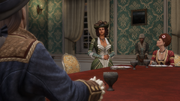 Philippe speaking with Aveline at dinner


References
| ||||||||||||||||||||||||||||||||||