

-
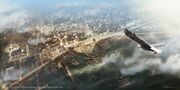 New Orleans panorama
 -
 New Orleans at dawn
 -
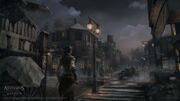 New Orleans at night
 -
 New Orleans docks
 -
 Streets of New Orleans
 -
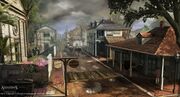 Streets of New Orleans
 -
 Streets of New Orleans during Mardi Gras
 -
 Downtown houses
 -
 Citizens during the Louisiana Rebellion
Welcome to Assassin's Creed Wiki! Log in and join the community.
New Orleans: Difference between revisions
Jump to navigation
Jump to search
imported>Kainzorus Prime →Eliminating the Templars: Balls. |
imported>Crookandcharlatan Kaaiin, I was gonna add that image :( |
||
| Line 32: | Line 32: | ||
====Louisiana Rebellion==== | ====Louisiana Rebellion==== | ||
{{main|Louisiana Rebellion}} | {{main|Louisiana Rebellion}} | ||
{{Quote|How blessed we are with a daughter who uses her talents in peace... not to riot in the streets of New Orleans. There is so much unrest since the arrival of the Spanish...|Philippe Olivier de Grandpré on the consequences of the Spanish occupation, 1768.|Assassin's Creed III: Liberation}} | {{Quote|How blessed we are with a daughter who uses her talents in peace... not to riot in the streets of New Orleans. There is so much unrest since the arrival of the Spanish...|[[Philippe Olivier de Grandpré]] on the consequences of the Spanish occupation, 1768.|Assassin's Creed III: Liberation}} | ||
That same year, [[Antonio de Ulloa]], a Templar adviser, arrived in New Orleans to serve as the Spanish governor of Louisiana. However, he allowed the French flag to remain over the city, leaving the administration of the territory to French Creole officials while he and his family lived at [[La Balize]], away from New Orleans.<ref name="Encyclopedia"/> In secret, de Ulloa organized the kidnapping of slaves and vagrants, sending them to a work camp ran by de Ferrer in [[Chichen Itza]], [[Mexico]].<ref name="AC3L"/> | That same year, [[Antonio de Ulloa]], a Templar adviser, arrived in New Orleans to serve as the Spanish governor of Louisiana. However, he allowed the French flag to remain over the city, leaving the administration of the territory to French Creole officials while he and his family lived at [[La Balize]], away from New Orleans.<ref name="Encyclopedia"/> In secret, de Ulloa organized the kidnapping of slaves and vagrants, sending them to a work camp ran by de Ferrer in [[Chichen Itza]], [[Mexico]].<ref name="AC3L"/> | ||
| Line 46: | Line 46: | ||
====Eliminating the Templars==== | ====Eliminating the Templars==== | ||
{{Quote|The Templars will never allow slaves to be free! They keep even the rich in bondage - though most people would never suspect...|Aveline on the Templars' control over New Orleans, 1768.|Assassin's Creed III: Liberation}} | |||
[[File:The Prodigal Daughter 5.png|thumb|250px|One of Vázquez's recruiters bribing Spanish soldiers]] | [[File:The Prodigal Daughter 5.png|thumb|250px|One of Vázquez's recruiters bribing Spanish soldiers]] | ||
While Aveline was away, a Templar by the name of [[Diego Vázquez]] was sent to New Orleans with orders to take over the Louisiana Bayou, which remained an important trade route. To achieve this, he sent out recruiters to bribe numerous Spanish [[Guards|soldiers]] into joining his cause. He subsequently established a strong presence in the bayou, alerting both the native smugglers [[Élise Lafleur]] and [[Roussillon]], as well as Agaté.<ref name="AC3L"/> | While Aveline was away, a Templar by the name of [[Diego Vázquez]] was sent to New Orleans with orders to take over the Louisiana Bayou, which remained an important trade route. To achieve this, he sent out recruiters to bribe numerous Spanish [[Guards|soldiers]] into joining his cause. He subsequently established a strong presence in the bayou, alerting both the native smugglers [[Élise Lafleur]] and [[Roussillon]], as well as Agaté.<ref name="AC3L"/> | ||
When Aveline returned to New Orleans in | When Aveline returned to New Orleans in 1771, she was quickly made aware of the bribings going on in town, and set out to investigate. Having tracked down and eliminated one of Vázquez's recruiters, Aveline learned of the Templar's plans for New Orleans. Believing him to be the elusive "Company Man", Aveline immediately traveled to the bayou to warn her allies, her Mentor in particular, of the impending dangers. On Agaté's instruction, she then made a patrol believe they had become the victim of a voodoo curse, which temporarily set back Vázquez's progress.<ref name="AC3L"/> | ||
Aveline | Aveline subsequently contacted her smugglies allies, who knew of a supply ship that Vázquez was planning to divert and use for his own purposes. By disabling the lighthouse on {{Wiki|Lake Pontchartrain}}, the Assassin made the Templar's vessel run aground and, together with Élise and Roussillon, set out to plunder the goods aboard. Among the supplies, they discovered a letter that revealed the Templars were intending to reclaim the work site at Chichen Itza, which Aveline had previously freed.<ref name="AC3L"/> | ||
With Aveline journeying to Chichen Itza to ascertain its continued safety, Vázquez's troops had an opportunity to recover and soon grew in number once more. In 1776, | [[File:Supplying the Revolution 1.png|thumb|250px|left|Aveline accompanying the smugglers to defend them from Vázquez's troops]] | ||
With Aveline journeying to Chichen Itza to ascertain its continued safety, Vázquez's troops had an opportunity to recover and soon grew in number once more. In 1776, the {{Wiki|Luis de Unzaga|Governor of Louisiana}} decided to support the American [[Patriots]] by having the smugglers send them supplies, an arrangement that the Templars opposed. Vázquez subsequently ordered his men to steal the wares from the smugglers at the nearest opportunity, but in this too he failed, as Aveline would once more obstruct his schemes.<ref name="AC3L"/> | |||
Realizing her mistake in believing she had sufficiently dealt with Vázquez, Aveline decided to attend the Capitán's Ball, hoping to find the Templar there. Successful in this endeavor, she charmed him during a dance, following which she lured him to a secluded area, where she assassinated him. With his dying breath, Vázquez revealed that he was not the Company Man, as Aveline had believed; in truth, the Company Man was a woman, though Vázquez died before he could reveal her name.<ref name="AC3L"/> | |||
Aveline | [[File:Abandoning Pretense 3.png|thumb|250px|Madeleine attempting to convince Aveline into joining the Templars]] | ||
With Vázquez's death, the Templars' presence in New Orleans was diminished, though the Company Man remained at large. Traveling to [[New York]], Aveline learned from a Templar [[Loyalists|Loyalist]] that Louisiana's head Templar was her own stepmother, [[Madeleine de L'Isle]], who had cleverly used the appearance of a married noblewoman to divert attention away from herself. Aveline returned to New Orleans and confronted her stepmother, who admitted that she had groomed Aveline throughout her life for induction into the Templar Order, as she believed they shared a common goal.<ref name="AC3L"/> | |||
Hesitant, Aveline traveled to the bayou to seek her Mentor's counsel. However, due to their sour relationship, the pair got into a heated argument that led to Agaté attacking his student with a hallucinogen. As she fought the poison-induced illusions, Aveline attempted to get through to her Mentor, following him to the top of his hideout. Rather than listen to reason, Agaté, overcome with regret and shame, committed suicide by throwing himself off the treetop platform.<ref name="AC3L"/> | |||
Although saddened, Aveline saw Agaté's death as an opportunity to infiltrate the Templar Order and destroy it from within. She subsequently went to the [[Saint Louis Cathedral]], where she was inducted into the Templar Order by Madeleine, showing Agaté's necklace as proof of her loyalty. After being given the [[Prophecy Disks|Prophecy Disk]], the [[First Civilization]] artifact she had been after all along, Madeleine then attempted to activate it, though it failed to work as intended.<ref name="AC3L"/> | |||
[[File:Erudito 4.png|thumb|250px|left|Aveline standing over the defeated Madeleine]] | |||
Taking advantage of Madeleine's confusion, Aveline caught the Templars unawares and managed to eliminate them all, leaving her stepmother for last. Madeleine attempted to convince Aveline that the Templars' work was for the benefit of [[humanity]], but her stepdaughter refused to serve her and assassinated her. In doing so, Aveline decimated the Templar Order in New Orleans and reclaimed the Prophecy Disk.<ref name="AC3L"/> | |||
{{-}} | |||
===Louisiana Purchase=== | ===Louisiana Purchase=== | ||
In 1801, Spanish rule ended and the city was handed back to the French. However, French rule ended two years later when [[Napoleon Bonaparte]] sold the colony to the | In the decades that followed, several devastating fires ravaged New Orleans, destroying much of the French colonial architecture. In 1801, Spanish rule ended and the city was handed back to the French, though Spain had made a considerable contribution to its expansion. However, French rule ended two years later when [[Napoleon Bonaparte]] sold the colony to the United States, a transaction directed by the United States President, [[Thomas Jefferson]].<ref name="Encyclopedia"/> | ||
==Layout== | ==Layout== | ||
New Orleans had a number of characteristic, scenic elements. As a prominent center for trade and commerce, the city was also a culturally diverse environment and full of life. Dotted with trees and lush gardens, the city's buildings were often constructed with angled roofs and decorative features such as balconies and gazebos. Marketplaces and courtyards were a common sight in New Orleans, and its streets were openly spaced with little traffic moving through them. A multifarious society, the general populace of New Orleans was varied, with a range of different people inhabiting the city. | New Orleans had a number of characteristic, scenic elements. As a prominent center for trade and commerce, the city was also a culturally diverse environment and full of life. Dotted with trees and lush gardens, the city's buildings were often constructed with angled roofs and decorative features such as balconies and gazebos. Marketplaces and courtyards were a common sight in New Orleans, and its streets were openly spaced with little traffic moving through them. A multifarious society, the general populace of New Orleans was varied, with a range of different people inhabiting the city.<ref name="AC3L"/> | ||
Founded as a French city, the colonists of New Orleans were usually of French origin and wore similar styles of clothing, often a mix between the wealthy and the poor. However, with a wide [[Slavery|slave]] society, servants in New Orleans were a common sight, often dressed in civilized clothing similar to that of the colonists. Notable landmarks in New Orleans included Saint Louis Cathedral, the {{Wiki|Place d'Armes}}, Saint Peter's Cemetery, {{Wiki|Congo Square}}, {{Wiki|Madame John's Legacy}}, the Governor's mansion, the de Grandpré mansion and the de Grandpré warehouse and Assassin headquarters.<ref name="AC3L"/> | Founded as a French city, the colonists of New Orleans were usually of French origin and wore similar styles of clothing, often a mix between the wealthy and the poor. However, with a wide [[Slavery|slave]] society, servants in New Orleans were a common sight, often dressed in civilized clothing similar to that of the colonists. Notable landmarks in New Orleans included Saint Louis Cathedral, the {{Wiki|Place d'Armes}}, Saint Peter's Cemetery, {{Wiki|Congo Square}}, {{Wiki|Madame John's Legacy}}, the Governor's mansion, the de Grandpré mansion and the de Grandpré warehouse and Assassin headquarters.<ref name="AC3L"/> | ||
| Line 92: | Line 102: | ||
AC3L Plantation mansion.png|Plantation's mansion | AC3L Plantation mansion.png|Plantation's mansion | ||
AC3L Plantation backyard.png|The mansion's backyard | AC3L Plantation backyard.png|The mansion's backyard | ||
In Vino Veritas 2.png|Rioters fighting Spanish soldiers during the Louisiana Rebellion | |||
</gallery> | </gallery> | ||
</tabber> | </tabber> | ||
| Line 98: | Line 109: | ||
{{Reflist}} | {{Reflist}} | ||
{{AC3L}} | {{AC3L}} | ||
Revision as of 13:39, 3 August 2014
New Orleans (French: La Nouvelle-Orléans) is a city located in southeastern Louisiana, straddling the Mississippi River.
History
French roots
Before French explorers and traders arrived in the 1690s, indigenous populations inhabited the grounds upon which New Orleans would be built; the city was founded on May 7, 1718 by the Company of the West. Slavery was prevalent even in the city's early days, being a significant component of New Orleans' complex and diversified society.[1]
Due to it being part of a critical trade route that linked the Mississippi River with the Gulf of Mexico, New Orleans quickly grew to become a major economic, political, and cultural center. Both the Assassins and the Templars soon realized the region's importance and subsequently established guilds there. The latter group would become involved in trade to secure their hold on the territory, as well as plot with local government officials.[1]
Spanish rule
Transition
- " I will do all I can to smooth the hand-over of the colony. And your mission will have all the workers it needs – provided you make good on your promise. Labor is in tight supply as it is, and, I must remain in power as gouverneur."
- ―D'Abbadie to de Ferrer, 1765.[src]
After France's defeat in the Seven Years' War in North America, New Orleans, along with the rest of Louisiana, was ceded to Spain in the Treaty of Fontainebleau in 1762, though the general populace remained unaware of this.[1] In 1763, Jean-Jacques Blaise d'Abbadie, the newly-appointed governor of Louisiana, was sent to the territory to dismantle the remaining French garrison and prepare the hand-over of the colony to Templar plants in the Spanish government.[2]

Roughly a year later, Spain's acquisition of Louisiana was officially announced. The Templar Order used the colony's transfer to gain access to the highest levels of government and extend their operations. Meanwhile, the transition from French colonial control to Spanish occupation left the residents of New Orleans dissatisfied with Spain's weak political authority, as it tried to distance itself from the previous French administrative structures.[1]
This ambiguous and unstable political environment soon enticed the Templars into attempting to take control of New Orleans.[1] In 1765, governor d'Abbadie made a deal with the Templar Rafael Joaquín de Ferrer; d'Abbadie would remain in power as governor, provided he supervised the colony's transfer and supplied de Ferrer with workers for a secret project. However, this scheme was uncovered by the Assassin Aveline de Grandpré, who assassinated the governor during a party held at his mansion.[2]
In 1766, de Ferrer plotted with a dissident Assassin from Saint-Domingue named Baptiste, who desired to join the Templar Order. Pretending to be his late Mentor François Mackandal, Baptiste founded a cult in the Louisiana Bayou and intended to poison New Orleans' nobility, which would allow the Templars to tighten their grip on the city. These plans were once again sabotaged by Aveline, who assassinated Baptiste on the orders of her Mentor Agaté.[2]
Louisiana Rebellion
- Main article: Louisiana Rebellion
- "How blessed we are with a daughter who uses her talents in peace... not to riot in the streets of New Orleans. There is so much unrest since the arrival of the Spanish..."
- ―Philippe Olivier de Grandpré on the consequences of the Spanish occupation, 1768.[src]
That same year, Antonio de Ulloa, a Templar adviser, arrived in New Orleans to serve as the Spanish governor of Louisiana. However, he allowed the French flag to remain over the city, leaving the administration of the territory to French Creole officials while he and his family lived at La Balize, away from New Orleans.[1] In secret, de Ulloa organized the kidnapping of slaves and vagrants, sending them to a work camp ran by de Ferrer in Chichen Itza, Mexico.[2]

In 1768, de Ulloa implemented rigid trade restrictions within the colony to benefit the Templars and allow their shipment of workers to continue. This caused his already fairly poor public stature to lower even more, with the French Creoles openly defying the governor's authority.[2]
During this time, Aveline caught wind of the growing number of disappearances and decided to investigate the matter. Following her infiltration of the fort in the bayou, where the captives were held before being sent to Mexico, Aveline returned to New Orleans, having confirmed the involvement of the Spanish. On the advice of Gérald Blanc, she began causing various disturbances within the city to lure de Ulloa out of La Balize.[2]

Aveline's ploy was successful, as the widespread riots in the city forced de Ulloa to leave his hiding place and attempt to negotiate for peace. Having received orders from her Mentor to assassinate the governor, Aveline set up an ambush for de Ulloa's envoy. However, after learning of the plans to divert slaves and vagrants south to Mexico, she decided to spare his life in return for a lens used to decode Templar documents, a map leading to the work camp in Mexico and de Ulloa's promise to go into exile.[2]
Under the approval of the French King, the Spanish commissioned de Ulloa's replacement, General Alejandro O'Reilly to suppress the rebellion and punish those responsible. To prevent any further violence, French Creole leaders urged citizens to avoid military confrontation and accept Spanish authority. In the summer of 1769, O'Reilly arrived in New Orleans without any major interference and created the Laws of the Castille, which introduced a series of harsh reforms to punish the rebels.[1] In the following years, Spain secured a tighter grip on the colony, but also encouraged free trade and eased the restrictions on the emancipation of slaves.[2]
Eliminating the Templars
- "The Templars will never allow slaves to be free! They keep even the rich in bondage - though most people would never suspect..."
- ―Aveline on the Templars' control over New Orleans, 1768.[src]

While Aveline was away, a Templar by the name of Diego Vázquez was sent to New Orleans with orders to take over the Louisiana Bayou, which remained an important trade route. To achieve this, he sent out recruiters to bribe numerous Spanish soldiers into joining his cause. He subsequently established a strong presence in the bayou, alerting both the native smugglers Élise Lafleur and Roussillon, as well as Agaté.[2]
When Aveline returned to New Orleans in 1771, she was quickly made aware of the bribings going on in town, and set out to investigate. Having tracked down and eliminated one of Vázquez's recruiters, Aveline learned of the Templar's plans for New Orleans. Believing him to be the elusive "Company Man", Aveline immediately traveled to the bayou to warn her allies, her Mentor in particular, of the impending dangers. On Agaté's instruction, she then made a patrol believe they had become the victim of a voodoo curse, which temporarily set back Vázquez's progress.[2]
Aveline subsequently contacted her smugglies allies, who knew of a supply ship that Vázquez was planning to divert and use for his own purposes. By disabling the lighthouse on Lake Pontchartrain, the Assassin made the Templar's vessel run aground and, together with Élise and Roussillon, set out to plunder the goods aboard. Among the supplies, they discovered a letter that revealed the Templars were intending to reclaim the work site at Chichen Itza, which Aveline had previously freed.[2]

With Aveline journeying to Chichen Itza to ascertain its continued safety, Vázquez's troops had an opportunity to recover and soon grew in number once more. In 1776, the Governor of Louisiana decided to support the American Patriots by having the smugglers send them supplies, an arrangement that the Templars opposed. Vázquez subsequently ordered his men to steal the wares from the smugglers at the nearest opportunity, but in this too he failed, as Aveline would once more obstruct his schemes.[2]
Realizing her mistake in believing she had sufficiently dealt with Vázquez, Aveline decided to attend the Capitán's Ball, hoping to find the Templar there. Successful in this endeavor, she charmed him during a dance, following which she lured him to a secluded area, where she assassinated him. With his dying breath, Vázquez revealed that he was not the Company Man, as Aveline had believed; in truth, the Company Man was a woman, though Vázquez died before he could reveal her name.[2]

With Vázquez's death, the Templars' presence in New Orleans was diminished, though the Company Man remained at large. Traveling to New York, Aveline learned from a Templar Loyalist that Louisiana's head Templar was her own stepmother, Madeleine de L'Isle, who had cleverly used the appearance of a married noblewoman to divert attention away from herself. Aveline returned to New Orleans and confronted her stepmother, who admitted that she had groomed Aveline throughout her life for induction into the Templar Order, as she believed they shared a common goal.[2]
Hesitant, Aveline traveled to the bayou to seek her Mentor's counsel. However, due to their sour relationship, the pair got into a heated argument that led to Agaté attacking his student with a hallucinogen. As she fought the poison-induced illusions, Aveline attempted to get through to her Mentor, following him to the top of his hideout. Rather than listen to reason, Agaté, overcome with regret and shame, committed suicide by throwing himself off the treetop platform.[2]
Although saddened, Aveline saw Agaté's death as an opportunity to infiltrate the Templar Order and destroy it from within. She subsequently went to the Saint Louis Cathedral, where she was inducted into the Templar Order by Madeleine, showing Agaté's necklace as proof of her loyalty. After being given the Prophecy Disk, the First Civilization artifact she had been after all along, Madeleine then attempted to activate it, though it failed to work as intended.[2]

Taking advantage of Madeleine's confusion, Aveline caught the Templars unawares and managed to eliminate them all, leaving her stepmother for last. Madeleine attempted to convince Aveline that the Templars' work was for the benefit of humanity, but her stepdaughter refused to serve her and assassinated her. In doing so, Aveline decimated the Templar Order in New Orleans and reclaimed the Prophecy Disk.[2]
Louisiana Purchase
In the decades that followed, several devastating fires ravaged New Orleans, destroying much of the French colonial architecture. In 1801, Spanish rule ended and the city was handed back to the French, though Spain had made a considerable contribution to its expansion. However, French rule ended two years later when Napoleon Bonaparte sold the colony to the United States, a transaction directed by the United States President, Thomas Jefferson.[1]
Layout
New Orleans had a number of characteristic, scenic elements. As a prominent center for trade and commerce, the city was also a culturally diverse environment and full of life. Dotted with trees and lush gardens, the city's buildings were often constructed with angled roofs and decorative features such as balconies and gazebos. Marketplaces and courtyards were a common sight in New Orleans, and its streets were openly spaced with little traffic moving through them. A multifarious society, the general populace of New Orleans was varied, with a range of different people inhabiting the city.[2]
Founded as a French city, the colonists of New Orleans were usually of French origin and wore similar styles of clothing, often a mix between the wealthy and the poor. However, with a wide slave society, servants in New Orleans were a common sight, often dressed in civilized clothing similar to that of the colonists. Notable landmarks in New Orleans included Saint Louis Cathedral, the Place d'Armes, Saint Peter's Cemetery, Congo Square, Madame John's Legacy, the Governor's mansion, the de Grandpré mansion and the de Grandpré warehouse and Assassin headquarters.[2]
Trivia
- French soldiers were only found in New Orleans and the Louisiana Bayou during Sequences 1 and 2. In later sequences, they were replaced by Spanish guards, as Spain had, by then, started to assert its control over the colony.
Gallery


-
 New Orleans docks
 -
 View of a poor district
 -
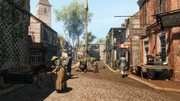 View of a rich district
 -
 Madri Gras decorations
 -
 The slave trader's holding area
 -
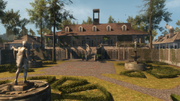 Plantation's mansion
 -
 The mansion's backyard
 -
 Rioters fighting Spanish soldiers during the Louisiana Rebellion


References
| ||||||||||||||||||||||||||||||||||