

New Orleans: Difference between revisions
imported>Crookandcharlatan Just trying to bring some structure into it for now |
imported>Kainzorus Prime No edit summary |
||
| Line 2: | Line 2: | ||
{{WP-REAL}} | {{WP-REAL}} | ||
{{Location Infobox | {{Location Infobox | ||
|image = | |image = AC3L New Orleans overlook.png | ||
|state = | |state = | ||
|rulers = French Empire<br>[[Spanish Empire]]<br>[[United States]] | |rulers = French Empire<br>[[Spanish Empire]]<br>[[United States]] | ||
| Line 32: | Line 32: | ||
The following year, the Spanish governor [[Antonio de Ulloa]] arrived in the city, but brought with him a small force of soldiers and did not raise the Spanish flag over the city. Two years later, he applied rigid trade laws and restrictions within the New Orleans to better serve the Templar Order and allowed their plot to transport slaves and workers to go ahead. In response, French Creoles rebelled against his regime, forcing de Ulloa to take shelter in [[La Balize]] outside of the city. | The following year, the Spanish governor [[Antonio de Ulloa]] arrived in the city, but brought with him a small force of soldiers and did not raise the Spanish flag over the city. Two years later, he applied rigid trade laws and restrictions within the New Orleans to better serve the Templar Order and allowed their plot to transport slaves and workers to go ahead. In response, French Creoles rebelled against his regime, forcing de Ulloa to take shelter in [[La Balize]] outside of the city. | ||
[[File: | [[File:AC3L Barricade.png|thumb|250px|left|Rebels resisting Ulloa's regime]] | ||
During this time, the [[Mentor]] of the Assassins, [[Agaté]], ordered Aveline to assassinate de Ulloa. Doing as she was assigned, Aveline drew the governor out of La Balize and ambushed his carriage. However, after learning of the plans to divert slaves and vagrants south to Mexico, she decided to spare his life in return for a lens used to decode Templar documents, a map leading to the work camp in Mexico and de Ulloa's promise to go into exile.<ref name="AC3L"/> | During this time, the [[Mentor]] of the Assassins, [[Agaté]], ordered Aveline to assassinate de Ulloa. Doing as she was assigned, Aveline drew the governor out of La Balize and ambushed his carriage. However, after learning of the plans to divert slaves and vagrants south to Mexico, she decided to spare his life in return for a lens used to decode Templar documents, a map leading to the work camp in Mexico and de Ulloa's promise to go into exile.<ref name="AC3L"/> | ||
| Line 54: | Line 54: | ||
==Gallery== | ==Gallery== | ||
<gallery captionalign="center" position="center" spacing="small" widths="180"> | <gallery captionalign="center" position="center" spacing="small" widths="180"> | ||
1777 New Orleans Downtown street by EddieBennun.jpg|Concept art of the streets in New Orleans | |||
ACLiberations Docks Artwork.jpg|Concept art of New Orleans' docks | ACLiberations Docks Artwork.jpg|Concept art of New Orleans' docks | ||
1777 New Orleans panoramic view by EddieBennun.jpg|Concept art of New Orleans | 1777 New Orleans panoramic view by EddieBennun.jpg|Concept art of New Orleans | ||
New Orleans at dust by EddieBennun.jpg|Concept art of New Orleans at night | New Orleans at dust by EddieBennun.jpg|Concept art of New Orleans at night | ||
Assassins Creed 3 Liberation,Louisiana Rebellion by EddieBennun.jpg|Concept art of citizens rebelling | |||
AC3L New Orleans port.png|New Orleans docks | |||
AC3L poor streets.png|View of a poor district | |||
AC3L New Orleans rich streets.png|View of a rich district | |||
AC3L French soldiers.png|French soldiers in the Place d'Armes | |||
AC3L Slave quarters.png|The slave quarters | |||
AC3L Plantation mansion.png|Plantation's mansion | |||
AC3L Plantation backyard.png|The mansion's backyard | |||
</gallery> | </gallery> | ||
Revision as of 14:55, 2 August 2014
New Orleans (French: La Nouvelle-Orléans) is a city located in southeastern Louisiana, straddling the Mississippi River.
History
French roots
Before French explorers and traders arrived in the 1690s, indigenous populations inhabited the grounds upon which New Orleans would be built; the city was founded on May 7, 1718 by the Company of the West. Slavery was prevalent even in the city's early days, being a significant component of New Orleans' complex and diversified society.[1]
Due to it being part of a critical trade route that linked the Mississippi River with the Gulf of Mexico, New Orleans quickly grew to become a major economic, political, and cultural center. Both the Assassins and the Templars soon realized the region's importance and subsequently established guilds there. The latter group would become involved in trade to secure their hold on the territory, as well as plot with local government officials.[1]
Spanish rule
Transition
After the French defeat in the Seven Years' War in North America, New Orleans, along with the rest of Louisiana, was ceded to Spain in the Treaty of Fontainebleau in 1762, though the general populace remained unaware of this.[1] In 1763, Jean-Jacques Blaise d'Abbadie, the newly-appointed governor of Louisiana, was sent to the territory to dismantle the remaining French garrison and prepare the hand-over of the colony to Templar plants in the Spanish government.[2]
Roughly a year later, Spain's acquisition of Louisiana was officially announced. The transition from French colonial control to Spanish occupation left the residents of New Orleans dissatisfied with Spain's weak political authority, as it tried to distance itself from the previous French administrative structures.[1]
This ambiguous and unstable political environment soon enticed the Templars into attempting to take control of New Orleans.[1] In 1765, governor d'Abbadie made a deal with the Templar Rafael Joaquín de Ferrer; d'Abbadie would remain in power as governor, provided he supervised the colony's transfer and supplied de Ferrer with workers for a secret project. However, this plot was uncovered by the Assassin Aveline de Grandpré, who assassinated the governor during a party held at his mansion.[2]
Louisiana Rebellion
- "There is so much unrest since the arrival of the Spanish..."
- ―Philippe Olivier de Grandpré on the consequences of the Spanish occupation, 1768.[src]
The Templar Order used the colony's transfer to gain access to the highest levels of government and extend their operations.[1] After setting up a covert slave trafficking operation, the Templars worked with French and Spanish officials in diverting slaves and vagrants from New Orleans to a work camp in Mexico, to excavate First Civilization ruins in search of an artifact known as the Prophecy Disk.[2]
The following year, the Spanish governor Antonio de Ulloa arrived in the city, but brought with him a small force of soldiers and did not raise the Spanish flag over the city. Two years later, he applied rigid trade laws and restrictions within the New Orleans to better serve the Templar Order and allowed their plot to transport slaves and workers to go ahead. In response, French Creoles rebelled against his regime, forcing de Ulloa to take shelter in La Balize outside of the city.

During this time, the Mentor of the Assassins, Agaté, ordered Aveline to assassinate de Ulloa. Doing as she was assigned, Aveline drew the governor out of La Balize and ambushed his carriage. However, after learning of the plans to divert slaves and vagrants south to Mexico, she decided to spare his life in return for a lens used to decode Templar documents, a map leading to the work camp in Mexico and de Ulloa's promise to go into exile.[2]
On 1 November 1768, under the approval of the French King, the Spanish commissioned de Ulloa's replacement, General Alejandro O'Reilly to suppress the rebellion and punish those responsible. To prevent any further violence, the French Creole leader urged citizens to avoid military confrontation and accept Spanish authority.[1]
Eliminating the Templars
In 1776, Aveline attended a soirée on the outskirts of New Orleans, in order to locate a Templar named Vázquez, as she believed he was the "Company Man", the head Templar in Louisiana. Aveline charmed Vázquez and lured him to quiet corner before assassinating him, but he revealed in his final words that he was not the Company Man and that it was actually a woman, but died before he could reveal her name.[2]
Whilst away in New York, Aveline learned that the true identity of the Company Man was her own stepmother, Madeleine de L'Isle. She returned to New Orleans and confronted her stepmother, who admitted that she had manipulated Aveline's life to groom her for induction into the Templar Order, as she believed they shared a common goal.[2]
Aveline agreed and traveled to Saint Louis Cathedral, where she was inducted into the Templar Order by Madeleine, after having faced off against her Mentor Agaté. However, her induction was merely a ruse to eradicate the Templars from within, and Aveline eliminated all of the Templars present, before confronting Madeleine. She attempted to persuade Aveline that her work was for the benefit of humanity, but Aveline refused to serve Madeleine and assassinated her.[2]
Louisiana Purchase
In 1801, Spanish rule ended and the city was handed back to the French. However, French rule ended two years later when Napoleon Bonaparte sold the colony to the United States, a transaction directed by the United States President, Thomas Jefferson.[2]
Layout
New Orleans had a number of characteristic, scenic elements. As a prominent center for trade and commerce, the city was also a culturally diverse environment and full of life. Dotted with trees and lush gardens, the city's buildings were often constructed with angled roofs and decorative features such as balconies and gazebos. Marketplaces and courtyards were a common sight in New Orleans, and its streets were openly spaced with little traffic moving through them. A multifarious society, the general populace of New Orleans was varied, with a range of different people inhabiting the city.
Founded as a French city, the colonists of New Orleans were usually of French origin and wore similar styles of clothing, often a mix between the wealthy and the poor. However, with a wide slave society, servants in New Orleans were a common sight, often dressed in civilized clothing similar to that of the colonists. Notable landmarks in New Orleans included Saint Louis Cathedral, the Place d'Armes, Saint Peter's Cemetery, Congo Square, Madame John's Legacy, the Governor's mansion, the de Grandpré mansion and the de Grandpré warehouse and Assassin headquarters.[2]
Gallery
-
 Concept art of the streets in New Orleans
 -
 Concept art of New Orleans' docks
 -
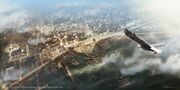 Concept art of New Orleans
 -
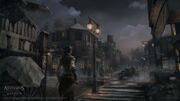 Concept art of New Orleans at night
 -
 Concept art of citizens rebelling
 -
 New Orleans docks
 -
 View of a poor district
 -
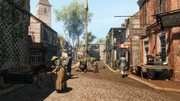 View of a rich district
 -
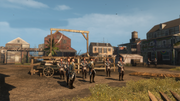 French soldiers in the Place d'Armes
 -
 The slave quarters
 -
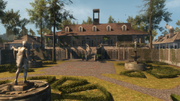 Plantation's mansion
 -
 The mansion's backyard


References
| ||||||||||||||||||||||||||||||||||