Welcome to Assassin's Creed Wiki! Log in and join the community.


Iltani: Difference between revisions
Jump to navigation
Jump to search
imported>Rikerslade mNo edit summary |
imported>The Forgotten Fragment mNo edit summary |
||
| Line 3: | Line 3: | ||
'''Iltani''' was a member of the [[Babylonian Assassins|Babylonian Brotherhood]] of [[Assassins]] during the {{Wiki|Argead Dynasty}}. | '''Iltani''' was a member of the [[Babylonian Assassins|Babylonian Brotherhood]] of [[Assassins]] during the {{Wiki|Argead Dynasty}}. | ||
Iltani was a member of the Babylonian [[Assassins Guilds]]. During her lifetime, [[Alexander the Great]] conquered most of South-West Asia by using a [[Pieces of Eden|Piece of Eden]], [[Staves of Eden|the Staff]]. | Iltani was a member of the Babylonian [[Assassins Guilds]]. During her lifetime, [[Alexander the Great]] conquered most of South-West [[Asia]] by using a [[Pieces of Eden|Piece of Eden]], [[Staves of Eden|the Staff]]. | ||
Some time prior to 10 or 11 June 323 BC, Iltani had [[poison]]ed Alexander the Great, who died as a result on 10 or 11 June 323 BC. | Some time prior to 10 or 11 June 323 BC, Iltani had [[poison]]ed Alexander the Great, who died as a result on 10 or 11 June 323 BC. | ||
Revision as of 04:24, 3 December 2013

Iltani was a member of the Babylonian Brotherhood of Assassins during the Argead Dynasty.
Iltani was a member of the Babylonian Assassins Guilds. During her lifetime, Alexander the Great conquered most of South-West Asia by using a Piece of Eden, the Staff.
Some time prior to 10 or 11 June 323 BC, Iltani had poisoned Alexander the Great, who died as a result on 10 or 11 June 323 BC.
By the time of the Renaissance, Iltani's sarcophagus had been moved to Santa Maria del Fiore in Florence. Fellow Assassin Ezio Auditore da Firenze explored her tomb and took the seal from her sarcophagus, which helped him to acquire the armor of Altaïr Ibn-La'Ahad.[1]
By the year 2000, a statue of Iltani stood in the Mentor's office in Dubai.[2]
Trivia
- Iltani is the feminine form of a Babylonian word meaning "lucky" or "favored by the god(dess)".
- It is also the Babylonian name for the north wind.
Gallery
-
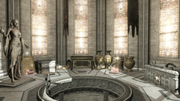 Iltani's statue and sarcophagus
 -
 The Seal of Iltani
 -
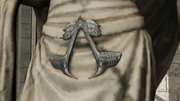 Iltani's insignia


References
- ↑ Assassin's Creed II
- ↑ Assassin's Creed: The Fall - Issue #3