

Gorgon: Difference between revisions
imported>Sadelyrate As 'lovely' as that bit in Ovid's Metamorphoses is, no canon mention is made of it. |
imported>Godgod13 No edit summary |
||
| Line 5: | Line 5: | ||
==History== | ==History== | ||
According to the stories, the legendary founder of [[Mycenae]] and hero [[Perseus]] was tasked by the ruler of [[Seriphos]] King [[Polydektes]] to slay the gorgon Medusa. | According to the stories, the legendary founder of [[Mycenae]] and hero [[Perseus]] was tasked by the ruler of [[Seriphos]] King [[Polydektes]] to slay the gorgon Medusa. Helped on the orders of the god [[Zeus]], the messenger of the gods [[Hermes Trismegistus|Hermes]] gave Perseus a [[Perseus' Sword of Eden|shining sickle]], which might have been a [[Harpe of Perseus|harpe]], as well as winged sandals and the goddess Athena gave Perseus a bronze shield, polished mirror-bright. Armed with these, Perseus succeeded in his task. | ||
During the [[Peloponnesian War]], a member of the [[Daughters of Artemis]], [[Ligeia]], fell prey to a [[Writhing Dread|Gorgon]]'s stare. The [[Sparta]]n ''[[Mercenary|misthios]]'' [[Kassandra]] later defeated the creature at the request of Ligeia's lover, [[Bryce]].<ref name="Writhing Dead">''Assassin's Creed: Odyssey'' – [[Writhing Dead]]</ref> | During the [[Peloponnesian War]], a member of the [[Daughters of Artemis]], [[Ligeia]], fell prey to a [[Writhing Dread|Gorgon]]'s stare. The [[Sparta]]n ''[[Mercenary|misthios]]'' [[Kassandra]] later defeated the creature at the request of Ligeia's lover, [[Bryce]].<ref name="Writhing Dead">''Assassin's Creed: Odyssey'' – [[Writhing Dead]]</ref> | ||
Revision as of 23:44, 13 October 2020

Gorgon is a creature in the Greek mythology. The legendary Medusa was considered the most famous of them. Stories of gorgons were born from a certain type of hybrid beasts created by the Isu as part of the Olympos Project.
History
According to the stories, the legendary founder of Mycenae and hero Perseus was tasked by the ruler of Seriphos King Polydektes to slay the gorgon Medusa. Helped on the orders of the god Zeus, the messenger of the gods Hermes gave Perseus a shining sickle, which might have been a harpe, as well as winged sandals and the goddess Athena gave Perseus a bronze shield, polished mirror-bright. Armed with these, Perseus succeeded in his task.
During the Peloponnesian War, a member of the Daughters of Artemis, Ligeia, fell prey to a Gorgon's stare. The Spartan misthios Kassandra later defeated the creature at the request of Ligeia's lover, Bryce.[1]
Influence and legacy
By the time of the Peloponnesian War in 5th century BCE, the image of a gorgon was used by the Greeks as a protective amulet used to decorate houses and shields. It was also implemented in various statues of the goddess Athena as part of her Aegis.[2]
Certain weapons were associated with gorgons: there was the Gorgon Slayer, a spear which belonged to the mercenary Zetes the Retired during the 5th century BCE, the Gorgoneion Xiphos which was said to echo the voices of the Gorgon's victims,[3] and Medusa, a heavy weapon found in Egypt during the 1st century BCE by the Medjay Bayek of Siwa.[4]
Behind the scenes
The term gorgon is derived from the Greek γοργός (gorgós), meaning 'grim, fierce, terrible'.[5]
Gallery
-
 Gorgon's head used as an apotropaic device on a house
 -

-
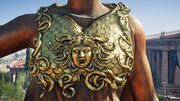
-
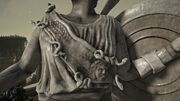 Gorgon as part of the Aegis on a marble statue of Athena


Appearances
- Assassin's Creed: Origins (mentioned only)
- Assassin's Creed: Odyssey (artwork)
References
- ↑ Assassin's Creed: Odyssey – Writhing Dead
- ↑ Assassin's Creed: Odyssey
- ↑ Assassin's Creed: Odyssey – Gorgoneion Xiphos
- ↑ Assassin's Creed: Origins
- ↑ γοργός on Wiktionary