


Cappadocia: Difference between revisions
imported>BlackCataclysm |
imported>Kaloneous Editing a gallery |
||
| Line 71: | Line 71: | ||
Cappadocia concept.jpg|Cappadocia concept illustration by [[Raphael Lacoste]]. | Cappadocia concept.jpg|Cappadocia concept illustration by [[Raphael Lacoste]]. | ||
Dechambo Cappadocia Concept 3.JPG|Concept art of Cappadocia by [[Martin Deschambault]]. | Dechambo Cappadocia Concept 3.JPG|Concept art of Cappadocia by [[Martin Deschambault]]. | ||
assassins-creed-revelations-outside cappadocia.jpg|Outside Cappadocia concept image. | |||
</gallery> | </gallery> | ||
Revision as of 05:52, 3 January 2012
Cappadocia is a region in central Turkey. Although it is partially above ground, the main section of the region lies underground.
During the early 16th century, Cappadocia was an ancient and mysterious region controlled and constructed by the Templar Order. Many poor and struggling Byzantines took refuge there after the fall of Constantinople at the hands of the Ottoman Empire.
History
Templar headquarters

During the early 16th century, the Templars set up their headquarters in Cappadocia, after being driven from their previous base in Rome by the Assassins. There, the Templars set up prisons and instated themselves as the rulers of the city, filling the streets with Byzantine Templars.
The Templar in charge of the Masyaf expedition, Manuel Palaiologos, resided in Cappadocia for some time after his family lost their hold on the Ottoman throne. He, along with his bodyguard and fellow Templar, Shahkulu, governed much of the city and held power within its walls. The two also negotiated the purchase of armaments for their Templars with the Captain of the Janissaries, Tarik Barleti, in 1511.
Assassin Invasion
By 1511, the Janissary Captain, Tarik Barleti, had Ottoman spies active in Cappadocia. These spies were meant to observe the Templars' activity in the city, and report it back to the Janissaries. While those reports were being collected, Tarik prepared to attack the Templars where they felt safest: Cappadocia. When the Assassin Ezio Auditore arrived in the city via ship in March of 1512, he met one of these spies: an attractive female named Dilara.
After meeting with this spy, Ezio made his way around the city, and later overheard Byzantine Templars discussing the fate of Dilara. The guards conversed about Shahkulu, and how he was preparing to kill Dilara, before the guards met with Shahkulu himself.
However, neither of the guards nor Shahkulu had the key to Dilara's prison cell. It was instead at the city market with an off-duty Byzantine. Making his way to the market, the Assassin pick-pocketed the key from the guard, and quickly hurried back to Dilara's cell. He immediately liberated the spy, but Dilara left abruptly and informed him she was going to kill Shahkulu.
Ezio eventually caught up with Dilara, who was observing Shahkulu as he beat one of her fellow spies, Janos. The Assassin then free-ran around the area, making his way to a small platform above where Shahkulu stood. There, he leaped from the platform and air-assassinated Shahkulu with his hidden blade. However, the renegade Turk got back up from blade wound, and attempted to fight the Assassin alongside his reinforcements. After a brief skirmish, Ezio dispatched Shahkulu for good before reuniting the two spies, and then leaving to find Manuel Palaiologos.
Hunt for Manuel
While navigating the city in a search for Manuel, Ezio spotted a depot where the Templar gunpowder was being stored. Ezio made his way through the depot, and eventually shot the gunpowder, creating a large explosion and fire in the depot.
Upon seeing and hearing the loud explosion of the weapons depot, Manuel rushed out from his heavily guarded area to an elevated position where he could see the entire city. There, Manuel began making a speech, before being forced to flee at the sight of Ezio moving towards him.
Manuel fled, and called out for his guards to kill the Assassin. The Templar eventually made his way to a large gate in the corner of the city, believing he was safe from the Assassin.
However, Ezio climbed over the gate, and began pursuing Manuel in another chase. Manuel eventually reached a set of docks, and was forced to confront the Assassin. Challenging Ezio to a duel, Manuel fought the Assassin, but was bested, and killed in the confrontation. After recovering one of the Masyaf Keys from Manuel, Ezio was confronted by Prince Ahmet on a boat offshore, who manifested himself to be a Templar as well. Ezio conversed briefly with Ahmet, and the prince commanded his men to kill the Assassin, before departing from the city.
Fire
Ezio managed to kill his attackers, and began to make his way out of the city. However, upon climbing back over the gate, Ezio noticed that the fire had spread to a large portion of the city, engulfing the entire depot. Ezio also noticed that its smoke was killing some citizens and hindering others from leaving.
Throughout the duration of Ezio's escape, the city bell rang loudly, and explosions periodically rocked the entire city. Despite the large fire and explosions, though, Ezio managed to escape from the city.
Trivia
- In an interview with CVG, Alexandre Amancio noted that parts of the city were reminiscent of Petra.
- While in Cappadocia, Ezio wore a full body-length cape with a hood over his Assassin robes. This was likely so that he would not be recognized within the Templar stronghold.
- As Cappadocia was never freed from Templar control, the unique items sold there throughout the 16th century always had the Templar tax on them, raising the prices by 10%.
- After completing the game, it was possible to take a boat to Cappadocia from the Eastern Galata District docks and explore the city further, if the player wished. The city looked the same as it was upon Ezio's first arrival.
- While in the city, Ezio has no means to reduce his notoriety.
Gallery
-
Ezio running through Cappadocia.
-
 Ezio in Cappadocia.
 -
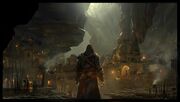 Cappadocia concept illustration by Raphael Lacoste.
 -
 Concept art of Cappadocia by Martin Deschambault.
 -
Outside Cappadocia concept image.


Source
| |||||||||||||||||||||||||||||||||||||