

Assassin Tombs: Difference between revisions
imported>Sol Pacificus Good rewrite. Some punctuation errors, don't use hyphens (-) when em dashes (—) should be used. Semi-colons (;) are only used to connect two independent clauses and the two clauses should "balance" one another. / I believe the article should be written in present tense since we might presume the tombs still exist. Also, I reworded the lede to reflect that this article is about a specific group of Assassin Tombs, not just Assassin tombs in general. |
m Text replacement - ">''Assassin's Creed: Brotherhood''" to ">''Assassin's Creed: Brotherhood''" |
||
| (8 intermediate revisions by 5 users not shown) | |||
| Line 4: | Line 4: | ||
==History== | ==History== | ||
The tombs were presumably built during the 14th century by the [[Italian Brotherhood of Assassins]], around the same time as the [[Sanctuary]] beneath the [[Villa Auditore]] in [[Monteriggioni]]. After founding the [[House of Auditore]], the Italian Assassin and noble [[Domenico Auditore]] constructed the Sanctuary to commemorate seven of the Brotherhood's most illustrious members, each of whom received a statue in the Sanctuary.<ref name="Monteriggioni's Secrets">''[[Assassin's Creed II]]'' – [[Floating conversations]]: Unlocking Monteriggioni's Secrets</ref> | The tombs were presumably built during the 14th century by the [[Italian Brotherhood of Assassins]], around the same time as the [[Sanctuary]] beneath the [[Villa Auditore]] in [[Monteriggioni]]. After founding the [[House of Auditore]], the Italian Assassin and noble [[Domenico Auditore]] constructed the Sanctuary to commemorate seven of the Brotherhood's most illustrious members, each of whom received a statue in the Sanctuary.<ref name="Monteriggioni's Secrets">''[[Assassin's Creed II]]'' – [[Floating conversations]]: "Unlocking Monteriggioni's Secrets"</ref> | ||
All seven of these legendary Assassins—with the exception of [[Altaïr Ibn-La'Ahad]]—also received a corresponding tomb, which contained a wealth of [[Treasure chest|treasure]], a sarcophagus, and a replica of their statue from the Sanctuary. Furthermore, inside each tomb lay an [[Assassin Seals|Assassin Seal]] which, when brought together with the other five, would unlock a secure gate in the Sanctuary, behind which the indestructible [[Armor of Altaïr]] was set. The six tombs were hidden within various churches and landmarks across a number of towns and cities | All seven of these legendary Assassins—with the exception of [[Altaïr Ibn-La'Ahad]]—also received a corresponding tomb, which contained a wealth of [[Treasure chest|treasure]], a sarcophagus, and a replica of their statue from the Sanctuary. Furthermore, inside each tomb lay an [[Assassin Seals|Assassin Seal]] which, when brought together with the other five, would unlock a secure gate in the Sanctuary, behind which the indestructible [[Armor of Altaïr]] was set. The six tombs were hidden within various churches and landmarks across a number of towns and cities in Italy. Secret paths to these tombs could be opened by unlocking skull-shaped locks.<ref name="Monteriggioni's Secrets" /> | ||
At some point in his youth, Domenico's great-grandson [[Mario Auditore|Mario]] searched for the tombs, with no success. In 1478, Mario showed the Sanctuary to his nephew [[Ezio Auditore da Firenze|Ezio Auditore]] as the latter was becoming devoted to the Assassin [[Assassin-Templar War|cause]], and told him about the tombs, encouraging Ezio to seek them out himself.<ref name="Monteriggioni's Secrets" /> | At some point in his youth, Domenico's great-grandson [[Mario Auditore|Mario]] searched for the tombs, with no success. In 1478, Mario showed the Sanctuary to his nephew [[Ezio Auditore da Firenze|Ezio Auditore]] as the latter was becoming devoted to the Assassin [[Assassin-Templar War|cause]], and told him about the tombs, encouraging Ezio to seek them out himself.<ref name="Monteriggioni's Secrets" /> | ||
== Locations == | ==Locations== | ||
===Florence and San Gimignano=== | ===Florence and San Gimignano=== | ||
[[File:See You There 3.png|thumb|250px|left|Ezio entering the Santa Maria Novella tomb]] | [[File:See You There 3.png|thumb|250px|left|Ezio entering the Santa Maria Novella tomb]] | ||
Within the region of [[Tuscany]] there were three tombs: two in [[Florence]] and one in [[San Gimignano]].<ref name="AC2">''[[Assassin's Creed II]]''</ref> The first was located within | Within the region of [[Tuscany]] there were three tombs: two in [[Florence]] and one in [[San Gimignano]].<ref name="AC2">''[[Assassin's Creed II]]''</ref> The first was located within the [[Basilica di Santa Maria Novella]]'s catacombs and was discovered by Ezio in 1478 after eavesdropping on the [[Roman Rite of the Templar Order|Italian Templars]]' meeting. It was dedicated to [[Darius]], the assassin of [[Xerxes I of Persia]].<ref>''[[Assassin's Creed II]]'' – [[Novella's Secret]]</ref> | ||
The second tomb was | The second tomb was located in the [[Cattedrale di Santa Maria del Fiore]], within the ''lanterna'' above the building's domed top. It commemorated [[Iltani]], who was responsible for [[poison]]ing and killing [[Alexander the Great]].<ref>''[[Assassin's Creed II]]'' – [[Il Duomo's Secret]]</ref> | ||
The third tomb was within San Gimignano and was built atop the [[Torre Grossa]] although access to the tomb was only possible by passing through the city's [[Palazzo Comunale, San Gimignano|Palazzo Comunale]] below. This tomb was dedicated to [[Wei Yu]], who had assassinated the first Emperor of [[China]], [[Qin Shi Huang]].<ref>''[[Assassin's Creed II]]'' – [[Torre Grossa's Secret]]</ref> | The third tomb was within San Gimignano and was built atop the [[Torre Grossa]], although access to the tomb was only possible by passing through the city's [[Palazzo Comunale, San Gimignano|Palazzo Comunale]] below. This tomb was dedicated to [[Wei Yu]], who had assassinated the first Emperor of [[China]], [[Qin Shi Huang]].<ref>''[[Assassin's Creed II]]'' – [[Torre Grossa's Secret]]</ref> | ||
===Forlì and Venice=== | ===Forlì and Venice=== | ||
[[File:See You There 2.png|thumb|250px|The secret entrance's mechanism in use]] | [[File:See You There 2.png|thumb|250px|The secret entrance's mechanism in use]] | ||
Within the territories of [[Romagna]] and the Venetian lagoon, three more tombs were built. In [[Forlì]], beneath the [[Rocca di Ravaldino]], lay the tomb of [[Qulan Gal]], the | Within the territories of [[Romagna]] and the Venetian lagoon, three more tombs were built. In [[Forlì]], beneath the [[Rocca di Ravaldino]], lay the tomb of [[Qulan Gal]], the [[Mongolian Brotherhood of Assassins|Mongolian Assassin]] who had struck [[Genghis Khan]]'s [[horse]] with an [[arrow]],<ref>''[[Assassin's Creed II]]'' – [[Ravaldino's Secret]]</ref> facilitating the Khan's [[Assassination of Genghis Khan|assassination]] by [[Darim Ibn-La'Ahad]].<ref>''[[Assassin's Creed: The Secret Crusade]]''</ref><ref>''[[Assassin's Creed: Reflections]]'' – [[Assassin's Creed: Reflections 2|Issue #2]]</ref> | ||
The other two lay in [[Venice]]. Within the [[San Marco District (Venice)| | The other two tombs lay in [[Venice]]. Within the [[San Marco District (Venice)|San Marco district]], the eponymous [[Basilica di San Marco]] housed a cenotaph of [[Amunet]],<ref>''[[Assassin's Creed II]]'' – [[San Marco's Secret]]</ref> whom Assassin legend held responsible for what was actually [[Cleopatra]]'s suicide,<ref>[[Assassin's Creed: Origins (comic)|''Assassin's Creed: Origins'' (comic)]] – [[Assassin's Creed: Origins 4|Issue #4]]</ref> and whose remains still rested in [[Egypt]].<ref name="ACO">''[[Assassin's Creed: Origins]]''</ref> | ||
The final tomb was located beneath the [[Santa Maria della Visitazione]] | The final tomb was located beneath the [[Chiesa di Santa Maria della Visitazione]] and commemorated [[Leonius]], the assassin of the [[Roman Empire|Roman Emperor]] [[Caligula]].<ref>''[[Assassin's Creed II]]'' – [[Visitazione's Secret]]</ref> | ||
===Armor of Altaïr=== | ===Armor of Altaïr=== | ||
{{Main|Armor of Altaïr}} | {{Main|Armor of Altaïr}} | ||
[[File:Armor of Altaïr ACII.png|thumb|250px|Ezio obtaining the Armor of Altaïr | [[File:Armor of Altaïr ACII.png|thumb|left|250px|Ezio obtaining the Armor of Altaïr]] | ||
Locked away behind a gate in the Sanctuary lay the Armor of Altaïr Ibn-La'Ahad, a virtually invulnerable suit of armor created by | Locked away behind a gate in the Sanctuary lay the Armor of Altaïr Ibn-La'Ahad, a virtually invulnerable suit of armor created by the [[Levantine Brotherhood of Assassins|Levantine Assassins]]' [[Mentor]] using knowledge he had gained through studying an [[Apple of Eden 2|Apple of Eden]].<ref name="Codex">''[[Assassin's Creed II]]'' – [[Altaïr Ibn-La'Ahad's Codex]]</ref> | ||
Between 1478 and 1497, Ezio found and explored all six Assassin Tombs throughout Italy and took their respective | Between 1478 and 1497, Ezio found and explored all six Assassin Tombs throughout Italy and took their respective Assassin Seals, placing them at the bottom of their corresponding statues in the Sanctuary. This unlocked the gate and allowed Ezio to claim the Armor of Altaïr for his own usage.<ref name="AC2" /> He went on to wear it for several years,<ref name="Love's Labour's Lost">''[[Assassin's Creed: Brotherhood]]'' – [[Love's Labour's Lost]]</ref><ref name="Mass Exodus">''[[Assassin's Creed: Brotherhood]]'' – [[Mass Exodus]]</ref> until its loss during the [[Siege of Monteriggioni]] on 2 January 1500.<ref>''[[Assassin's Creed: Brotherhood]]'' – [[Vilified]]</ref> | ||
=== Monteriggioni === | ===Monteriggioni=== | ||
[[File:Paying_Respects_6.png|thumb|250px|Ezio in the Auditore | {{Main|Auditore Family Crypt}} | ||
[[File:Paying_Respects_6.png|thumb|250px|Ezio in the Auditore Family Crypt]] | |||
A seventh tomb, the [[Auditore Family Crypt]], was built in Monteriggioni and connected to the Sanctuary through a series of underground tunnels. It was constructed by Domenico Auditore to serve as the resting place of Domenico himself and his son, [[Renato Auditore|Renato]]. Domenico's life story, including his recruitment to the Assassins and his foundation of the Auditore family, was inscribed across the walls along the pathway, from the main entrance to the crypt itself.<ref name="Paying Respects">''[[Assassin's Creed II]]'' – [[Paying Respects]]</ref> | |||
At the same time | At the same time as his search for the six Assassin Tombs, Ezio explored this crypt as well, learning of his family's history and involvement with the Assassins.<ref name="Paying Respects" /> Ezio's father [[Giovanni Auditore da Firenze|Giovanni]] had previously explored the crypt in his youth,<ref>''[[Assassin's Creed: Project Legacy]]'' – [[Italian Wars: Chapter 3 - Mario Auditore]]''</ref> and their descendant [[Desmond Miles]] would do so centuries later in 2012.<ref>''[[Assassin's Creed: Brotherhood]]'' – [[21st century conversations#Assassin's Creed: Brotherhood|Modern day]] </ref> | ||
== Behind the scenes == | ==Behind the scenes== | ||
Prior to the release of ''[[Assassin's Creed: Origins]]'' in 2017, each Assassin Tomb was believed to be the actual resting place for the Assassin it was dedicated to due to the presence of a sarcophagus containing a mummified body. However, ''Origins'' | Prior to the release of ''[[Assassin's Creed: Origins]]'' in 2017, each Assassin Tomb was believed to be the actual resting place for the Assassin it was dedicated to due to the presence of a sarcophagus containing a mummified body. However, ''Origins'' retconned this by having Amunet actually be buried alongside her husband [[Bayek]] in Egypt, meaning that the mummy from Amunet's tomb in Italy was fake. Whether this is the case for the other tombs, however, remains unknown. | ||
==Gallery== | |||
<gallery captionalign="center" position="center" widths="180"> | |||
Il Duomo's Secret 10.png|The Tomb of Iltani | |||
Wei Yu 1 v.png|The Tomb of Wei Yu | |||
Amunet 1 v.png|The Tomb of Amunet | |||
Leonius 1 v.png|The Tomb of Leonius' outside chamber | |||
Visitazione's Secret 10.png|Leonius' statue and sarcophagus | |||
Qulan Gal 1 v.png|The Tomb of Qulan Gal | |||
</gallery> | |||
==Appearances== | ==Appearances== | ||
*''[[Assassin's Creed II]]'' {{1st}} | *''[[Assassin's Creed II]]'' {{1st}} | ||
*''[[Assassin's Creed: Memories]]'' {{Imo}} | *''[[Assassin's Creed: Memories]]'' {{Imo}} | ||
*''[[Assassin's Creed: Identity]]'' {{Mdat}} {{Imo}} | |||
==References== | ==References== | ||
Latest revision as of 05:55, 22 September 2026

The Assassin Tombs are a group of six tombs or shrines hidden across Italy and dedicated to legendary Assassins from around the world.
History[edit | edit source]
The tombs were presumably built during the 14th century by the Italian Brotherhood of Assassins, around the same time as the Sanctuary beneath the Villa Auditore in Monteriggioni. After founding the House of Auditore, the Italian Assassin and noble Domenico Auditore constructed the Sanctuary to commemorate seven of the Brotherhood's most illustrious members, each of whom received a statue in the Sanctuary.[1]
All seven of these legendary Assassins—with the exception of Altaïr Ibn-La'Ahad—also received a corresponding tomb, which contained a wealth of treasure, a sarcophagus, and a replica of their statue from the Sanctuary. Furthermore, inside each tomb lay an Assassin Seal which, when brought together with the other five, would unlock a secure gate in the Sanctuary, behind which the indestructible Armor of Altaïr was set. The six tombs were hidden within various churches and landmarks across a number of towns and cities in Italy. Secret paths to these tombs could be opened by unlocking skull-shaped locks.[1]
At some point in his youth, Domenico's great-grandson Mario searched for the tombs, with no success. In 1478, Mario showed the Sanctuary to his nephew Ezio Auditore as the latter was becoming devoted to the Assassin cause, and told him about the tombs, encouraging Ezio to seek them out himself.[1]
Locations[edit | edit source]
Florence and San Gimignano[edit | edit source]

Within the region of Tuscany there were three tombs: two in Florence and one in San Gimignano.[2] The first was located within the Basilica di Santa Maria Novella's catacombs and was discovered by Ezio in 1478 after eavesdropping on the Italian Templars' meeting. It was dedicated to Darius, the assassin of Xerxes I of Persia.[3]
The second tomb was located in the Cattedrale di Santa Maria del Fiore, within the lanterna above the building's domed top. It commemorated Iltani, who was responsible for poisoning and killing Alexander the Great.[4]
The third tomb was within San Gimignano and was built atop the Torre Grossa, although access to the tomb was only possible by passing through the city's Palazzo Comunale below. This tomb was dedicated to Wei Yu, who had assassinated the first Emperor of China, Qin Shi Huang.[5]
Forlì and Venice[edit | edit source]

Within the territories of Romagna and the Venetian lagoon, three more tombs were built. In Forlì, beneath the Rocca di Ravaldino, lay the tomb of Qulan Gal, the Mongolian Assassin who had struck Genghis Khan's horse with an arrow,[6] facilitating the Khan's assassination by Darim Ibn-La'Ahad.[7][8]
The other two tombs lay in Venice. Within the San Marco district, the eponymous Basilica di San Marco housed a cenotaph of Amunet,[9] whom Assassin legend held responsible for what was actually Cleopatra's suicide,[10] and whose remains still rested in Egypt.[11]
The final tomb was located beneath the Chiesa di Santa Maria della Visitazione and commemorated Leonius, the assassin of the Roman Emperor Caligula.[12]
Armor of Altaïr[edit | edit source]
- Main article: Armor of Altaïr

Locked away behind a gate in the Sanctuary lay the Armor of Altaïr Ibn-La'Ahad, a virtually invulnerable suit of armor created by the Levantine Assassins' Mentor using knowledge he had gained through studying an Apple of Eden.[13]
Between 1478 and 1497, Ezio found and explored all six Assassin Tombs throughout Italy and took their respective Assassin Seals, placing them at the bottom of their corresponding statues in the Sanctuary. This unlocked the gate and allowed Ezio to claim the Armor of Altaïr for his own usage.[2] He went on to wear it for several years,[14][15] until its loss during the Siege of Monteriggioni on 2 January 1500.[16]
Monteriggioni[edit | edit source]
- Main article: Auditore Family Crypt

A seventh tomb, the Auditore Family Crypt, was built in Monteriggioni and connected to the Sanctuary through a series of underground tunnels. It was constructed by Domenico Auditore to serve as the resting place of Domenico himself and his son, Renato. Domenico's life story, including his recruitment to the Assassins and his foundation of the Auditore family, was inscribed across the walls along the pathway, from the main entrance to the crypt itself.[17]
At the same time as his search for the six Assassin Tombs, Ezio explored this crypt as well, learning of his family's history and involvement with the Assassins.[17] Ezio's father Giovanni had previously explored the crypt in his youth,[18] and their descendant Desmond Miles would do so centuries later in 2012.[19]
Behind the scenes[edit | edit source]
Prior to the release of Assassin's Creed: Origins in 2017, each Assassin Tomb was believed to be the actual resting place for the Assassin it was dedicated to due to the presence of a sarcophagus containing a mummified body. However, Origins retconned this by having Amunet actually be buried alongside her husband Bayek in Egypt, meaning that the mummy from Amunet's tomb in Italy was fake. Whether this is the case for the other tombs, however, remains unknown.
Gallery[edit | edit source]
-
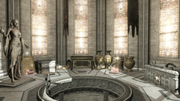 The Tomb of Iltani
 -
 The Tomb of Wei Yu
 -
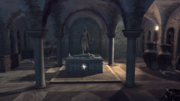 The Tomb of Amunet
 -
 The Tomb of Leonius' outside chamber
 -
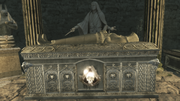 Leonius' statue and sarcophagus
 -
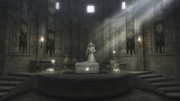 The Tomb of Qulan Gal


Appearances[edit | edit source]
- Assassin's Creed II (first appearance)
- Assassin's Creed: Memories (indirect mention only)
- Assassin's Creed: Identity (mentioned in Database entry only) (indirect mention only)
References[edit | edit source]
- ↑ 1.0 1.1 1.2 Assassin's Creed II – Floating conversations: "Unlocking Monteriggioni's Secrets"
- ↑ 2.0 2.1 Assassin's Creed II
- ↑ Assassin's Creed II – Novella's Secret
- ↑ Assassin's Creed II – Il Duomo's Secret
- ↑ Assassin's Creed II – Torre Grossa's Secret
- ↑ Assassin's Creed II – Ravaldino's Secret
- ↑ Assassin's Creed: The Secret Crusade
- ↑ Assassin's Creed: Reflections – Issue #2
- ↑ Assassin's Creed II – San Marco's Secret
- ↑ Assassin's Creed: Origins (comic) – Issue #4
- ↑ Assassin's Creed: Origins
- ↑ Assassin's Creed II – Visitazione's Secret
- ↑ Assassin's Creed II – Altaïr Ibn-La'Ahad's Codex
- ↑ Assassin's Creed: Brotherhood – Love's Labour's Lost
- ↑ Assassin's Creed: Brotherhood – Mass Exodus
- ↑ Assassin's Creed: Brotherhood – Vilified
- ↑ 17.0 17.1 Assassin's Creed II – Paying Respects
- ↑ Assassin's Creed: Project Legacy – Italian Wars: Chapter 3 - Mario Auditore
- ↑ Assassin's Creed: Brotherhood – Modern day