

Yerebatan Cistern: Difference between revisions
imported>Piero.schiavone1994 No edit summary |
m Text replacement - "{{Landmarks Infobox" to "{{Landmark Infobox" |
||
| (6 intermediate revisions by 6 users not shown) | |||
| Line 1: | Line 1: | ||
{{Era| | {{Era|Landmarks}}{{WP-REAL|Basilica Cistern}} | ||
{{WP-REAL|Basilica Cistern}} | |||
{{Youmay|the location|[[The Yerebatan Cistern|the memory]]}} | {{Youmay|the location|[[The Yerebatan Cistern|the memory]]}} | ||
{{Landmark Infobox | |||
{{ | |||
|name = Yerebatan Cistern | |name = Yerebatan Cistern | ||
|image = Yerebatan Cistern Database image.png | |image = Yerebatan Cistern Database image.png | ||
|description = Constantinople's largest underground cistern. | |description = Constantinople's largest underground cistern. | ||
|location = [[Imperial District]], Constantinople | |location = [[Imperial District]], [[Constantinople]] | ||
|functions = Basilica<br>Cistern | |functions = Basilica<br>Cistern | ||
|dateconstructed= | |dateconstructed= | ||
}} | |||
The '''Yerebatan Cistern''' or '''Basilica Cistern''' is the largest of several hundred ancient cisterns that lie beneath [[Constantinople]]. | |||
The '''Yerebatan Cistern''' or '''Basilica Cistern''' | |||
==History== | ==History== | ||
The cistern, located 150 meters southwest of the [[Hagia Sophia]], was originally a basilica. During the reign of the [[Byzantine Empire|Byzantine Emperor]] [[Justinian I]], it was converted into a water storage facility for the palace complex situated immediately to the east. | The cistern, located 150 meters southwest of the [[Hagia Sophia]], was originally a basilica. During the reign of the [[Byzantine Empire|Byzantine Emperor]] [[Justinian I]], it was converted into a water storage facility for the palace complex situated immediately to the east. After the fall of the {{Wiki|Latin Empire|Latin dynasty}} and the restoration of the {{Wiki|Palaiologos|Palaiologi}}, the cistern fell out of use and was forgotten about by all but a few residents of the city.<ref name="Database">''[[Assassin's Creed: Revelations]]'' – [[Database: Yerebatan Cistern]]</ref> | ||
In 1257, [[Niccolò Polo]] had the first of [[Altaïr Ibn-La'Ahad]]'s [[Masyaf Key]]s hidden in the Yerebatan Cistern. Over two centuries later, in 1511, the [[Italian Brotherhood of Assassins|Italian Assassin]] [[Ezio Auditore da Firenze]] entered the cistern via a secret passage in the old Polo trading post, which by then had become a bookshop run by [[Sofia Sartor]].<ref>''Assassin's Creed: Revelations'' – [[A Familiar Face]]</ref> | |||
[[ | There, Ezio found that the [[Byzantine Rite of the Templar Order|Byzantine Templars]] had been searching for the Masyaf Key for thirteen months, without success. Stealthily making his way through the Yerebatan Cistern, Ezio recovered the Key, as well as a map to the locations of the other Keys hidden by the Polos.<ref>''Assassin's Creed: Revelations'' – [[The Yerebatan Cistern]]</ref> | ||
After retrieving all the Keys and accessing Altaïr's [[Library of Altaïr Ibn-La'Ahad|library]] in [[Masyaf]],<ref>''Assassin's Creed: Revelations'' – [[A Homecoming]]</ref> Ezio and Sofia returned to Constantinople for a brief stay in June 1512. The couple sold Sofia's bookshop to the [[Ottoman Brotherhood of Assassins|Ottoman Assassins]], and Ezio also gave them the Keys to hide in the Yerebatan Cistern, in the same place he had found the first Key.<ref>[[Assassin's Creed: Revelations (novel)|''Assassin's Creed: Revelations'' novel]]</ref> | |||
By this point, the cistern's existence had become unknown to Constantinople's general populace, though rumors persisted. It was rediscovered late into [[Suleiman I]]'s reign by a visiting diplomat, who relayed his findings to the Sultan. | By this point, the cistern's existence had become unknown to Constantinople's general populace, though rumors persisted. It was rediscovered late into [[Suleiman I]]'s reign by a visiting diplomat, who relayed his findings to the Sultan.<ref name="Database" /> | ||
==Trivia== | ==Trivia== | ||
| Line 27: | Line 26: | ||
==Gallery== | ==Gallery== | ||
<gallery captionalign="center" position="center | <gallery captionalign="center" position="center" widths="180"> | ||
Assassin's creed Revelation Ezio by Omartin.jpg|Concept art of the cistern | Assassin's creed Revelation Ezio by Omartin.jpg|Concept art of the cistern | ||
ACR_Cistern_Peacock_Column.png|The "Peacock-eyed" column | ACR_Cistern_Peacock_Column.png|The "Peacock-eyed" column | ||
Cistern 1.png|Two Byzantine Templars within the cistern | |||
</gallery> | </gallery> | ||
== | ==Appearances== | ||
*''[[Assassin's Creed: Revelations]]'' | *''[[Assassin's Creed: Revelations]]'' {{1st}} | ||
*[[Assassin's Creed: Revelations (novel)|''Assassin's Creed: Revelations'' novel]] | |||
==References== | |||
{{Reflist}} | |||
{{ACR}} | {{ACR}} | ||
[[Category:Landmarks in Constantinople]] | [[Category:Landmarks in Constantinople]] | ||
Latest revision as of 23:50, 31 August 2026
| This article is about the location. You may be looking for the memory. |
The Yerebatan Cistern or Basilica Cistern is the largest of several hundred ancient cisterns that lie beneath Constantinople.
History[edit | edit source]
The cistern, located 150 meters southwest of the Hagia Sophia, was originally a basilica. During the reign of the Byzantine Emperor Justinian I, it was converted into a water storage facility for the palace complex situated immediately to the east. After the fall of the Latin dynasty and the restoration of the Palaiologi, the cistern fell out of use and was forgotten about by all but a few residents of the city.[1]
In 1257, Niccolò Polo had the first of Altaïr Ibn-La'Ahad's Masyaf Keys hidden in the Yerebatan Cistern. Over two centuries later, in 1511, the Italian Assassin Ezio Auditore da Firenze entered the cistern via a secret passage in the old Polo trading post, which by then had become a bookshop run by Sofia Sartor.[2]
There, Ezio found that the Byzantine Templars had been searching for the Masyaf Key for thirteen months, without success. Stealthily making his way through the Yerebatan Cistern, Ezio recovered the Key, as well as a map to the locations of the other Keys hidden by the Polos.[3]
After retrieving all the Keys and accessing Altaïr's library in Masyaf,[4] Ezio and Sofia returned to Constantinople for a brief stay in June 1512. The couple sold Sofia's bookshop to the Ottoman Assassins, and Ezio also gave them the Keys to hide in the Yerebatan Cistern, in the same place he had found the first Key.[5]
By this point, the cistern's existence had become unknown to Constantinople's general populace, though rumors persisted. It was rediscovered late into Suleiman I's reign by a visiting diplomat, who relayed his findings to the Sultan.[1]
Trivia[edit | edit source]
- Yerebatan is a Turkish word meaning "sunken", and the place is also known as Yerebatan Sarayı ("Sunken Palace") and Yerebatan Sarnıcı ("Sunken Cistern").
Gallery[edit | edit source]
-
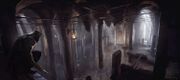 Concept art of the cistern
 -
 The "Peacock-eyed" column
 -
 Two Byzantine Templars within the cistern


Appearances[edit | edit source]
- Assassin's Creed: Revelations (first appearance)
- Assassin's Creed: Revelations novel
References[edit | edit source]
- ↑ 1.0 1.1 Assassin's Creed: Revelations – Database: Yerebatan Cistern
- ↑ Assassin's Creed: Revelations – A Familiar Face
- ↑ Assassin's Creed: Revelations – The Yerebatan Cistern
- ↑ Assassin's Creed: Revelations – A Homecoming
- ↑ Assassin's Creed: Revelations novel
| |||||||||||||||||||||||||||||||||||||