

-
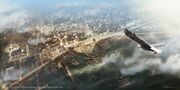 New Orleans panorama
 -
 New Orleans at dawn
 -
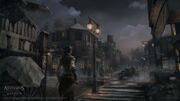 New Orleans at night
 -
 New Orleans during a storm
 -
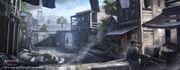 Streets of New Orleans
 -
 Streets of New Orleans
 -
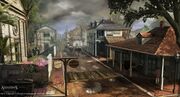 Streets of New Orleans
 -
 Streets of New Orleans during Mardi Gras
 -
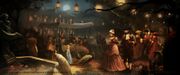 Party at a plantation
 -
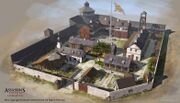 Military barracks
 -
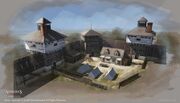 Another military barracks
 -
 Downtown houses
 -
 Spanish troops in New Orleans
 -
 Citizens during the Louisiana Rebellion
 -
 New Orleans docks
 -
 New Orleans docks
 -
 Port skyline
 -
 City skyline
Welcome to Assassin's Creed Wiki! Log in and join the community.
New Orleans: Difference between revisions
Jump to navigation
Jump to search
imported>Lady Kyashira No edit summary |
imported>Gener4l Cl4ank4 mNo edit summary |
||
| (4 intermediate revisions by 3 users not shown) | |||
| Line 1: | Line 1: | ||
{{Era|Locations}}{{WP-REAL}} | {{Era|Locations}}{{WP-REAL}} | ||
{{Dialogue|Gérald|The Spanish are... sympathetic to our aims now. New laws may... ease your efforts to help the slaves.|Aveline|Could it be that for the first time, home holds more comfort than conflict?|[[Gérald Blanc | {{Dialogue|Gérald|The Spanish are... sympathetic to our aims now. New laws may... ease your efforts to help the slaves.|Aveline|Could it be that for the first time, home holds more comfort than conflict?|[[Gérald Blanc]] and Aveline de Grandpré on New Orleans, 1771.|Assassin's Creed III: Liberation|Prodigal Daughter}} | ||
{{Location Infobox | {{Location Infobox | ||
|image = AC3L | |image = AC3L New Orleans overlook.png | ||
|state = [[United States]] | |state = [[United States]] | ||
|rulers = [[Kingdom of France]] {{c|1718 – 1763}}<br>[[Spanish Empire]] {{c|1763 – 1801}}<br>First French Republic {{c|1801 – 1803}} | |rulers = [[Kingdom of France]] {{c|1718 – 1763}}<br>[[Spanish Empire]] {{c|1763 – 1801}}<br>First French Republic {{c|1801 – 1803}} | ||
| Line 11: | Line 11: | ||
|targets = [[Jean-Jacques Blaise d'Abbadie]]<br>[[Antonio de Ulloa]]<br>[[Diego Vázquez]]<br>[[Madeleine de L'Isle]] | |targets = [[Jean-Jacques Blaise d'Abbadie]]<br>[[Antonio de Ulloa]]<br>[[Diego Vázquez]]<br>[[Madeleine de L'Isle]] | ||
}} | }} | ||
'''New Orleans''' (French: ''La Nouvelle-Orléans'') is the largest city | '''New Orleans''' (French: ''La Nouvelle-Orléans'') is the largest city in the [[United States|U.S.]] state of [[Louisiana]]. It is located the southeastern part of the state, straddling the {{Wiki|Mississippi River}}. | ||
Due to its prominent position in trade, New Orleans quickly became a major economic, political and cultural center. Although [[France|French]] in origin, the city would change hands a number of times throughout history. | Due to its prominent position in trade, New Orleans quickly became a major economic, political, and cultural center. Although [[France|French]] in origin, the city would change hands a number of times throughout history. | ||
==History== | ==History== | ||
===French roots=== | ===French roots=== | ||
Before French explorers and traders arrived in the 1690s, indigenous populations inhabited the grounds upon which New Orleans would be built; the city was founded on May | Before French explorers and traders arrived in the 1690s, indigenous populations inhabited the grounds upon which New Orleans would be built; the city was founded on 7 May 1718 by the {{Wiki|Mississippi Company|Company of the West}}. [[Slavery]] was prevalent even in the city's early days, being a significant component of New Orleans' complex and diversified society.<ref name="Encyclopedia">''[[Assassin's Creed Encyclopedia]]''</ref> During this time, the [[Edward Kenway's fleet|fleet]] of the [[Piracy|pirate]] [[Edward Kenway]] sold [[tobacco]] to the city's merchants.<ref>''[[Assassin's Creed IV: Black Flag]]'' – [[Edward Kenway's fleet]]: "The General Store"</ref> | ||
Due to it being part of a critical trade route that linked the Mississippi River with the {{Wiki|Gulf of Mexico}}, New Orleans quickly grew to become a major economic, political, and cultural center. Both the [[Assassins]] and the [[Templars]] soon realized the region's importance and subsequently established guilds there. The latter group would become involved in trade to secure their hold on the territory, as well as plot with local government officials.<ref name="Encyclopedia"/> | Due to it being part of a critical trade route that linked the Mississippi River with the {{Wiki|Gulf of Mexico}}, New Orleans quickly grew to become a major economic, political, and cultural center. Both the [[Assassins]] and the [[Templars]] soon realized the region's importance and subsequently established guilds there. The latter group would become involved in trade to secure their hold on the territory, as well as plot with local government officials.<ref name="Encyclopedia"/> | ||
| Line 23: | Line 23: | ||
===Spanish rule=== | ===Spanish rule=== | ||
====Transition==== | ====Transition==== | ||
{{Quote| I will do all I can to smooth the hand-over of the colony. And your mission will have all the workers it needs – provided you make good on your promise. Labor is in tight supply as it is, and, I must remain in power as gouverneur.| | {{Quote| I will do all I can to smooth the hand-over of the colony. And your mission will have all the workers it needs – provided you make good on your promise. Labor is in tight supply as it is, and, I must remain in power as gouverneur.|Governor d'Abbadie to de Ferrer, 1765.|Assassin's Creed III: Liberation|The Colony's Good}} | ||
After France's defeat in the [[ | After France's defeat in the [[Seven Years' War]] in [[United States|North America]], New Orleans, along with the rest of Louisiana, was ceded to [[Spain]] in the {{Wiki|Treaty of Fontainebleau (1762)|Treaty of Fontainebleau}} in 1762, though the general populace remained unaware of this.<ref name="Encyclopedia"/> In 1763, [[Jean-Jacques Blaise d'Abbadie]], the newly-appointed governor of Louisiana, was sent to the territory to dismantle the remaining French garrison and prepare the hand-over of the colony to Templar plants in the Spanish government.<ref>''[[Assassin's Creed III: Liberation]]'' – [[Database: Jean-Jacques Blaise d'Abbadie]]</ref> | ||
[[File:AC3L French soldiers.png|thumb|left|250px|French troops stationed in New Orleans despite Spanish occupation]] | [[File:AC3L French soldiers.png|thumb|left|250px|French troops stationed in New Orleans despite Spanish occupation]] | ||
Roughly a year later, Spain's acquisition of Louisiana was officially announced. The Templar Order used the colony's transfer to gain access to the highest levels of government and extend their operations. Meanwhile, the transition from French colonial control to Spanish occupation left the residents of New Orleans dissatisfied with Spain's weak political authority, as it tried to distance itself from the previous French administrative structures.<ref name="Encyclopedia"/> | Roughly a year later, Spain's acquisition of Louisiana was officially announced. The Templar Order used the colony's transfer to gain access to the highest levels of government and extend their operations. Meanwhile, the transition from French colonial control to Spanish occupation left the residents of New Orleans dissatisfied with Spain's weak political authority, as it tried to distance itself from the previous French administrative structures.<ref name="Encyclopedia"/> | ||
This ambiguous and unstable political environment soon enticed the Templars into attempting to take control of New Orleans.<ref name="Encyclopedia"/> In 1765, governor d'Abbadie made a deal with the Templar [[Rafael Joaquín de Ferrer]]; d'Abbadie would remain in power, provided he supervised the colony's transfer and supplied de Ferrer with workers for a secret project. However, this scheme was uncovered by the Assassin [[Aveline de Grandpré]], who assassinated the governor during a party held at his [[Governor's Mansion (New Orleans)|mansion]].<ref | This ambiguous and unstable political environment soon enticed the Templars into attempting to take control of New Orleans.<ref name="Encyclopedia"/> In 1765, governor d'Abbadie made a deal with the Templar [[Rafael Joaquín de Ferrer]]; d'Abbadie would remain in power, provided he supervised the colony's transfer and supplied de Ferrer with workers for a secret project. However, this scheme was uncovered by the Assassin [[Aveline de Grandpré]], who assassinated the governor during a party held at his [[Governor's Mansion (New Orleans)|mansion]].<ref>''[[Assassin's Creed III: Liberation]]'' – [[The Colony's Good]]</ref> | ||
In 1766, the nobility of New Orleans was targeted by a dissident Assassin from [[Saint-Domingue]] named [[Baptiste]], who intended to poison them to help the Templars tighten their grip on the city. This crisis was averted when Baptiste was assassinated by Aveline, putting an end to his plans for New Orleans.<ref | In 1766, the nobility of New Orleans was targeted by a dissident Assassin from [[Haiti|Saint-Domingue]] named [[Baptiste]], who intended to poison them to help the Templars tighten their grip on the city. This crisis was averted when Baptiste was assassinated by Aveline, putting an end to his plans for New Orleans.<ref>''[[Assassin's Creed III: Liberation]]'' – [[Eve of Saint John]]</ref> | ||
====Louisiana Rebellion==== | ====Louisiana Rebellion==== | ||
{{main|Louisiana Rebellion}} | {{main|Louisiana Rebellion}} | ||
{{Quote|How blessed we are with a daughter who uses her talents in peace... not to riot in the streets of New Orleans. There is so much unrest since the arrival of the Spanish...|[[Philippe Olivier de Grandpré]] on the consequences of the Spanish occupation, 1768.|Assassin's Creed III: Liberation}} | {{Quote|How blessed we are with a daughter who uses her talents in peace... not to riot in the streets of New Orleans. There is so much unrest since the arrival of the Spanish...|[[Philippe Olivier de Grandpré]] on the consequences of the Spanish occupation, 1768.|Assassin's Creed III: Liberation|Prélude to Rebellion}} | ||
That same year, [[Antonio de Ulloa]], a Templar | That same year, [[Antonio de Ulloa]], a Templar advisor, arrived in New Orleans to serve as the first Spanish Governor of Louisiana. However, he allowed the French flag to remain over the city, leaving the administration of the territory to French Creole officials while he and his family lived at [[La Balize]], away from New Orleans.<ref name="Encyclopedia"/> In secret, de Ulloa had citizens of low standing kidnapped, sending them to a work camp run by de Ferrer in [[Chichen Itza]], [[Mexico]].<ref name="Governor">''[[Assassin's Creed III: Liberation]]'' – [[A Governor No More]]</ref> | ||
[[File:AC3L Barricade.png|thumb|250px|Citizens fighting de Ulloa's soldiers]] | [[File:AC3L Barricade.png|thumb|250px|Citizens fighting de Ulloa's soldiers]] | ||
In 1768, de Ulloa implemented rigid trade restrictions within the colony, which benefited the Templars and allowed their shipment of workers to continue. This caused French Creoles' opinion of him to drop even lower and led them to rebel against the governor's regime. Riots soon grew commonplace, with citizens setting up barricades and openly challenging Spanish soldiers.<ref | In 1768, de Ulloa implemented rigid trade restrictions within the colony, which benefited the Templars and allowed their shipment of workers to continue. This caused French Creoles' opinion of him to drop even lower and led them to rebel against the governor's regime. Riots soon grew commonplace, with citizens setting up barricades and openly challenging Spanish soldiers.<ref>''[[Assassin's Creed III: Liberation]]'' – [[Prélude to Rebellion]]</ref><ref>''[[Assassin's Creed III: Liberation]]'' – [[In Vino Veritas]]</ref> | ||
The widespread chaos in the city eventually forced de Ulloa to leave his hiding place, so that he could attempt to negotiate for peace. While en route, his envoy was ambushed by Aveline, who had orders to assassinate the governor; however, she ultimately chose to spare him, and forced Ulloa to go into exile. Following his departure, New Orleans was briefly governed by the French Creoles.<ref name=" | The widespread chaos in the city eventually forced de Ulloa to leave his hiding place, so that he could attempt to negotiate for peace. While en route, his envoy was ambushed by Aveline, who had orders to assassinate the governor; however, she ultimately chose to spare him, and forced Ulloa to go into exile. Following his departure, New Orleans was briefly governed by the French Creoles.<ref name="Governor"/> | ||
Under the approval of the French King, the Spanish commissioned de Ulloa's replacement, General [[Alejandro O'Reilly]] to suppress the rebellion and punish those responsible. To prevent any further violence, French Creole leaders urged citizens to avoid military confrontation and accept Spanish authority. In the summer of 1769, O'Reilly arrived in New Orleans without any major interference and executed those that had been at the forefront of the rebellion. He introduced "O'Reilly's Code", which embodied the laws of Castile and of the Indies, thus aligning Louisiana's legal system with that of Spain.<ref name="Encyclopedia"/> In the following years, Spain secured a tighter grip on the colony, but also encouraged free trade and eased the restrictions on the emancipation of slaves.<ref | Under the approval of the French King, the Spanish commissioned de Ulloa's replacement, General [[Alejandro O'Reilly]], to suppress the rebellion and punish those responsible. To prevent any further violence, French Creole leaders urged citizens to avoid military confrontation and accept Spanish authority. In the summer of 1769, O'Reilly arrived in New Orleans without any major interference and executed those that had been at the forefront of the rebellion. He introduced "O'Reilly's Code", which embodied the laws of Castile and of the Indies, thus aligning Louisiana's legal system with that of Spain.<ref name="Encyclopedia"/> In the following years, Spain secured a tighter grip on the colony, but also encouraged free trade and eased the restrictions on the emancipation of slaves.<ref>''[[Assassin's Creed III: Liberation]]'' – [[Prodigal Daughter]]</ref> | ||
====Elimination of the Templars==== | ====Elimination of the Templars==== | ||
{{Quote|The Templars will never allow slaves to be free! They keep even the rich in bondage - though most people would never suspect...|Aveline on the Templars' control over New Orleans, 1768.|Assassin's Creed III: Liberation}} | {{Quote|The Templars will never allow slaves to be free! They keep even the rich in bondage - though most people would never suspect...|Aveline on the Templars' control over New Orleans, 1768.|Assassin's Creed III: Liberation|Citizen E (2)}} | ||
[[File:The Prodigal Daughter 5.png|thumb|250px|left|One of Vázquez's recruiters bribing Spanish soldiers]] | [[File:The Prodigal Daughter 5.png|thumb|250px|left|One of Vázquez's recruiters bribing Spanish soldiers]] | ||
For a while, the city remained free of Templar machinations, but by 1771, a Templar by the name of [[Diego Vázquez]] became active in the region, recruiting Spanish [[ | For a while, the city remained free of Templar machinations, but by 1771, a Templar by the name of [[Diego Vázquez]] became active in the region, recruiting Spanish [[soldier]]s to his cause through bribery. He intended to seize control of the [[Louisiana Bayou]], which was economically important to New Orleans due to its popularity as a smuggling route.<ref>''[[Assassin's Creed III: Liberation]]'' – [[Rotten Barracks]]</ref> Vázquez's progress was temporarily set back by Aveline that same year, but her absence allowed his troops to recover.<ref>''[[Assassin's Creed III: Liberation]]'' – [[Power of Voodoo]]</ref> | ||
Preferring the [[United Kingdom|British]] be kept away from Spanish territory, the [[Luis de Unzaga|Governor of Louisiana]] decided to support the American [[Patriots]] in 1776 by having the smugglers send them supplies, an arrangement that the Templars opposed. Vázquez subsequently ordered his men to steal the wares from the smugglers at the nearest opportunity, but in this too he failed, as Aveline would once more obstruct his schemes.<ref | Preferring the [[United Kingdom|British]] be kept away from Spanish territory, the [[Luis de Unzaga|Governor of Louisiana]] decided to support the American [[Patriots]] in 1776 by having the smugglers send them supplies, an arrangement that the Templars opposed. Vázquez subsequently ordered his men to steal the wares from the smugglers at the nearest opportunity, but in this too he failed, as Aveline would once more obstruct his schemes.<ref>''[[Assassin's Creed III: Liberation]]'' – [[Supplying the Revolution]]</ref> | ||
Following the assassination of Vázquez that same year, the Templars' power in New Orleans dwindled, though the "Company Man" remained at large. In 1777, Louisiana's head Templar was revealed to be [[Madeleine de L'Isle]], Aveline's stepmother. After being led to believe that Aveline would join the Templars, Madeleine was killed by her stepdaughter in the [[Saint Louis Cathedral]], | Following the assassination of Vázquez that same year, the Templars' power in New Orleans dwindled, though the "Company Man" remained at large.<ref>''[[Assassin's Creed III: Liberation]]'' – [[The Last Dance]]</ref> In 1777, Louisiana's head Templar was revealed to be [[Madeleine de L'Isle]], Aveline's stepmother.<ref>''[[Assassin's Creed III: Liberation]]'' – [[Abandoning Pretense]]</ref> After being led to believe that Aveline would join the Templars, Madeleine was killed by her stepdaughter in the [[Saint Louis Cathedral]], removing Templar influence in New Orleans.<ref>''[[Assassin's Creed III: Liberation]]'' – [[Erudito (memory)|Erudito]]</ref> | ||
===Louisiana Purchase=== | ===Louisiana Purchase=== | ||
In the decades that followed, several devastating fires ravaged New Orleans, destroying much of the French colonial architecture. In 1801, Spanish rule ended and the city was handed back to the French, though Spain had made a considerable contribution to its expansion. However, French rule ended two years later when [[Napoleon Bonaparte]] sold the colony to the United States, a transaction directed by the United States President, [[Thomas Jefferson]].<ref name="Encyclopedia"/> | In the decades that followed, several devastating fires ravaged New Orleans, destroying much of the French colonial architecture. In 1801, Spanish rule ended and the city was handed back to the French, though Spain had made a considerable contribution to its expansion. However, French rule ended two years later when [[Napoleon Bonaparte]] sold the colony to the United States, a transaction directed by the United States President, [[Thomas Jefferson]].<ref name="Encyclopedia"/> | ||
===Modern times=== | |||
On 29 August 2005, New Orleans was hit by {{Wiki|Hurricane Katrina}} which proved to be fairly destructive.<ref name="Katrina">{{WP|Hurricane Katrina}}</ref> On 16 September, nearly a month later, {{Wiki|Federal Emergency Management Agency|FEMA}}-hired contractors travels around the then-flooded New Orleans by boat to remove the bodies of those killed by the Hurricane.<ref>''[[Assassin's Creed: Brotherhood]]'' – [[Rifts#Cluster 7|Rifts: Cluster 7]]</ref><ref>{{Cite web| url=https://commons.wikimedia.org/wiki/File:FEMA_-_19310_-_Photograph_by_Jocelyn_Augustino_taken_on_09-16-2005_in_Louisiana.jpg| title=File:FEMA - 19310 - Photograph by Jocelyn Augustino taken on 09-16-2005 in Louisiana.jpg| publisher=WikiMedia Commons|author=Jocelyn Augustino|accessdate=8 March 2025}}</ref> | |||
==Layout== | ==Layout== | ||
[[File:AC3L_New_Orleans_port.png|thumb|250px|The docks]] | [[File:AC3L_New_Orleans_port.png|thumb|250px|The docks]] | ||
Enclosed by a palisade wall, the city of New Orleans could be roughly divided into three regions. In the southernmost region lay the docks, populated by rough sailors and tense smugglers. One of New Orleans' most important sources of income, the docks housed numerous warehouses and storage facilities, as well the slave trader's holding area, located in the southwest corner of the city.<ref name="AC3L"/> | Enclosed by a palisade wall, the city of New Orleans could be roughly divided into three regions. In the southernmost region lay the docks, populated by rough sailors and tense smugglers. One of New Orleans' most important sources of income, the docks housed numerous warehouses and storage facilities, as well the slave trader's holding area, located in the southwest corner of the city.<ref name="AC3L">''[[Assassin's Creed III: Liberation]]''</ref> | ||
The central region was the largest, being home to New Orleans' wealthy and powerful. With the Saint Louis Cathedral as its dominating landmark, the district was a testament to the city's prominent position in trade, being dotted with opulent mansions, trees and lush gardens. Decorative features such as gazebos and balconies, as well as courtyards and markets - the French Market near the docks being the most prominent example - were commonplace. During Mardi Gras, masks, lanterns and colorful fabrics were strung up to give the region a festive air.<ref name="AC3L"/> | The central region was the largest, being home to New Orleans' wealthy and powerful. With the Saint Louis Cathedral as its dominating landmark, the district was a testament to the city's prominent position in trade, being dotted with opulent mansions, trees and lush gardens. Decorative features such as gazebos and balconies, as well as courtyards and markets - the French Market near the docks being the most prominent example - were commonplace. During Mardi Gras, masks, lanterns and colorful fabrics were strung up to give the region a festive air.<ref name="AC3L"/> | ||
| Line 78: | Line 81: | ||
<tabber> | <tabber> | ||
|-|Concept art= | |-|Concept art= | ||
<gallery captionalign="center" position="center | <gallery captionalign="center" position="center" widths="180"> | ||
1777 New Orleans panoramic view by EddieBennun.jpg|New Orleans panorama | 1777 New Orleans panoramic view by EddieBennun.jpg|New Orleans panorama | ||
New Orleans at dаwn by EddieBennun.jpg|New Orleans at dawn | New Orleans at dаwn by EddieBennun.jpg|New Orleans at dawn | ||
| Line 99: | Line 102: | ||
</gallery> | </gallery> | ||
|-|In-game= | |-|In-game= | ||
<gallery captionalign="center" position="center | <gallery captionalign="center" position="center" widths="180"> | ||
AC3L Map.png|In-game map of New Orleans | AC3L Map.png|In-game map of New Orleans | ||
AC3L New Orleans | AC3L Flag of New Orleans.png|Flag of New Orleans | ||
New Orleans by Night 4.png|Aveline overlooking New Orleans | |||
AC3L New Orleans rich streets.png|View of a rich district | AC3L New Orleans rich streets.png|View of a rich district | ||
AC3L Mardi Gras decoration.png|Mardi Gras decorations | AC3L Mardi Gras decoration.png|Mardi Gras decorations | ||
| Line 111: | Line 115: | ||
AC3L Congo Square.png|Congo Square | AC3L Congo Square.png|Congo Square | ||
In Vino Veritas 2.png|Rioters fighting Spanish soldiers during the Louisiana Rebellion | In Vino Veritas 2.png|Rioters fighting Spanish soldiers during the Louisiana Rebellion | ||
</gallery> | </gallery> | ||
</tabber> | </tabber> | ||
==Appearances== | ==Appearances== | ||
*''[[Assassin's Creed: Brotherhood]]'' {{Io|ph}} | |||
*''[[Assassin's Creed III: Liberation]]'' | *''[[Assassin's Creed III: Liberation]]'' | ||
*''[[Assassin's Creed IV: Black Flag]]'' {{Mo}} | *''[[Assassin's Creed IV: Black Flag]]'' {{Mo}} | ||
| Line 121: | Line 125: | ||
==References== | ==References== | ||
{{Reflist}} | {{Scroll box|content={{Reflist}}}} | ||
{{AC3L}} | {{AC3L}} | ||
[[zh:新奥尔良]] | [[zh:新奥尔良]] | ||
Latest revision as of 13:18, 10 October 2025
- Gérald: "The Spanish are... sympathetic to our aims now. New laws may... ease your efforts to help the slaves."
- Aveline: "Could it be that for the first time, home holds more comfort than conflict?"
- —Gérald Blanc and Aveline de Grandpré on New Orleans, 1771.[src]-[m]
New Orleans (French: La Nouvelle-Orléans) is the largest city in the U.S. state of Louisiana. It is located the southeastern part of the state, straddling the Mississippi River.
Due to its prominent position in trade, New Orleans quickly became a major economic, political, and cultural center. Although French in origin, the city would change hands a number of times throughout history.
History[edit | edit source]
French roots[edit | edit source]
Before French explorers and traders arrived in the 1690s, indigenous populations inhabited the grounds upon which New Orleans would be built; the city was founded on 7 May 1718 by the Company of the West. Slavery was prevalent even in the city's early days, being a significant component of New Orleans' complex and diversified society.[1] During this time, the fleet of the pirate Edward Kenway sold tobacco to the city's merchants.[2]
Due to it being part of a critical trade route that linked the Mississippi River with the Gulf of Mexico, New Orleans quickly grew to become a major economic, political, and cultural center. Both the Assassins and the Templars soon realized the region's importance and subsequently established guilds there. The latter group would become involved in trade to secure their hold on the territory, as well as plot with local government officials.[1]
Spanish rule[edit | edit source]
Transition[edit | edit source]
After France's defeat in the Seven Years' War in North America, New Orleans, along with the rest of Louisiana, was ceded to Spain in the Treaty of Fontainebleau in 1762, though the general populace remained unaware of this.[1] In 1763, Jean-Jacques Blaise d'Abbadie, the newly-appointed governor of Louisiana, was sent to the territory to dismantle the remaining French garrison and prepare the hand-over of the colony to Templar plants in the Spanish government.[3]

Roughly a year later, Spain's acquisition of Louisiana was officially announced. The Templar Order used the colony's transfer to gain access to the highest levels of government and extend their operations. Meanwhile, the transition from French colonial control to Spanish occupation left the residents of New Orleans dissatisfied with Spain's weak political authority, as it tried to distance itself from the previous French administrative structures.[1]
This ambiguous and unstable political environment soon enticed the Templars into attempting to take control of New Orleans.[1] In 1765, governor d'Abbadie made a deal with the Templar Rafael Joaquín de Ferrer; d'Abbadie would remain in power, provided he supervised the colony's transfer and supplied de Ferrer with workers for a secret project. However, this scheme was uncovered by the Assassin Aveline de Grandpré, who assassinated the governor during a party held at his mansion.[4]
In 1766, the nobility of New Orleans was targeted by a dissident Assassin from Saint-Domingue named Baptiste, who intended to poison them to help the Templars tighten their grip on the city. This crisis was averted when Baptiste was assassinated by Aveline, putting an end to his plans for New Orleans.[5]
Louisiana Rebellion[edit | edit source]
- Main article: Louisiana Rebellion
- "How blessed we are with a daughter who uses her talents in peace... not to riot in the streets of New Orleans. There is so much unrest since the arrival of the Spanish..."
- ―Philippe Olivier de Grandpré on the consequences of the Spanish occupation, 1768.[src]-[m]
That same year, Antonio de Ulloa, a Templar advisor, arrived in New Orleans to serve as the first Spanish Governor of Louisiana. However, he allowed the French flag to remain over the city, leaving the administration of the territory to French Creole officials while he and his family lived at La Balize, away from New Orleans.[1] In secret, de Ulloa had citizens of low standing kidnapped, sending them to a work camp run by de Ferrer in Chichen Itza, Mexico.[6]

In 1768, de Ulloa implemented rigid trade restrictions within the colony, which benefited the Templars and allowed their shipment of workers to continue. This caused French Creoles' opinion of him to drop even lower and led them to rebel against the governor's regime. Riots soon grew commonplace, with citizens setting up barricades and openly challenging Spanish soldiers.[7][8]
The widespread chaos in the city eventually forced de Ulloa to leave his hiding place, so that he could attempt to negotiate for peace. While en route, his envoy was ambushed by Aveline, who had orders to assassinate the governor; however, she ultimately chose to spare him, and forced Ulloa to go into exile. Following his departure, New Orleans was briefly governed by the French Creoles.[6]
Under the approval of the French King, the Spanish commissioned de Ulloa's replacement, General Alejandro O'Reilly, to suppress the rebellion and punish those responsible. To prevent any further violence, French Creole leaders urged citizens to avoid military confrontation and accept Spanish authority. In the summer of 1769, O'Reilly arrived in New Orleans without any major interference and executed those that had been at the forefront of the rebellion. He introduced "O'Reilly's Code", which embodied the laws of Castile and of the Indies, thus aligning Louisiana's legal system with that of Spain.[1] In the following years, Spain secured a tighter grip on the colony, but also encouraged free trade and eased the restrictions on the emancipation of slaves.[9]
Elimination of the Templars[edit | edit source]

For a while, the city remained free of Templar machinations, but by 1771, a Templar by the name of Diego Vázquez became active in the region, recruiting Spanish soldiers to his cause through bribery. He intended to seize control of the Louisiana Bayou, which was economically important to New Orleans due to its popularity as a smuggling route.[10] Vázquez's progress was temporarily set back by Aveline that same year, but her absence allowed his troops to recover.[11]
Preferring the British be kept away from Spanish territory, the Governor of Louisiana decided to support the American Patriots in 1776 by having the smugglers send them supplies, an arrangement that the Templars opposed. Vázquez subsequently ordered his men to steal the wares from the smugglers at the nearest opportunity, but in this too he failed, as Aveline would once more obstruct his schemes.[12]
Following the assassination of Vázquez that same year, the Templars' power in New Orleans dwindled, though the "Company Man" remained at large.[13] In 1777, Louisiana's head Templar was revealed to be Madeleine de L'Isle, Aveline's stepmother.[14] After being led to believe that Aveline would join the Templars, Madeleine was killed by her stepdaughter in the Saint Louis Cathedral, removing Templar influence in New Orleans.[15]
Louisiana Purchase[edit | edit source]
In the decades that followed, several devastating fires ravaged New Orleans, destroying much of the French colonial architecture. In 1801, Spanish rule ended and the city was handed back to the French, though Spain had made a considerable contribution to its expansion. However, French rule ended two years later when Napoleon Bonaparte sold the colony to the United States, a transaction directed by the United States President, Thomas Jefferson.[1]
Modern times[edit | edit source]
On 29 August 2005, New Orleans was hit by Hurricane Katrina which proved to be fairly destructive.[16] On 16 September, nearly a month later, FEMA-hired contractors travels around the then-flooded New Orleans by boat to remove the bodies of those killed by the Hurricane.[17][18]
Layout[edit | edit source]

Enclosed by a palisade wall, the city of New Orleans could be roughly divided into three regions. In the southernmost region lay the docks, populated by rough sailors and tense smugglers. One of New Orleans' most important sources of income, the docks housed numerous warehouses and storage facilities, as well the slave trader's holding area, located in the southwest corner of the city.[19]
The central region was the largest, being home to New Orleans' wealthy and powerful. With the Saint Louis Cathedral as its dominating landmark, the district was a testament to the city's prominent position in trade, being dotted with opulent mansions, trees and lush gardens. Decorative features such as gazebos and balconies, as well as courtyards and markets - the French Market near the docks being the most prominent example - were commonplace. During Mardi Gras, masks, lanterns and colorful fabrics were strung up to give the region a festive air.[19]

The northernmost region, largely inhabited by farmers and workers, did not share in the city's wealth, as evidenced by most residences being in a dilapidated state. Animals could sometimes be seen walking around in the streets, which were unpaved and tended to be narrower than those of New Orleans' wealthier neighborhoods. The poor district housed the city graveyard, as well as the military barracks located in the northeast.[19]
A multifarious society, the general populace of New Orleans was varied, with a range of different people inhabiting it. The city's residents were usually, though not exclusively, of French origin, leading them to wear similar styles of clothing; even the servants were often dressed in civilized attire akin to that of their masters, albeit with less vibrant colors.[19]
Notable landmarks in New Orleans included Saint Louis Cathedral, the Place d'Armes, Saint Peter's Cemetery, Congo Square, Madame John's Legacy, the Governor's mansion, the de Grandpré mansion and the de Grandpré warehouse.[19]
Trivia[edit | edit source]
- Historically, New Orleans' layout during the 18th century would have followed a grid plan, a type of city plan in which streets run at right angles to each other. However, the level designers did not adhere to this structure too strongly as they found it did not accommodate interesting gameplay.[20] Still, the layout in game seems to be loosely based on the 1761 plan for New Orleans based on de La Tour's 1720 survey.[21]
- French soldiers were only found in New Orleans, and the Louisiana Bayou, during Sequences 1 and 2. In later sequences, they were replaced by Spanish guards, as Spain had, by then, started to assert its control over the colony.
- During the short sequence in which Aveline and Gérald escape in a gunpowder carriage, the streets of New Orleans were altered slightly to give the rig more room to move.
Gallery[edit | edit source]


-
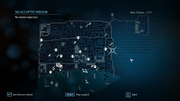 In-game map of New Orleans
 -
 Flag of New Orleans
 -
 Aveline overlooking New Orleans
 -
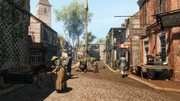 View of a rich district
 -
 Mardi Gras decorations
 -
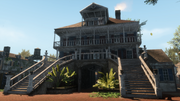 De Grandpré mansion
 -
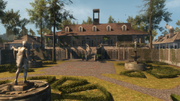 Plantation's mansion
 -
 The mansion's backyard
 -
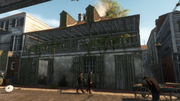 Madame John's Legacy
 -
 The slave trader's holding area
 -
 Congo Square
 -
 Rioters fighting Spanish soldiers during the Louisiana Rebellion


Appearances[edit | edit source]
- Assassin's Creed: Brotherhood (photo only)
- Assassin's Creed III: Liberation
- Assassin's Creed IV: Black Flag (mentioned only)
- Assassin's Creed: Rogue (mentioned only)
References[edit | edit source]


| ||||||||||||||||||||||||||||||||||