

François-Joseph Paul de Grasse: Difference between revisions
imported>Azfar Atiq |
m Text replacement - "<gallery captionalign="center" position="center" spacing="small" widths="180">" to "<gallery captionalign="center" position="center" widths="180">" |
||
| (27 intermediate revisions by 18 users not shown) | |||
| Line 1: | Line 1: | ||
{{Era| | {{Era|Individuals}}{{WP-REAL|François Joseph Paul de Grasse}} | ||
{{WP-REAL|François Joseph Paul de Grasse | {{Quote|A promise is a promise - even when made to a lunatique.|De Grasse to Connor, 1781.|Assassin's Creed III|Battle of the Chesapeake (memory)}} | ||
{{Quote|A promise is a promise - even when made to a lunatique.|De Grasse to Connor, 1781.|Assassin's Creed III}} | |||
{{Character Infobox | {{Character Infobox | ||
|image = | | image =DB_Admiral_De_Grasse.png | ||
|birth = 13 September 1722<br>{{Wiki|Le Bar-sur-Loup}}, [[ | | birth = 13 September 1722<br>{{Wiki|Le Bar-sur-Loup}}, [[Kingdom of France]] | ||
|death = 11 January 1788 | | death = 11 January 1788 {{c|aged 65}}<br>{{Wiki|Tilly, Yvelines|Tilly}}, Kingdom of France | ||
| | | species = [[Human]] | ||
| | | database = [[Database: Admiral De Grasse|Admiral De Grasse]] | ||
'''François-Joseph Paul, Marquis de Grasse Tilly, Comte de Grasse''' (1722 – 1788) was | | affiliates = [[French Navy]] | ||
}} | |||
'''François-Joseph Paul, Marquis de Grasse Tilly, Comte de Grasse''' (1722 – 1788) was an admiral in the [[French Navy]] who was best known for his command of the [[France|French]] fleet at the [[Battle of the Chesapeake]], which directly led to the [[United Kingdom|British]] [[Siege of Yorktown|surrender]] at [[Yorktown]]. | |||
==Biography== | ==Biography== | ||
===Early life and career=== | ===Early life and career=== | ||
Born as the youngest child of a French nobleman, de Grasse joined the military at the age of eleven when he became a page in the religious military {{Wiki|Sovereign Military Order of Malta|Order of Malta}}. Having fully joined the French Navy in 1740, he had become a captain by 1775, helping the French secure [[Haiti|Saint-Domingue]]. | Born as the youngest child of a French nobleman, de Grasse joined the military at the age of eleven when he became a page in the religious military {{Wiki|Sovereign Military Order of Malta|Order of Malta}}. Having fully joined the French Navy in 1740, he had become a captain by 1775, helping the French secure [[Haiti|Saint-Domingue]].<ref name="Database">''[[Assassin's Creed III]]'' – [[Database: Admiral De Grasse]]</ref> | ||
===Battle of the Chesapeake=== | ===Battle of the Chesapeake=== | ||
{{Dialogue2|De Grasse|Lafayette promised me a fleet beyond compare, and a captain without peer! Instead I find myself greeted by one old ship and a boy in costume!|Connor|I promise we are all you need, Admiral.|I doubt this very much. But beggars do not choose, hmm?|De Grasse meeting Connor at Chesapeake Bay, 1781.|Assassin's Creed III}} | {{Dialogue2|De Grasse|Lafayette promised me a fleet beyond compare, and a captain without peer! Instead I find myself greeted by one old ship and a boy in costume!|Connor|I promise we are all you need, Admiral.|I doubt this very much. But beggars do not choose, hmm?|De Grasse meeting Connor at Chesapeake Bay, 1781.|Assassin's Creed III|Battle of the Chesapeake (memory)}} | ||
In 1781, de Grasse was promoted to Admiral, and despite failing health was ordered to sail to [[North America|America]] to aid [[George Washington]] and the American revolutionaries. Washington gave de Grasse a choice between attacking the British stronghold of [[New York City]] or [[Virginia]], where a large amount of British troops were stationed. De Grasse chose Virginia, reasoning that the waters were easier to navigate in, and that he didn't have the required equipment for a siege of New York. | In 1781, de Grasse was promoted to Admiral, and despite his failing health was ordered to sail to [[North America|America]] to aid [[George Washington]] and the American [[Patriots|revolutionaries]]. Washington gave de Grasse a choice between attacking the British stronghold of [[New York City]] or [[Virginia (state)|Virginia]], where a large amount of [[British Army|British troops]] were stationed. De Grasse chose Virginia, reasoning that the waters were easier to navigate in, and that he didn't have the required equipment for a siege of New York.<ref name="Database" /> | ||
Being stationed in the [[Caribbean|West Indies]], de Grasse attempted to head for Virginia in secrecy, causing the [[Royal Navy]] to send ships to [[Chesapeake Bay]] in an attempt to cut him off. While the British took the fast route, de Grasse and his fleet took a slower route, avoiding larger shipping lanes and staying out of sight. When the British fleet arrived at Chesapeake Bay, they found it empty, and sailed for New York to rendezvous with the rest of the Navy. This left the Bay empty when de Grasse arrived in August 1781. Less than a week later, the British fleet returned, heavily outnumbered by de Grasse's fleet occupying the Bay. | Being stationed in the [[Caribbean|West Indies]], de Grasse attempted to head for Virginia in secrecy, causing the [[Royal Navy]] to send [[ships]] to [[Chesapeake Bay]] in an attempt to cut him off. While the British took the fast route, de Grasse and his fleet took a slower route, avoiding larger shipping lanes and staying out of sight. When the British fleet arrived at Chesapeake Bay, they found it empty, and sailed for New York to rendezvous with the rest of the Navy. This left the Bay empty when de Grasse arrived in August 1781. Less than a week later, the British fleet returned, heavily outnumbered by de Grasse's fleet occupying the Bay.<ref name="Database" /> | ||
Around this time, the [[Assassins|Assassin]] [[Ratonhnhaké:ton|Connor]] | Around this time, the [[Assassins|Assassin]] [[Ratonhnhaké:ton|Connor]] sought de Grasse's help through the [[Gilbert du Motier, Marquis de Lafayette|Marquis de Lafayette]], in order to shell [[Fort George]] and create a distraction so that he could slip inside undetected and kill [[Charles Lee]]. Meeting with the Assassin shortly before the battle, de Grasse instructed him to hold Chesapeake and keep British ships away from Yorktown, while the admiral engaged the main fleet and led them south, away from Yorktown's harbor.<ref name="Chesapeake">''[[Assassin's Creed III]]'' – [[Battle of the Chesapeake (memory)|Battle of the Chesapeake]]</ref> | ||
[[File:ACIII-BattleofChesapeake 18.png|thumb|250px|De Grasse agreeing to help Connor]] | [[File:ACIII-BattleofChesapeake 18.png|thumb|250px|left|De Grasse agreeing to help Connor]] | ||
The fleets only fought for two hours, before night fell, and it was the only time they fired upon each other. With the British away from the harbor, French reinforcements arrived from [[Rhode Island]], and occupied the Bay again. After the battle, Connor met with the admiral again, and the latter agreed to the Assassin's plan, though he admitted it made no sense to him. | The fleets only fought for two hours, before night fell, and it was the only time they fired upon each other. With the British away from the harbor, French reinforcements arrived from [[Rhode Island]], and occupied the Bay again. After the battle, Connor met with the admiral again, and the latter agreed to the Assassin's plan, though he admitted it made no sense to him.<ref name="Chesapeake" /> | ||
Ten days later, de Grasse's fleet was anchored in New York's harbor, flying British flags scavenged from the wrecks in the Chesapeake. After Connor lit a signal fire, the fleet opened fire, breaching Fort George's walls and creating the diversion Connor desired. De Grasse's victory at Chesapeake was so important that Washington wrote to him the day after [[Charles Cornwallis]]' surrender at Yorktown, saying that the honor of the victory there belonged to the admiral. | Ten days later, de Grasse's fleet was anchored in New York's harbor, flying British flags scavenged from the wrecks in the Chesapeake. After Connor lit a signal fire, the fleet opened fire, breaching Fort George's walls and creating the diversion Connor desired.<ref name="Last Stand">''[[Assassin's Creed III]]'' – [[Lee's Last Stand]]</ref> De Grasse's victory at Chesapeake was so important that Washington wrote to him the day after [[Charles Cornwallis]]' surrender at Yorktown, saying that the honor of the victory there belonged to the admiral.<ref name="Database" /> | ||
===Later life=== | ===Later life=== | ||
De Grasse died in 1788, | De Grasse died in 1788, shortly before the beginning of the [[French Revolution]]. Despite his actions during the Revolutionary War, the French revolutionaries considered him nobility, and his estate was ransacked. His family fled to the [[United States]] afterwards, being welcomed as the children of a hero.<ref name="Database" /> | ||
== Trivia == | ==Trivia== | ||
In Tyranny of King Washington, Benjamin Franklin's | *In ''[[The Tyranny of King Washington]]'', the outfit which [[Benjamin Franklin]] wore was identical to de Grasse's. | ||
==Gallery== | ==Gallery== | ||
<gallery captionalign="center" position="center | <gallery captionalign="center" position="center" widths="180"> | ||
ACIII-BattleofChesapeake 4.png|Connor telling de Grasse of his plan | ACIII-BattleofChesapeake 4.png|Connor telling de Grasse of his plan | ||
</gallery> | </gallery> | ||
== | ==Appearances== | ||
*''[[Assassin's Creed III]]'' | *''[[Assassin's Creed III]]'' | ||
==References== | |||
{{Reflist}} | |||
{{AC3}} | |||
{{DEFAULTSORT:Grasse, François-Joseph Paul de}} | {{DEFAULTSORT:Grasse, François-Joseph Paul de}} | ||
[[Category:1722 births]] | [[Category:1722 births]] | ||
[[Category:1788 deaths]] | [[Category:1788 deaths]] | ||
[[Category:Individuals]] | [[Category:Individuals]] | ||
[[Category: | [[Category:French people]] | ||
[[Category:Servants]] | [[Category:Servants]] | ||
[[Category:Admirals]] | [[Category:Admirals]] | ||
[[Category:Marquesses]] | [[Category:Marquesses]] | ||
[[Category:Counts]] | [[Category:Counts]] | ||
[[Category:French Navy personnel]] | [[Category:French Navy personnel]] | ||
<!--[zh:弗朗索瓦-约瑟夫·保罗·德格拉斯]--> | |||
Latest revision as of 01:41, 25 May 2026
François-Joseph Paul, Marquis de Grasse Tilly, Comte de Grasse (1722 – 1788) was an admiral in the French Navy who was best known for his command of the French fleet at the Battle of the Chesapeake, which directly led to the British surrender at Yorktown.
Biography[edit | edit source]
Early life and career[edit | edit source]
Born as the youngest child of a French nobleman, de Grasse joined the military at the age of eleven when he became a page in the religious military Order of Malta. Having fully joined the French Navy in 1740, he had become a captain by 1775, helping the French secure Saint-Domingue.[1]
Battle of the Chesapeake[edit | edit source]
- De Grasse: "Lafayette promised me a fleet beyond compare, and a captain without peer! Instead I find myself greeted by one old ship and a boy in costume!"
- Connor: "I promise we are all you need, Admiral."
- De Grasse: "I doubt this very much. But beggars do not choose, hmm?"
- —De Grasse meeting Connor at Chesapeake Bay, 1781.[src]-[m]
In 1781, de Grasse was promoted to Admiral, and despite his failing health was ordered to sail to America to aid George Washington and the American revolutionaries. Washington gave de Grasse a choice between attacking the British stronghold of New York City or Virginia, where a large amount of British troops were stationed. De Grasse chose Virginia, reasoning that the waters were easier to navigate in, and that he didn't have the required equipment for a siege of New York.[1]
Being stationed in the West Indies, de Grasse attempted to head for Virginia in secrecy, causing the Royal Navy to send ships to Chesapeake Bay in an attempt to cut him off. While the British took the fast route, de Grasse and his fleet took a slower route, avoiding larger shipping lanes and staying out of sight. When the British fleet arrived at Chesapeake Bay, they found it empty, and sailed for New York to rendezvous with the rest of the Navy. This left the Bay empty when de Grasse arrived in August 1781. Less than a week later, the British fleet returned, heavily outnumbered by de Grasse's fleet occupying the Bay.[1]
Around this time, the Assassin Connor sought de Grasse's help through the Marquis de Lafayette, in order to shell Fort George and create a distraction so that he could slip inside undetected and kill Charles Lee. Meeting with the Assassin shortly before the battle, de Grasse instructed him to hold Chesapeake and keep British ships away from Yorktown, while the admiral engaged the main fleet and led them south, away from Yorktown's harbor.[2]

The fleets only fought for two hours, before night fell, and it was the only time they fired upon each other. With the British away from the harbor, French reinforcements arrived from Rhode Island, and occupied the Bay again. After the battle, Connor met with the admiral again, and the latter agreed to the Assassin's plan, though he admitted it made no sense to him.[2]
Ten days later, de Grasse's fleet was anchored in New York's harbor, flying British flags scavenged from the wrecks in the Chesapeake. After Connor lit a signal fire, the fleet opened fire, breaching Fort George's walls and creating the diversion Connor desired.[3] De Grasse's victory at Chesapeake was so important that Washington wrote to him the day after Charles Cornwallis' surrender at Yorktown, saying that the honor of the victory there belonged to the admiral.[1]
Later life[edit | edit source]
De Grasse died in 1788, shortly before the beginning of the French Revolution. Despite his actions during the Revolutionary War, the French revolutionaries considered him nobility, and his estate was ransacked. His family fled to the United States afterwards, being welcomed as the children of a hero.[1]
Trivia[edit | edit source]
- In The Tyranny of King Washington, the outfit which Benjamin Franklin wore was identical to de Grasse's.
Gallery[edit | edit source]
-
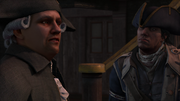 Connor telling de Grasse of his plan

Appearances[edit | edit source]
References[edit | edit source]