

Azuchi Castle

|
Ezio, my friend! How may I be of service? This article has a lot of room for expansion. Please improve it with additional information in accordance with the Manual of Style |
Azuchi Castle (安土城) was a Japanese castle in Ōmi whose ruins are located in what is now Ōmihachiman's Azuchi neighborhood. During the Sengoku period, the castle was one of the principal strongholds of the daimyō Oda Nobunaga and his family household until Nobunaga's murder in 1582.[1] Hashiba Hideyoshi and Nobunaga's son Nobutada had residences in the castle.[2]
History[edit | edit source]
Situated on a hill on the eastern shore of Lake Biwa, Azuchi Castle was constructed by Nobunaga between 1576 and 1579. The castle was designed to be most imposing castle of his time and served as Nobunaga's primary residence from 1579 until his death in 1582. It was also the first of its kind in which the castle's design was a combination of plain and mountain castles, including a thirty-two meter main donjon. Around it was the residences of Nobunaga's retainers and vassals, who were arranged alonged the slopes in order of importance, with the highest-ranking individuals living closest to the castle. The lower parts of the castle were inhabited by the merchants and craftsmen, who developed a small town of a thousand people and decreeing the area as "free markets".[3]
In 1582, the samurai Yasuke returned to Azuchi a few days after Nobunaga's death to meet with Hideyoshi's wife, Lady Nene. He arrived at her residence to find that she and her husband had become the targets of an assassination plot by Akechi Mitsuhide, the general who had betrayed Nobunaga. After protecting Nene, the lady informed Yasuke that her husband had left for Himeji Castle to gather his allies, and also told the samurai about her contact Aoi, who was in Ōtsu and might help his hunt of the Shinbakufu, the group responsible for Nobunaga's death.[4]
At some point after 1582, the castle was burned to the ground. The reason was largely unknown and by the end of the 20th century, only its ruins remains. Surveys, archaeological expeditions and restorations were subsequently conducted after 1989 as an attempt to recreate what the castle look liked at its prime.[2]
Gallery[edit | edit source]
-
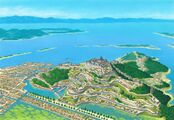 Concept drawing of the castle
 -
 Concept art
 -
 Concept art


