

Amagasaki Castle

Amagasaki Castle (尼崎城) is a castle in Amagasaki, Japan, formerly located in the Izumi Settsu region.
History[edit | edit source]
Between the years of 1512 and 1517, the castle was built by Hosokawa Takakuni, who sought to create a point between the land routes of Kyoto and Osaka. In 1575, Araki Murashige sought to fight against his former lord Oda Nobunaga and retreated into the castle for six months. Nobunaga persuaded Murashige's vassals to try and convince him to surrender, but after he refused, Nobunaga executed all the vassals as a lesson.[1]
In early 1582, the Iga kunoichi Fujibayashi Naoe, along with remnants of the Ikkō-ikki, including Kyonyo, Yaya, and Mitsumune, led an assault on the castle to find and assassinate Wada Koretake, a samurai serving under Nobunaga and secret member of the Shinbakufu. While Kyonyo led his forces to fight against Koretake's men, Naoe went to confront Koretake in the courtyard. Besting him, Naoe stood over a dying Koretake and interrogated him about the box the Shinbakufu had stolen from Iga, but Koretake only sneered and mocked Naoe in response, leading her to finish him off with her Hidden Blade.[2]
Convening with her allies afterwards, Naoe saw Mitsumune about to execute one of Koretake's men who was surrendering. Although Yaya sought to stop him, Naoe agreed with the monk that those who fought for Nobunaga deserved no mercy. Outraged, Yaya left them to their cruelty while Naoe spoke with Kyonyo. Before leaving, Kyonyo gifted Naoe a statue of Shinran and encouraged her not to lose hope.[2]
Later that year, Naoe and her new ally Yasuke infiltrated the castle, assassinated its five samurai daisho, looted the Tools Master Mask from the castle's treasure chest,[3] collected a sake flask for Niwa Nagahide's collection,[4] and climbed atop the tenshu to survey the land.[3] By 1617, Toda Ujikane redesigned the castle with a four-flank keep, multiple moats, and numerous turrets.[1]
Gallery[edit | edit source]
-
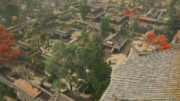 The inner castle as seen from its tenshu
