


Gaius Julius Caesar

|
Ezio, my friend! How may I be of service? This article is in desperate need of a revamp. Please improve it in any way necessary in order for it to achieve a higher standard of quality in accordance with our Manual of Style. |
Gaius Julius Caesar (13 July 100 BCE – 15 March 44 BCE) was a prominent general of the Roman army and a notable politician. He played a key role in transforming the flagging Roman Republic into the seemingly unstoppable Roman Empire.
Biography
Julius Caesar accrued numerous military victories in his role as the general of the Roman army stationed in Cisalpine Gaul, Transalpine Gaul, and Illyricum, three provinces that Caesar administered as governor. He was successful in conquering the Gallic tribes throughout modern-day France, Germany, and Belgium. Caesar was the great nemesis of the Gallic chieftain Vercingetorix, who he defeated in one of his most famous conquests, the Battle of Alesia.
In 48 B.C, Egyptian Pharoah, Cleopatra met Caesar and formed a liason with him.[1] Cleopatra's influence over Caesar flustered the senators, particularly, Marcus Junius Brutus, a covert-Assassin.[1] Later, as Rome was in the midst of a civil war, Caesar declared himself dictator and appointed himself Consul of the Roman Senate. The senators feared Caesar's increasing political and military control of Rome, and Caesar was evidently supported by the Templars, though it is unknown whether or not he was aware of their existence.[2] Caesar's new power, his connections to the Templars and his trust in the advice of foreign leaders, Cleopatra in particular, pushed a number of senators to decide to eliminate Caesar for the benefit of the Roman people.
Brutus led the conspiracy against Caesar alongside Gaius Cassius Longinus,[3] a fellow Assassin.[4] Brutus and Cassius planned to assassinate Caesar in the Senate on the "Ides of March". Their attempt was successful, and the conspirators stabbed Caesar twenty-three times. However, his death seemed to bring only more chaos than before. Civil war continued for another thirteen years, and in the end Caesar's adopted heir Octavian – later known as Augustus – became the first emperor of the Roman Empire.
Trivia
- There is a trophy for the PlayStation 3 in Assassin's Creed: Brotherhood named after Julius Caesar. It is earned by gaining all other trophies, fifty in total. Also the Dagger of Brutus, which was used by Marcus Junius Brutus to kill Caesar, can be obtained.[3]
- The popular Caesar cipher code format is widely attributed to have been designed by Caesar, thus its name. The code has often been used in the Assassin's Creed series, most commonly in secret messages left behind by Clay Kaczmarek.
Gallery
-
Caesar's death at the Assassins' hands
-
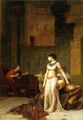 Caesar and Cleopatra in the royal palace

