Assassin insignia
The Assassin Insignia of the Assassin Order, though varying slightly over different time periods and countries, holds essentially the same shape and style. Each of its variations also possibly denote the various sects of the Order.
History
During the Third Crusade, the insignia was used to mark the entrances of Assassins' Bureaus, and could be seen on the banners decorating the fortress of Masyaf.[1]
During the Italian Renaissance, it was used on the mechanisms in the many Assassin's Tombs, and on the banners and walls of Monteriggioni.[2] It was also displayed on the banners hung in the Tiber Island Headquarters.[3]
Additionally, the insignia was worn openly on the armor and clothing of certain known Assassins, such as Mario Auditore,[2] Ezio Auditore da Firenze[2] and Nikolai Orelov.[4] Certain modern-day Assassins also wore the insignia in the form of a tattoo, such as Desmond Miles[3] and Daniel Cross.[4]
Trivia
- In the Sanctuary, all of the statues have different variants of the Assassin insignia on their waists.
- In Brotherhood, Desmond searches for Assassin insignias painted onto the walls to guide him to the Colosseum Vault.
- The insignia bears some resemblance to the symbol of the Freemasons (the Square and Compasses).
- Both the original insignia and the Russian variation are vertically asymmetrical, unlike the Italian variation. However, the symmetry of the Italian logo may be because of the Renaissance ideals of the time, in which mathematical proportions and symmetry were standard.
- The original Assassin insignia can be seen on the back of the Seusenhofer Armor, and the Armor of Brutus.
- The Assassins insignia can also been seen on Ezio's new robes in Assassin's Creed: Revelations, on the buckle on his chest, and on the crest of his hood.
Renditions
-
Middle Ages insignia.
-
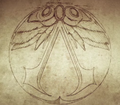 Italian Renaissance insignia.
 -
 Russian Revolution insignia.
 -
Roman Assassin's Guild insignia


