

Sheep: Difference between revisions
imported>Darman36 White Horse novel now out for a while |
imported>Darman36 |
||
| Line 29: | Line 29: | ||
*''[[Assassin's Creed II]]'' {{1st}} | *''[[Assassin's Creed II]]'' {{1st}} | ||
*''[[Assassin's Creed IV: Black Flag]]'' {{Mo}} | *''[[Assassin's Creed IV: Black Flag]]'' {{Mo}} | ||
*''[[Assassin's Creed: Black Flag]]'' | |||
*''[[Assassin's Creed: Origins]]'' | *''[[Assassin's Creed: Origins]]'' | ||
*''[[Assassin's Creed: Odyssey]]'' | *''[[Assassin's Creed: Odyssey]]'' | ||
Revision as of 18:41, 14 October 2022

Sheep is a term used of the various species of four-legged mammals of the genus Ovis. As a main source of wool, domesticated sheep have been part of human history from early on.
Mythology

In Greek mythology, the Golden Fleece was the coat of a ram, hung from a tree whence the hero Jason and his Argonauts retrieved it.[1]
History
5th century BCE
Sheep were a common sight in Greece before and during the Peloponnesian War. This was especially true in the capital city of Arkadia, Tegea, wherein sheep wandered on the streets as they willed, along with other animals. Their hooves were valued at 6 drachmae apiece.[2]
1st century BCE
Sheep were also prominent in Ptolemaic Egypt of 1st century BCE.[3]
9th century
During the 9th century, the English landscape featured many meadows used for livestock, including sheep. Bred for their meat and wool, sheep were often found near rural villages or at lonely farms.[4]
Cultural significance
Terms related to sheep have been used in metaphorical manner. 'Lamb' is used as a term of endearment, for example by the Spartan Myrrine about her daughter, the misthios Kassandra.[5] 'Sheep' itself is used to denote a timid or cowardly person,[6] particularly if they followed rules without question.[7]
Gallery
-
 A sheep and a pig resting on a busy street in Tegea
 -
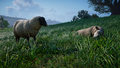 Sheep in 9th century England


Appearances
- Assassin's Creed II (first appearance)
- Assassin's Creed IV: Black Flag (mentioned only)
- Assassin's Creed: Black Flag
- Assassin's Creed: Origins
- Assassin's Creed: Odyssey
- Assassin's Creed: Valhalla
- Discovery Tour: Viking Age (mentioned only)
- Assassin's Creed: Valhalla – Sword of the White Horse
References
- ↑ Assassin's Creed II – Glyph #7: "Keep On Seeking, And You Will Find"
- ↑ Assassin's Creed: Odyssey
- ↑ Assassin's Creed: Origins
- ↑ Assassin's Creed: Valhalla
- ↑ Assassin's Creed: Odyssey – A Mother's Prayers
- ↑ Assassin's Creed: Odyssey – The Writing's on the Wall
- ↑ Assassin's Creed IV: Black Flag – Black Bart's Gambit