


Shahkulu: Difference between revisions
imported>AssassinRome No edit summary |
imported>User2121 |
||
| Line 20: | Line 20: | ||
Persia was consolidated by Ismail I of the Safavid dynasty in the early 16th century. Ismail, being a champion of Shiite faith and partially a Turkmen, was also sympathetic to the Turkmens of Ottoman Empire. He sent agents to Ottoman lands (who usually used the unofficial title of khalif) to attract supporters. His activities did not escape the attention of the Ottomans, but the Ottoman Empire was too preoccupied with the oncoming period of interregnum during the last years of the crippled sultan Bayezid II. Thus Ismail was able to gain many supporters among Ottoman subjects. One such supporter was Karabıyıkoğlu, who adopted the title Shahkulu, meaning "servant of the shah". Ottoman sources however usually entitle him as Sheitankulu, meaning "servant of the Devil". He was living in the territory called Tekeli, named after the former beylik of Teke in a village near Antalya, southwestern Turkey. He was both a Shiite religious leader and a rebel leader. | Persia was consolidated by Ismail I of the Safavid dynasty in the early 16th century. Ismail, being a champion of Shiite faith and partially a Turkmen, was also sympathetic to the Turkmens of Ottoman Empire. He sent agents to Ottoman lands (who usually used the unofficial title of khalif) to attract supporters. His activities did not escape the attention of the Ottomans, but the Ottoman Empire was too preoccupied with the oncoming period of interregnum during the last years of the crippled sultan Bayezid II. Thus Ismail was able to gain many supporters among Ottoman subjects. One such supporter was Karabıyıkoğlu, who adopted the title Shahkulu, meaning "servant of the shah". Ottoman sources however usually entitle him as Sheitankulu, meaning "servant of the Devil". He was living in the territory called Tekeli, named after the former beylik of Teke in a village near Antalya, southwestern Turkey. He was both a Shiite religious leader and a rebel leader. | ||
Shahkulu defeated the forces of Ahmet Pasha and executed him. This increased the fame and the prestige of Shahkulu. To his partisans, after raiding a royal caravan and killing a high-ranking Ottoman statesman, he was invincible. A second army was sent after him. The commanders of the army were [[Şehzade Ahmet]], one of the claimants to throne, and the grand vizier Hadım Ali Pasha. They were able to corner Shahkulu near Altıntaş, but instead of fighting, Ahmet tried to win over the [[Janissaries]] for his cause. Failing to achieve, he left the battlefield. Shahkulu saw his chance and escaped. Ali Pasha with a smaller force chased him, and clashed with him at Chubukova between Kayseri and Sivas. The battle was a draw, | Shahkulu defeated the forces of Ahmet Pasha and executed him. This increased the fame and the prestige of Shahkulu. To his partisans, after raiding a royal caravan and killing a high-ranking Ottoman statesman, he was invincible. A second army was sent after him. The commanders of the army were [[Şehzade Ahmet]], one of the claimants to throne, and the grand vizier Hadım Ali Pasha. They were able to corner Shahkulu near Altıntaş, but instead of fighting, Ahmet tried to win over the [[Janissaries]] for his cause. Failing to achieve, he left the battlefield. Shahkulu saw his chance and escaped. Ali Pasha with a smaller force chased him, and clashed with him at Chubukova between Kayseri and Sivas. The battle was a draw, and Ali Pasha was killed(July 1511). | ||
Shahkulu retreated to Constantinople, and tortured many civilians that were brought to him. At one point, he consulted [[Manuel Palaiologos]] in [[Cappadocia]] . However, his actions recieved the attention of [[Ezio Auditore da Firenze]] , who crept into one of his sessions and assassinated him. | |||
==Gallery== | ==Gallery== | ||
Revision as of 21:39, 5 November 2011
Template:WPtargets

|
He who increaseth knowledge, increaseth sorrow. This article contains spoilers, meaning it has information and facts concerning recent or upcoming releases from the Assassin's Creed series. If you do not want to know about these events, it is recommended to read on with caution, or not at all. |

|
Ezio, my friend! How may I be of service? This article is in desperate need of a revamp. Please improve it in any way necessary in order for it to achieve a higher standard of quality in accordance with our Manual of Style. |
Shahkulu (died 1511) was a leader of the Shahkulu rebellion - widespread pro-Shia and pro-Safavid uprising in Anatolia, directed against the Ottoman Empire in 1511.
History
Persia was consolidated by Ismail I of the Safavid dynasty in the early 16th century. Ismail, being a champion of Shiite faith and partially a Turkmen, was also sympathetic to the Turkmens of Ottoman Empire. He sent agents to Ottoman lands (who usually used the unofficial title of khalif) to attract supporters. His activities did not escape the attention of the Ottomans, but the Ottoman Empire was too preoccupied with the oncoming period of interregnum during the last years of the crippled sultan Bayezid II. Thus Ismail was able to gain many supporters among Ottoman subjects. One such supporter was Karabıyıkoğlu, who adopted the title Shahkulu, meaning "servant of the shah". Ottoman sources however usually entitle him as Sheitankulu, meaning "servant of the Devil". He was living in the territory called Tekeli, named after the former beylik of Teke in a village near Antalya, southwestern Turkey. He was both a Shiite religious leader and a rebel leader.
Shahkulu defeated the forces of Ahmet Pasha and executed him. This increased the fame and the prestige of Shahkulu. To his partisans, after raiding a royal caravan and killing a high-ranking Ottoman statesman, he was invincible. A second army was sent after him. The commanders of the army were Şehzade Ahmet, one of the claimants to throne, and the grand vizier Hadım Ali Pasha. They were able to corner Shahkulu near Altıntaş, but instead of fighting, Ahmet tried to win over the Janissaries for his cause. Failing to achieve, he left the battlefield. Shahkulu saw his chance and escaped. Ali Pasha with a smaller force chased him, and clashed with him at Chubukova between Kayseri and Sivas. The battle was a draw, and Ali Pasha was killed(July 1511).
Shahkulu retreated to Constantinople, and tortured many civilians that were brought to him. At one point, he consulted Manuel Palaiologos in Cappadocia . However, his actions recieved the attention of Ezio Auditore da Firenze , who crept into one of his sessions and assassinated him.
Gallery
-
Shahkulu beating up a person.
-
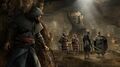 Shahkulu and Manuel talking in Cappadocia.
 -
A playing card.


Source
| |||||||||||||||||||||||||||||||||||||