


Rome: Difference between revisions
imported>Kaloneous |
imported>Slate Vesper Revamp. |
||
| Line 1: | Line 1: | ||
{{Era|AC2| | {{Era|AC2|ACB|PL|Renaissance|Bbook|Rbook|FC|ACL|ASD}} | ||
{{WP-REAL}} | {{WP-REAL}} | ||
{{WPlocations}} | {{WPlocations}} | ||
{{Location Infobox | {{Location Infobox | ||
|image = Rome.jpg | |||
|image | |state = Papal States, [[Italy]] | ||
|rulers = [[Papacy]] | |||
|state | |factions = [[Templars]]<br>[[Assassins]]<br>[[Thieves]]<br>[[Courtesans]]<br>[[Mercenaries]]<br>[[House of Borgia]]<br>[[Followers of Romulus]] | ||
|rulers | |founded = Romulus and Remus | ||
|factions | |date = 753 BCE | ||
|landmark = [[Colosseum]]<br>[[Capella Sistina]]<br>[[Castel Sant'Angelo]] | |||
|founded | |flags = 101 [[House of Borgia|Borgia]] [[Flags|flags]] | ||
|date | |targets = [[Gaius Julius Caesar]]<br>[[Rodrigo Borgia]]<br>[[Juan Borgia the Elder|Juan Borgia]]<br>[[Octavian de Valois]]<br>[[Micheletto Corella]]<br>[[Il Carnefice]]<br>[[Malfatto]]<br>[[Silvestro Sabbatini]]<br>[[Lia de Russo]]<br>[[Lanz]]<br>[[Donato Mancini]]<br>[[Brother Ristoro]]<br>[[Gaspar de la Croix]]<br>[[Auguste Oberlin]]}} | ||
{{Quote|Roma is the pillar that holds our entire enterprise aloft. She cannot waver; which means neither can you.|Cesare Borgia to his allies.|Assassin's Creed: Brotherhood}} | |||
'''Rome''', or '''Roma''' to its residents, is the capital city of [[Italy]]. | |||
|landmark | |||
|flags | |||
|targets | |||
{{ | |||
During the [[Renaissance]], Rome was the capital of the {{Wiki|Papal States}} and headquarters of the Italian sect of the [[Templars|Templar Order]]. Also, as part of [[Liberation of Rome|Rome's liberation]], the city became the base for the [[Italian Assassins|Italian branch]] of the [[Assassins|Assassin Order]]. | |||
==History== | ==History== | ||
=== | ===Beginning of an empire=== | ||
According to legend, two brothers were given a choice, the money or the kingdom; one chose the kingdom while the other chose the money. Both | According to legend, two brothers were given a choice, consisting of the money or the kingdom; one chose the kingdom while the other chose the money. Both brothers went on to have fine daughters, but the one with the money used it to hire [[mercenaries]], who stole the kingdom from his brother, the King, and imprisoned his niece in the process. Whilst she was jailed, however, she gave birth to twin boys, being Romulus and Remus. | ||
The new king ordered that | The new king ordered that the children and her be killed, though his daughter pleaded that her cousin be spared, to which he ordered that only the twins be executed, while his niece was not to be harmed. As the servants feared the river because of high tide, instead of drowning the twins, they simply placed them near the shallow section of the river, thinking they would die when the tide came instead. | ||
Despite this, the twins floated down the river until they were found and cared for by a wolf and a bird. Soon enough, a shepherd saw the twins and, remembering a rumor about the twins living, he took care of them and raised them as his own until the old king caught wind of their survival. Together they reclaimed the city, and when their grandfather asked them to guard over the city and become its rulers, they refused the offer, as they believed it was their grandfather's kingdom, and not theirs. From there, they decided to build their own city, which would later be called Rome, named by Romulus after he killed his brother for control and power. | |||
Archaeological evidence supports that Rome did in fact grow from pastoral settlements on [[Colle Palatino]], the future site of the Roman Forum, upon which there are several caves. Eventually, the Republic of Rome was founded in c. 510 | Archaeological evidence supports that Rome did in fact grow from pastoral settlements on [[Colle Palatino]], the future site of the Roman Forum, upon which there are several caves. Eventually, the Republic of Rome was founded in c. 510 BCE, and the successful and wealthy Republic gave birth to the imperial Roman Empires c. 27 BCE, which were sprawling territories ruled by succeeding emperors. | ||
In 476, the Western Roman Empire fell, and the Roman Catholic Church managed to take power in 756. After that, Rome became an economic and cultural powerhouse in Europe, even though [[Florence]] surpassed Rome as the centre of the Italian Renaissance. Due to the rivalry between the two cities, the papacy spent vast amounts of money to create cultural masterworks. | In 476, the Western Roman Empire fell, and the Roman Catholic Church managed to take power in 756. After that, Rome became an economic and cultural powerhouse in Europe, even though [[Florence]] surpassed Rome as the centre of the Italian Renaissance. Due to the rivalry between the two cities, the papacy spent vast amounts of money to create cultural masterworks. | ||
===Roman era=== | ===Roman era=== | ||
On 15 March 45 | On 15 March 45 BCE, [[Gaius Julius Caesar]] was killed by the Assassins, led by [[Marcus Junius Brutus]].<ref name="Assassin's Creed: Project Legacy">''[[Assassin's Creed: Project Legacy]]''</ref> | ||
In the year 41, the | In the year 41, the Assassin [[Leonius]] assassinated the Templar [[Caligula]] in Rome, whom he stabbed with a [[Short blades|dagger]].<ref name="AC2">''[[Assassin's Creed II]]''</ref> | ||
===Renaissance era=== | ===Renaissance era=== | ||
In 1476, [[Rodrigo Borgia]], [[Grand Master]] of the | In 1476, [[Rodrigo Borgia]], [[Grand Master]] of the Templar Order and a powerful figure in Vatican politics briefly left the city to discuss his Order's plans, before returning to affirm [[Papacy|Papal]] approval. Assent was given by Pope Sixtus IV, and the Templars were provided with military support for their endeavors.<ref name="Lineage">''[[Assassin's Creed: Lineage]]''</ref> | ||
In 1492, Rodrigo became Pope Alexander VI, and head of the Papal States and Catholic Church. Ruling from Rome, he was left alone by the Assassins for the most part, until 1499, when [[Ezio Auditore da Firenze]] learned that [[ | In 1492, Rodrigo became Pope Alexander VI, and head of the Papal States and Catholic Church. Ruling from Rome, he was left alone by the Assassins for the most part, until 1499, when [[Ezio Auditore da Firenze]] learned that the [[Vatican Vault]] was located in Rome, beneath the [[Capella Sistina|Sistine Chapel]].<ref name="AC2"/> | ||
In 1500, following the [[Fall of Monteriggioni|siege]] by [[Cesare Borgia]] on the Assassin headquarters of [[Monteriggioni]], Ezio | In 1500, following the [[Fall of Monteriggioni|siege]] by [[Cesare Borgia]] on the Assassin headquarters of [[Monteriggioni]], Ezio returned to Rome to exact his revenge. At the time, the city had fallen far behind those of Florence and [[Venice]], and had grown stagnant in terms of development, due to the influence of the [[House of Borgia|Borgia]].<ref name="Brotherhood">''[[Assassin's Creed: Brotherhood]]''</ref> | ||
The Borgia maintained oppression over the city with [[Borgia Towers]] located throughout Rome, which prevented [[Merchants|shops]] from opening. In order to free Rome of the Borgia influence, Ezio killed the [[Borgia Captains|overlords]] of the towers and burned the structures themselves to the ground, taking them over for the Assassin Order afterwards.<ref name=" | The Borgia maintained oppression over the city with [[Borgia Towers|towers]] located throughout Rome, which prevented [[Merchants|shops]] from opening. In order to free Rome of the Borgia influence, Ezio killed the [[Borgia Captains|overlords]] of the towers and burned the structures themselves to the ground, taking them over for the Assassin Order afterwards.<ref name="Brotherhood"/> | ||
Additionally, due to the loss of Monteriggioni, Ezio established the [[Assassins Guild]] in Rome, and set up its [[Tiber Island headquarters|headquarters]] on [[Tiber Island]]. By recruiting several Roman [[civilians]] as [[ | Additionally, due to the loss of Monteriggioni, Ezio established the [[Assassins Guilds|Assassins Guild]] in Rome, and set up its [[Tiber Island headquarters|headquarters]] on [[Tiber Island]]. By recruiting several Roman [[civilians]] as Assassin [[apprentices]], the Brotherhood worked to free Rome of Templar control.<ref name="Brotherhood"/> | ||
{{wide image|Rome_1_by_murcuseo-d338rco.jpg|1800px|Panorama of Rome during the late 15 | {{wide image|Rome_1_by_murcuseo-d338rco.jpg|1800px|Panorama of Rome during the late 15 th century.|alt = Panorama of Rome}} | ||
|alt=Panorama of Rome}} | |||
===Modern | ===Modern times=== | ||
[[Desmond Miles | On October 10 2012, [[Desmond Miles]], [[Lucy Stillman]], [[Rebecca Crane]] and [[Shaun Hastings]] travelled to Rome to retrieve the [[Ezio's Apple of Eden|Apple of Eden]], after Desmond had relived Ezio's memories in Rome and found that Ezio had locked the [[Pieces of Eden|Piece of Eden]] in the [[Colosseum Vault]], as well as leaving the [[72|password]] to unlock the Vault on the wall of the [[Sanctuary]], where they were stationed. | ||
As well as this, [[Abstergo Industries]] used Rome as a simulated location, for the [[Assassin's Creed: Brotherhood|first]] and [[Assassin's Creed: Revelations|second stage]] of training for the [[Abstergo recruits|recruits]] in their [[Animi Training Program]]. | |||
Landmarks in Rome included the [[Pantheon]], the [[Colosseo]], the [[Passetto di Borgo]], the [[Castel Sant'Angelo]] and | ==Layout== | ||
The city was divided into four districts: [[Centro District|Centro]], [[Antico District|Antico]], [[Campagna district|Campagna]], and the [[Vaticano District]]. With the exception of the Vaticano district, these were also subdivided into 12 territories, each one controlled by a Borgia tower.<ref name="Brotherhood"/> | |||
Landmarks in Rome included the [[Pantheon]], the [[Colosseo]], the [[Passetto di Borgo]], the [[Castel Sant'Angelo]] and the Capella Sistina.<ref name="AC2"/><ref name="Brotherhood"/> | |||
==Trivia== | ==Trivia== | ||
*The city of Rome | *The city of Rome was the single largest map ever seen in the [[Assassin's Creed (series)|''Assassin's Creed'' series]], being three times larger than Florence, the first city featured in ''[[Assassin's Creed II]]''.<ref>[http://www.computerandvideogames.com/article.php?id=260729 13 killer Assassin's Creed: Brotherhood facts]</ref> | ||
*In-game, the city | *In-game, the city was tilted roughly 15 degrees to the right from real life. | ||
*While Rome and Florence's architecture were historically similar during the game's time period, the developers of ''[[Assassin's Creed: Brotherhood]]'' designed Rome with its later Baroque style to be more familiar to their audience.<ref>[http://www.livescience.com/culture/assassins-creed-virtual-rome-renaissance-scholar-101112.html A Renaissance Scholar Helps Build Virtual Rome, ''Live Science'' article]</ref> | *While Rome and Florence's architecture were historically similar during the game's time period, the developers of ''[[Assassin's Creed: Brotherhood]]'' designed Rome with its later Baroque style to be more familiar to their audience.<ref>[http://www.livescience.com/culture/assassins-creed-virtual-rome-renaissance-scholar-101112.html A Renaissance Scholar Helps Build Virtual Rome, ''Live Science'' article]</ref> | ||
*The area where Ezio climbed up to the Castello from the river in ''Assassin's Creed II'' | *The area where Ezio climbed up to the Castello from the river in ''Assassin's Creed II'' was unreachable in ''Assassin's Creed: Brotherhood'', with fencing and blockades along the Castello and Vaticano district. | ||
*The buildings seen north of the Passetto di Borgo in ''Assassin's Creed II'' | *The buildings seen north of the Passetto di Borgo in ''Assassin's Creed II'' did not appear in ''Assassin's Creed: Brotherhood''. | ||
==Gallery== | ==Gallery== | ||
| Line 78: | Line 74: | ||
Rome's Renaissance District concept art.jpg|Renaissance District concept art. | Rome's Renaissance District concept art.jpg|Renaissance District concept art. | ||
The Countryside of Rome concept art.jpg|The Countryside of Rome concept art. | The Countryside of Rome concept art.jpg|The Countryside of Rome concept art. | ||
Climbing rome.jpg|A wide view of the | Climbing rome.jpg|A wide view of the Centro district, seen from the [[Mercato di Traiano]]. | ||
Rome Bird's eye view.jpg|Bird-eye view of Rome. | Rome Bird's eye view.jpg|Bird's-eye view of Rome. | ||
Castel Sant Angelo..jpg|The centre of Borgia control, the Castel Sant'Angelo. | Castel Sant Angelo..jpg|The centre of Borgia control, the Castel Sant'Angelo. | ||
Paoraaahadwf.jpg|Rome at sunset. | Paoraaahadwf.jpg|Rome at sunset. | ||
| Line 88: | Line 84: | ||
==References== | ==References== | ||
{{ | {{Reflist}} | ||
{{ | {{AC2}} | ||
{{ | {{ACBH}} | ||
[[es:Roma]] | [[es:Roma]] | ||
[[Category:Italy]] | [[Category:Italy]] | ||
[[Category:Cities of Europe]] | [[Category:Cities of Europe]] | ||
[[Category: | [[Category:Rome]] | ||
[[Category:Assassin's Creed II Locations]] | [[Category:Assassin's Creed II Locations]] | ||
[[Category:Assassin's Creed: Brotherhood Locations]] | [[Category:Assassin's Creed: Brotherhood Locations]] | ||
| Line 102: | Line 96: | ||
[[Category:Assassin's Creed: Revelations Multiplayer Locations]] | [[Category:Assassin's Creed: Revelations Multiplayer Locations]] | ||
[[Category:Assassin's Creed: Project Legacy Locations]] | [[Category:Assassin's Creed: Project Legacy Locations]] | ||
[[Category:Assassin's Creed: Lineage Locations]] | |||
[[Category:Assassin's Creed: Ascendance Locations]] | [[Category:Assassin's Creed: Ascendance Locations]] | ||
[[Category:Assassin's Creed | [[Category:Assassin's Creed: Renaissance Locations]] | ||
[[Category:Assassin's Creed: Brotherhood (Novel) Locations]] | [[Category:Assassin's Creed: Brotherhood (Novel) Locations]] | ||
[[Category:Assassin's Creed: Revelations (Novel) Locations]] | [[Category:Assassin's Creed: Revelations (Novel) Locations]] | ||
[[Category:Assassin's Creed | [[Category:Assassin's Creed (French Comic) Locations]] | ||
Revision as of 14:30, 13 September 2012
- "Roma is the pillar that holds our entire enterprise aloft. She cannot waver; which means neither can you."
- ―Cesare Borgia to his allies.[src]
Rome, or Roma to its residents, is the capital city of Italy.
During the Renaissance, Rome was the capital of the Papal States and headquarters of the Italian sect of the Templar Order. Also, as part of Rome's liberation, the city became the base for the Italian branch of the Assassin Order.
History
Beginning of an empire
According to legend, two brothers were given a choice, consisting of the money or the kingdom; one chose the kingdom while the other chose the money. Both brothers went on to have fine daughters, but the one with the money used it to hire mercenaries, who stole the kingdom from his brother, the King, and imprisoned his niece in the process. Whilst she was jailed, however, she gave birth to twin boys, being Romulus and Remus.
The new king ordered that the children and her be killed, though his daughter pleaded that her cousin be spared, to which he ordered that only the twins be executed, while his niece was not to be harmed. As the servants feared the river because of high tide, instead of drowning the twins, they simply placed them near the shallow section of the river, thinking they would die when the tide came instead.
Despite this, the twins floated down the river until they were found and cared for by a wolf and a bird. Soon enough, a shepherd saw the twins and, remembering a rumor about the twins living, he took care of them and raised them as his own until the old king caught wind of their survival. Together they reclaimed the city, and when their grandfather asked them to guard over the city and become its rulers, they refused the offer, as they believed it was their grandfather's kingdom, and not theirs. From there, they decided to build their own city, which would later be called Rome, named by Romulus after he killed his brother for control and power.
Archaeological evidence supports that Rome did in fact grow from pastoral settlements on Colle Palatino, the future site of the Roman Forum, upon which there are several caves. Eventually, the Republic of Rome was founded in c. 510 BCE, and the successful and wealthy Republic gave birth to the imperial Roman Empires c. 27 BCE, which were sprawling territories ruled by succeeding emperors.
In 476, the Western Roman Empire fell, and the Roman Catholic Church managed to take power in 756. After that, Rome became an economic and cultural powerhouse in Europe, even though Florence surpassed Rome as the centre of the Italian Renaissance. Due to the rivalry between the two cities, the papacy spent vast amounts of money to create cultural masterworks.
Roman era
On 15 March 45 BCE, Gaius Julius Caesar was killed by the Assassins, led by Marcus Junius Brutus.[1]
In the year 41, the Assassin Leonius assassinated the Templar Caligula in Rome, whom he stabbed with a dagger.[2]
Renaissance era
In 1476, Rodrigo Borgia, Grand Master of the Templar Order and a powerful figure in Vatican politics briefly left the city to discuss his Order's plans, before returning to affirm Papal approval. Assent was given by Pope Sixtus IV, and the Templars were provided with military support for their endeavors.[3]
In 1492, Rodrigo became Pope Alexander VI, and head of the Papal States and Catholic Church. Ruling from Rome, he was left alone by the Assassins for the most part, until 1499, when Ezio Auditore da Firenze learned that the Vatican Vault was located in Rome, beneath the Sistine Chapel.[2]
In 1500, following the siege by Cesare Borgia on the Assassin headquarters of Monteriggioni, Ezio returned to Rome to exact his revenge. At the time, the city had fallen far behind those of Florence and Venice, and had grown stagnant in terms of development, due to the influence of the Borgia.[4]
The Borgia maintained oppression over the city with towers located throughout Rome, which prevented shops from opening. In order to free Rome of the Borgia influence, Ezio killed the overlords of the towers and burned the structures themselves to the ground, taking them over for the Assassin Order afterwards.[4]
Additionally, due to the loss of Monteriggioni, Ezio established the Assassins Guild in Rome, and set up its headquarters on Tiber Island. By recruiting several Roman civilians as Assassin apprentices, the Brotherhood worked to free Rome of Templar control.[4]

Modern times
On October 10 2012, Desmond Miles, Lucy Stillman, Rebecca Crane and Shaun Hastings travelled to Rome to retrieve the Apple of Eden, after Desmond had relived Ezio's memories in Rome and found that Ezio had locked the Piece of Eden in the Colosseum Vault, as well as leaving the password to unlock the Vault on the wall of the Sanctuary, where they were stationed.
As well as this, Abstergo Industries used Rome as a simulated location, for the first and second stage of training for the recruits in their Animi Training Program.
Layout
The city was divided into four districts: Centro, Antico, Campagna, and the Vaticano District. With the exception of the Vaticano district, these were also subdivided into 12 territories, each one controlled by a Borgia tower.[4]
Landmarks in Rome included the Pantheon, the Colosseo, the Passetto di Borgo, the Castel Sant'Angelo and the Capella Sistina.[2][4]
Trivia
- The city of Rome was the single largest map ever seen in the Assassin's Creed series, being three times larger than Florence, the first city featured in Assassin's Creed II.[5]
- In-game, the city was tilted roughly 15 degrees to the right from real life.
- While Rome and Florence's architecture were historically similar during the game's time period, the developers of Assassin's Creed: Brotherhood designed Rome with its later Baroque style to be more familiar to their audience.[6]
- The area where Ezio climbed up to the Castello from the river in Assassin's Creed II was unreachable in Assassin's Creed: Brotherhood, with fencing and blockades along the Castello and Vaticano district.
- The buildings seen north of the Passetto di Borgo in Assassin's Creed II did not appear in Assassin's Creed: Brotherhood.
Gallery
-
The map of Rome used for Abstergo Industries' Animus Training Program.
-
Concept art of the Castel Sant'Angelo.
-
Concept art of Rome.
-
Ezio riding through the city towards the Pantheon.
-
 Antique District concept art.
 -
 Medieval District concept art.
 -
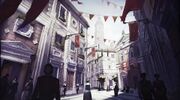 Renaissance District concept art.
 -
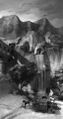 The Countryside of Rome concept art.
 -
A wide view of the Centro district, seen from the Mercato di Traiano.
-
 Bird's-eye view of Rome.
 -
The centre of Borgia control, the Castel Sant'Angelo.
-
Rome at sunset.
-
 Panoramic view of Rome at night.
 -
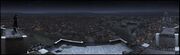 Roman rooftops at night.
 -
 Panoramic view of Rome at dusk.


References
| |||||||||||||||||||||||||||||||||||||
- Italy
- Cities of Europe
- Rome
- Assassin's Creed II Locations
- Assassin's Creed: Brotherhood Locations
- Assassin's Creed: Brotherhood Multiplayer Locations
- Assassin's Creed: Revelations Multiplayer Locations
- Assassin's Creed: Project Legacy Locations
- Assassin's Creed: Lineage Locations
- Assassin's Creed: Ascendance Locations
- Assassin's Creed: Renaissance Locations
- Assassin's Creed: Brotherhood (Novel) Locations
- Assassin's Creed: Revelations (Novel) Locations
- Assassin's Creed (French Comic) Locations