


Israel Putnam: Difference between revisions
imported>Darman36 |
imported>Gener4l Cl4ank4 mNo edit summary |
||
| Line 4: | Line 4: | ||
| image = ACIII-I Putnam Render.png | | image = ACIII-I Putnam Render.png | ||
| birth = 7 January 1718<br>[[Salem|Salem Village]], [[Massachusetts|Massachusetts Bay]], [[United States|British America]] | | birth = 7 January 1718<br>[[Salem|Salem Village]], [[Massachusetts|Massachusetts Bay]], [[United States|British America]] | ||
| death = 29 May 1790 | | death = 29 May 1790 {{c|aged 72}}<br>{{Wiki|Brooklyn, Connecticut|Brooklyn}}, [[Connecticut]], United States | ||
| species = [[Human]] | | species = [[Human]] | ||
| affiliates = [[Sons of Liberty]]<br>[[Continental Army]] | | affiliates = [[Sons of Liberty]]<br>[[Continental Army]] | ||
| Line 17: | Line 17: | ||
==Biography== | ==Biography== | ||
===Early life=== | ===Early life=== | ||
The {{Wiki|Putnam family}} originated from the town of [[Salem]], [[Massachusetts]],<ref name="Database">''[[Assassin's Creed III]]'' – [[Database: Israel Putnam]]</ref> which | The {{Wiki|Putnam family}} originated from the town of [[Salem]], [[Massachusetts]],<ref name="Database">''[[Assassin's Creed III]]'' – [[Database: Israel Putnam]]</ref> which became famous for the [[Salem witch trials|witch trials]] in which 20 innocent people were accused of witchcraft and executed. The Putnams were responsible for the conviction of [[Rebecca Nurse]], whose family had a rivalry with them.<ref>''[[Assassin's Creed (Titan Comics)|Assassin's Creed]]'' – [[Assassin's Creed 4 (issue)|Issue #4]]</ref> | ||
At a young age, Israel Putnam moved to [[Connecticut]] to take up farming. Following this, he joined the colonial militia during the [[French and Indian War]], and earned a reputation for bravery and inspiring the soldiers around him. Putnam is also credited to have killed the last [[ | At a young age, Israel Putnam moved to [[Connecticut]] to take up farming. Following this, he joined the colonial militia during the [[French and Indian War]], and earned a reputation for bravery and inspiring the soldiers around him. Putnam is also credited to have killed the last [[wolf]] in Connecticut in 1742. It is said he crawled into its den with a [[musket]], a torch, and a rope tied around his feet so that he could be pulled out.<ref name="Database" /> | ||
In 1758, Putnam was captured by a group of [[Kanien'kehá:ka]] in the village of {{Wiki|Mohawk, Montgomery County, New York|Caughnawaga}}, but he was rescued just before his execution. Several years later, in 1762, he was [[shipwreck]]ed in [[Cuba]] during the {{Wiki|Siege of Havana|Battle of Havana}}. During his time in Cuba, Putnam discovered cigars and introduced them to the colonies.<ref name="Database" /> | In 1758, Putnam was captured by a group of [[Kanien'kehá:ka]] in the village of {{Wiki|Mohawk, Montgomery County, New York|Caughnawaga}}, but he was rescued just before his execution. Several years later, in 1762, he was [[shipwreck]]ed in [[Cuba]] during the {{Wiki|Siege of Havana|Battle of Havana}}. During his time in Cuba, Putnam discovered cigars and introduced them to the colonies.<ref name="Database" /> | ||
After the war ended, Putnam returned to Connecticut, where he was a vocal opponent of the British tax policies. He also founded the Connecticut branch of the [[Sons of Liberty]]. When he heard about the battles of [[Lexington]] and [[Concord]], Putnam immediately signed up for the Continental Army and was named Brigadier General of the Connecticut forces.<ref name="Database" /> | After the war ended, Putnam returned to Connecticut, where he was a vocal opponent of the British tax policies. He also founded the Connecticut branch of the [[Sons of Liberty]]. When he heard about the [[Battles of Lexington and Concord|battles]] of [[Lexington]] and [[Concord]], Putnam immediately signed up for the Continental Army and was named Brigadier General of the Connecticut forces.<ref name="Database" /> | ||
===Battle of Bunker Hill=== | ===Battle of Bunker Hill=== | ||
{{Quote|The enemy advances and you tremble. They've better numbers, you say. Better weapons. Better training. But I do not fear, and neither should you. For what they have in material, they lack in conviction and care. But not us. We have discipline. We have order. And most importantly, we have passion. We believe!|Israel Putnam's speech before the battle.|Assassin's Creed III}}During the Battle of Bunker Hill in 1775, Putnam was approached by the Assassin Ratonhnhaké:ton, better known as Connor, who was looking for the [[British Army]] major and [[Templars|Templar]] John Pitcairn.<ref name=" | {{Quote|The enemy advances and you tremble. They've better numbers, you say. Better weapons. Better training. But I do not fear, and neither should you. For what they have in material, they lack in conviction and care. But not us. We have discipline. We have order. And most importantly, we have passion. We believe!|Israel Putnam's speech before the battle.|Assassin's Creed III|Battle of Bunker Hill (memory)}} | ||
During the Battle of Bunker Hill in 1775, Putnam was approached by the Assassin [[Ratonhnhaké:ton]], better known as Connor, who was looking for the [[British Army]] major and [[Templars|Templar]] [[John Pitcairn]].<ref name="Conflict Looms">''Assassin's Creed III'' – [[Conflict Looms]]</ref> | |||
In order to flush Pitcairn out, Putnam tasked the young Assassin with disabling two British frigates which were bombarding the hill from the harbor. Once the frigates were disabled, Putnam rallied his troops by delivering an inspiring speech, and Connor then set out to assassinate Pitcairn, after being called by Putnam "as mad as a march hare".<ref name=" | In order to flush Pitcairn out, Putnam tasked the young Assassin with disabling two British frigates which were bombarding the hill from the harbor.<ref name="Conflict Looms"/> Once the frigates were disabled, Putnam rallied his troops by delivering an inspiring speech, and Connor then set out to assassinate Pitcairn, after being called by Putnam "as mad as a march hare".<ref name="Battle of Bunker Hill">''Assassin's Creed III'' – [[Battle of Bunker Hill (memory)|Battle of Bunker Hill]]</ref> | ||
[[File:ACIII-Publicexecution 11.png|thumb|left|250px|Putnam calling off the soldiers]] | [[File:ACIII-Publicexecution 11.png|thumb|left|250px|Putnam calling off the soldiers]] | ||
Traversing the battle and entering Pitcairn's camp, Connor succeeded in killing the major, but nevertheless Putnam was outnumbered and forced to retreat, granting the British a Pyrrhic victory.<ref name=" | Traversing the battle and entering Pitcairn's camp, Connor succeeded in killing the major, but nevertheless Putnam was outnumbered and forced to retreat, granting the British a Pyrrhic victory.<ref name="Battle of Bunker Hill"/> | ||
A year later, Connor was captured by the Templars and falsely accused of plotting to assassinate General [[George Washington]], a crime the Templars themselves were planning to commit.<ref name=" | A year later, Connor was captured by the Templars and falsely accused of plotting to assassinate General [[George Washington]], a crime the Templars themselves were planning to commit.<ref name="Something on the Side">''Assassin's Creed III'' – [[Something on the Side]]</ref> | ||
The Assassin later escaped execution and killed the true conspirator, [[Thomas Hickey]], before he could strike Washington. When surrounded by armed guards after killing Hickey, Putnam arrived to vouch for Connor's innocence, proclaiming him a hero to the Patriot cause.<ref name="Public Execution">''Assassin's Creed III'' – [[Public Execution]]</ref> | |||
===Later life=== | ===Later life=== | ||
{{Quote|Washington had high hopes for Putnam as a leader, and he was named Washington's second-in-command in New York. Unfortunately, Putnam was a good soldier but a poor tactician. The battle at Long Island was a rout. Putnam fared no better at his next post guarding forts on the Hudson River.|Israel Putnam's [[database]] entry.|Assassin's Creed III}}After helping prevent the assassination of Washington, Putnam's career began to decline. After being named Washington's second-in-command in [[New York]], Putnam was routed in the {{Wiki|Battle of Long Island}}. Later, he was nearly captured after losing the {{Wiki|Battle of Forts Clinton and Montgomery}}.<ref name=" | {{Quote|Washington had high hopes for Putnam as a leader, and he was named Washington's second-in-command in New York. Unfortunately, Putnam was a good soldier but a poor tactician. The battle at Long Island was a rout. Putnam fared no better at his next post guarding forts on the Hudson River.|Israel Putnam's [[database]] entry.|Assassin's Creed III|Database: Israel Putnam}} | ||
After helping prevent the assassination of Washington, Putnam's career began to decline. After being named Washington's second-in-command in [[New York]], Putnam was routed in the {{Wiki|Battle of Long Island}}. Later, he was nearly captured after losing the {{Wiki|Battle of Forts Clinton and Montgomery}}.<ref name="Database"/> | |||
After these two devastating losses, Putnam requested to be reassigned to recruitment, and Washington agreed. Then, in December of 1779, Putnam suffered a paralyzing stroke, which ended his military career. He died eleven years later, in 1790.<ref | After these two devastating losses, Putnam requested to be reassigned to recruitment, and Washington agreed.<ref name="Database"/> Then, in December of 1779, Putnam suffered a paralyzing stroke, which ended his military career. He died eleven years later, in 1790.<ref>{{WP|Israel Putnam}}</ref> | ||
==Alternate timeline== | ==Alternate timeline== | ||
In an altered reality | {{Quote|I've done such horrible deeds. ... it's the scepter, but ... that's no excuse. Every man holds evil deep within. The Apple just brought it out.|Israel Putnam's dying words in the alternate reality.|The Tyranny of King Washington: The Betrayal|Escape to New York}} | ||
In an altered reality where Washington ruled America as a tyrant king with an [[Apple of Eden 3|Apple of Eden]], Putnam served as his right-hand man with [[Benedict Arnold]]. Under the Apple's influence, Putnam became corrupted, brutal and cruel. While at Washington's [[New York Pyramid|palace]], [[Kaniehtí:io]] infiltrated the throne room and stole the King's scepter which contained the Apple. Putnam and his men chased after her and was able to fire a shot from his musket, knocking away the scepter from Kaniehtí:io as she made her escape.<ref name="Halls of Injustice">''Assassin's Creed III – [[The Tyranny of King Washington: The Redemption]]'' – [[Halls of Injustice]]</ref> | |||
[[File:ACIII-Warn 9.png|thumb|250px|Putnam along with King Washington]] | [[File:ACIII-Warn 9.png|thumb|250px|Putnam along with King Washington]] | ||
Putnam was present during the burning of [[Kanatahséton]], riding at Washington's side. Washington expressed doubts about his resolve and powers, but he was assured by both his generals when they reaffirmed their loyalty. Putnam gave the order to destroy the village and kill all of the villagers.<ref name=" | Putnam was present during the burning of [[Kanatahséton]], riding at Washington's side. Washington expressed doubts about his resolve and powers, but he was assured by both his generals when they reaffirmed their loyalty. Putnam gave the order to destroy the village and kill all of the villagers.<ref name="Warn the Village">''Assassin's Creed III – [[The Tyranny of King Washington: The Infamy]]'' – [[Warn the Village]]</ref> | ||
For the next five months, Putnam ruled over [[Frontier]] in Washington's name alongside Arnold, and was the commanding officer of the encampment at [[Valley Forge]]. Putnam went to visit Arnold at Fort Duquesne, but unbeknownst to him was being followed by Ratonhnhaké:ton, who soon after infiltrated and assassinated Arnold. Catching him off guard, Putnam approached Ratonhnhaké:ton from behind and knocked him unconscious with his pistol.<ref name="Infamy | For the next five months, Putnam ruled over [[Frontier]] in Washington's name alongside Arnold, and was the commanding officer of the encampment at [[Valley Forge]]. Putnam went to visit Arnold at Fort Duquesne, but unbeknownst to him was being followed by Ratonhnhaké:ton, who soon after infiltrated and assassinated Arnold. Catching him off guard, Putnam approached Ratonhnhaké:ton from behind and knocked him unconscious with his pistol.<ref name="Justice Served">''Assassin's Creed III – The Tyranny of King Washington: The Infamy'' – [[Justice Served]]</ref> | ||
Putnam traveled to [[Boston]] | Putnam traveled to [[Boston]] and presented the captive Ratonhnhaké:ton to King Washington as a gift, to which Washington decided to sentence Ratonhnhaké:ton to death by beheading along with a group of random civilians. Washington soon began to question [[Benjamin Franklin]]'s loyalty and conviction, hence he allowed Putnam full control over Boston and ordered him to deal with the rebellion.<ref name="Prison Break">''Assassin's Creed III – [[The Tyranny of King Washington: The Betrayal]]'' – [[Prison Break]]</ref> After Franklin's defection, Putnam successfully lured the rebels to [[Boston Neck]]. The rebel troops were shot down and Putnam personally killed [[Samuel Adams]], beating him to death with his pistol, while also chopping off the fingers of [[Kanen'tó:kon]] left hand with his own [[Stone Tomahawk|stone tomahawk]].<ref name="Betrayal">''Assassin's Creed III – The Tyranny of King Washington: The Betrayal'' – [[Pieces in Motion]]</ref> | ||
[[File:Escape to New York 6.png|thumb|left|250px|Putnam holding Kanen'tó:kon hostage]] | [[File:Escape to New York 6.png|thumb|left|250px|Putnam holding Kanen'tó:kon hostage]] | ||
Ratonhnhaké:ton and Franklin later attempted to flee Boston with a crew on board the ''[[Aquila]]''. Putnam arrived at the port, holding Kanen'tó:kon hostage and ordered Ratonhnhaké:ton to surrender. Using his [[Eagle Flight|animal powers]], Ratonhnhaké:ton attacked and wounded Putnam. While dying, Putnam came to his senses, realizing that he had been corrupted by the Apple's power and with his last words expressed regret for the atrocities he had committed.<ref name="Betrayal | Ratonhnhaké:ton and Franklin later attempted to flee Boston with a crew on board the ''[[Aquila]]''. Putnam arrived at the port, holding Kanen'tó:kon hostage and ordered Ratonhnhaké:ton to surrender. Using his [[Eagle Flight|animal powers]], Ratonhnhaké:ton attacked and wounded Putnam. While dying, Putnam came to his senses, realizing that he had been corrupted by the Apple's power and with his last words expressed regret for the atrocities he had committed.<ref name="Escape to New York">''Assassin's Creed III – The Tyranny of King Washington: The Betrayal'' – [[Escape to New York]]</ref> | ||
==Personality and traits== | ==Personality and traits== | ||
{{Quote|How dare you sneak up on me like that! Why don't you just go off there and just help this camp retreat! Don't ever do that again you hear me! God Damnit.|Israel Putnam.|Assassin's Creed III}}[[File:Battle of Bunker Hill 2.png|right|Connor listening to Putnam at Bunker Hill|thumb|250px]] | {{Quote|How dare you sneak up on me like that! Why don't you just go off there and just help this camp retreat! Don't ever do that again you hear me! God Damnit.|Israel Putnam to Connor.|Assassin's Creed III|Battle of Bunker Hill (memory)}} | ||
As a military officer, Putnam was strict and straightforward with his troops, admitting to them that the British had better weapons and training at the Battle of Bunker Hill. Before the battle however, he roused his soldiers with an inspiring speech, but later admitted to Connor that it was all a lie. | [[File:Battle of Bunker Hill 2.png|right|Connor listening to Putnam at Bunker Hill|thumb|250px]] | ||
As a military officer, Putnam was strict and straightforward with his troops, admitting to them that the British had better weapons and training at the Battle of Bunker Hill. Before the battle however, he roused his soldiers with an inspiring speech, but later admitted to Connor that it was all a lie.<ref name="AC3">''Assassin's Creed III''</ref> | |||
In addition, Putnam was loud and unrestrained. He would constantly shout at soldiers over insignificant issues, treated other officers as soldiers and was pessimistic regarding the war, believing to have lost the Battle of Bunker Hill before it truly began.<ref name="AC3"/> | In addition, Putnam was loud and unrestrained. He would constantly shout at soldiers over insignificant issues, treated other officers as soldiers and was pessimistic regarding the war, believing to have lost the Battle of Bunker Hill before it truly began.<ref name="AC3"/> | ||
| Line 63: | Line 67: | ||
==Trivia== | ==Trivia== | ||
*A bronze statue was erected in {{Wiki|Redding, Connecticut}} to commemorate Putnam's famous escape from the British in 1777. | *A bronze statue was erected in {{Wiki|Redding, Connecticut}} to commemorate Putnam's famous escape from the British in 1777. | ||
*In ''[[Assassin's Creed: Rogue]]'', a group of British soldiers | *In ''[[Assassin's Creed: Rogue]]'', a group of British soldiers could be heard narrating Putnam's survival due to the intervention of the French Officer, to which some expressed doubt or disbelief that the incident occurred. | ||
*Coincidentally, | *Coincidentally, Putnam died at the age of [[72]], alongside [[Rodrigo Borgia]] and [[Maria Auditore da Firenze]]. 72 is a recurring and important number in the [[Assassin's Creed (series)|''Assassin's Creed'' series]]. | ||
==Gallery== | ==Gallery== | ||
<gallery captionalign="center" position="center | <gallery captionalign="center" position="center" widths="180"> | ||
ACMPutnamCigar.jpg|''[[Assassin's Creed: Memories]]'' art of Putnam | ACMPutnamCigar.jpg|''[[Assassin's Creed: Memories]]'' art of Putnam | ||
ACMPutnamAkimbo.jpg|''Memories'' art of Putnam | ACMPutnamAkimbo.jpg|''Memories'' art of Putnam | ||
Revision as of 23:57, 10 September 2025
- "What would you know about victory? I killed a she-wolf in her den, armed with only a knife. I escaped the Caughnawaga Indians who sought to burn me alive. And, I was the sole survivor of a shipwreck at the Battle of Havana. So you'll excuse me if I choose not to follow your advice."
- ―Israel Putnam speaking to a Continental Army officer at the Battle of Bunker Hill.[src]-[m]
Israel Putnam (1718 – 1790) was an American general in the Continental Army, who fought with distinction at the Battle of Bunker Hill during the American Revolutionary War.
Around the time of the battle, Putnam came into contact with the Assassin Connor, who assisted him by assassinating Putnam's British counterpart, John Pitcairn, who led the Regulars at Bunker Hill.
A year later, Putnam was present during an attempted assassination of George Washington, which was also foiled by the Assassins, where he declared Connor a hero.
Biography
Early life
The Putnam family originated from the town of Salem, Massachusetts,[1] which became famous for the witch trials in which 20 innocent people were accused of witchcraft and executed. The Putnams were responsible for the conviction of Rebecca Nurse, whose family had a rivalry with them.[2]
At a young age, Israel Putnam moved to Connecticut to take up farming. Following this, he joined the colonial militia during the French and Indian War, and earned a reputation for bravery and inspiring the soldiers around him. Putnam is also credited to have killed the last wolf in Connecticut in 1742. It is said he crawled into its den with a musket, a torch, and a rope tied around his feet so that he could be pulled out.[1]
In 1758, Putnam was captured by a group of Kanien'kehá:ka in the village of Caughnawaga, but he was rescued just before his execution. Several years later, in 1762, he was shipwrecked in Cuba during the Battle of Havana. During his time in Cuba, Putnam discovered cigars and introduced them to the colonies.[1]
After the war ended, Putnam returned to Connecticut, where he was a vocal opponent of the British tax policies. He also founded the Connecticut branch of the Sons of Liberty. When he heard about the battles of Lexington and Concord, Putnam immediately signed up for the Continental Army and was named Brigadier General of the Connecticut forces.[1]
Battle of Bunker Hill
- "The enemy advances and you tremble. They've better numbers, you say. Better weapons. Better training. But I do not fear, and neither should you. For what they have in material, they lack in conviction and care. But not us. We have discipline. We have order. And most importantly, we have passion. We believe!"
- ―Israel Putnam's speech before the battle.[src]-[m]
During the Battle of Bunker Hill in 1775, Putnam was approached by the Assassin Ratonhnhaké:ton, better known as Connor, who was looking for the British Army major and Templar John Pitcairn.[3]
In order to flush Pitcairn out, Putnam tasked the young Assassin with disabling two British frigates which were bombarding the hill from the harbor.[3] Once the frigates were disabled, Putnam rallied his troops by delivering an inspiring speech, and Connor then set out to assassinate Pitcairn, after being called by Putnam "as mad as a march hare".[4]

Traversing the battle and entering Pitcairn's camp, Connor succeeded in killing the major, but nevertheless Putnam was outnumbered and forced to retreat, granting the British a Pyrrhic victory.[4]
A year later, Connor was captured by the Templars and falsely accused of plotting to assassinate General George Washington, a crime the Templars themselves were planning to commit.[5]
The Assassin later escaped execution and killed the true conspirator, Thomas Hickey, before he could strike Washington. When surrounded by armed guards after killing Hickey, Putnam arrived to vouch for Connor's innocence, proclaiming him a hero to the Patriot cause.[6]
Later life
- "Washington had high hopes for Putnam as a leader, and he was named Washington's second-in-command in New York. Unfortunately, Putnam was a good soldier but a poor tactician. The battle at Long Island was a rout. Putnam fared no better at his next post guarding forts on the Hudson River."
- ―Israel Putnam's database entry.[src]-[m]
After helping prevent the assassination of Washington, Putnam's career began to decline. After being named Washington's second-in-command in New York, Putnam was routed in the Battle of Long Island. Later, he was nearly captured after losing the Battle of Forts Clinton and Montgomery.[1]
After these two devastating losses, Putnam requested to be reassigned to recruitment, and Washington agreed.[1] Then, in December of 1779, Putnam suffered a paralyzing stroke, which ended his military career. He died eleven years later, in 1790.[7]
Alternate timeline
In an altered reality where Washington ruled America as a tyrant king with an Apple of Eden, Putnam served as his right-hand man with Benedict Arnold. Under the Apple's influence, Putnam became corrupted, brutal and cruel. While at Washington's palace, Kaniehtí:io infiltrated the throne room and stole the King's scepter which contained the Apple. Putnam and his men chased after her and was able to fire a shot from his musket, knocking away the scepter from Kaniehtí:io as she made her escape.[8]

Putnam was present during the burning of Kanatahséton, riding at Washington's side. Washington expressed doubts about his resolve and powers, but he was assured by both his generals when they reaffirmed their loyalty. Putnam gave the order to destroy the village and kill all of the villagers.[9]
For the next five months, Putnam ruled over Frontier in Washington's name alongside Arnold, and was the commanding officer of the encampment at Valley Forge. Putnam went to visit Arnold at Fort Duquesne, but unbeknownst to him was being followed by Ratonhnhaké:ton, who soon after infiltrated and assassinated Arnold. Catching him off guard, Putnam approached Ratonhnhaké:ton from behind and knocked him unconscious with his pistol.[10]
Putnam traveled to Boston and presented the captive Ratonhnhaké:ton to King Washington as a gift, to which Washington decided to sentence Ratonhnhaké:ton to death by beheading along with a group of random civilians. Washington soon began to question Benjamin Franklin's loyalty and conviction, hence he allowed Putnam full control over Boston and ordered him to deal with the rebellion.[11] After Franklin's defection, Putnam successfully lured the rebels to Boston Neck. The rebel troops were shot down and Putnam personally killed Samuel Adams, beating him to death with his pistol, while also chopping off the fingers of Kanen'tó:kon left hand with his own stone tomahawk.[12]

Ratonhnhaké:ton and Franklin later attempted to flee Boston with a crew on board the Aquila. Putnam arrived at the port, holding Kanen'tó:kon hostage and ordered Ratonhnhaké:ton to surrender. Using his animal powers, Ratonhnhaké:ton attacked and wounded Putnam. While dying, Putnam came to his senses, realizing that he had been corrupted by the Apple's power and with his last words expressed regret for the atrocities he had committed.[13]
Personality and traits

As a military officer, Putnam was strict and straightforward with his troops, admitting to them that the British had better weapons and training at the Battle of Bunker Hill. Before the battle however, he roused his soldiers with an inspiring speech, but later admitted to Connor that it was all a lie.[14]
In addition, Putnam was loud and unrestrained. He would constantly shout at soldiers over insignificant issues, treated other officers as soldiers and was pessimistic regarding the war, believing to have lost the Battle of Bunker Hill before it truly began.[14]
Trivia
- A bronze statue was erected in Redding, Connecticut to commemorate Putnam's famous escape from the British in 1777.
- In Assassin's Creed: Rogue, a group of British soldiers could be heard narrating Putnam's survival due to the intervention of the French Officer, to which some expressed doubt or disbelief that the incident occurred.
- Coincidentally, Putnam died at the age of 72, alongside Rodrigo Borgia and Maria Auditore da Firenze. 72 is a recurring and important number in the Assassin's Creed series.
Gallery
-
 Assassin's Creed: Memories art of Putnam
 -
 Memories art of Putnam
 -
 Putnam meeting Connor
 -
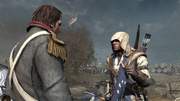 Putnam and Connor at Bunker Hill
 -
 Putnam smoking a cigar
 -
 Putnam with Connor in New York


Appearances
- Assassin's Creed III (first appearance)
- Assassin's Creed: Rogue (mentioned only)
- Assassin's Creed: Memories
References
- ↑ 1.0 1.1 1.2 1.3 1.4 1.5 Assassin's Creed III – Database: Israel Putnam
- ↑ Assassin's Creed – Issue #4
- ↑ 3.0 3.1 Assassin's Creed III – Conflict Looms
- ↑ 4.0 4.1 Assassin's Creed III – Battle of Bunker Hill
- ↑ Assassin's Creed III – Something on the Side
- ↑ Assassin's Creed III – Public Execution
- ↑
 Israel Putnam on Wikipedia
- ↑ Assassin's Creed III – The Tyranny of King Washington: The Redemption – Halls of Injustice
- ↑ Assassin's Creed III – The Tyranny of King Washington: The Infamy – Warn the Village
- ↑ Assassin's Creed III – The Tyranny of King Washington: The Infamy – Justice Served
- ↑ Assassin's Creed III – The Tyranny of King Washington: The Betrayal – Prison Break
- ↑ Assassin's Creed III – The Tyranny of King Washington: The Betrayal – Pieces in Motion
- ↑ Assassin's Creed III – The Tyranny of King Washington: The Betrayal – Escape to New York
- ↑ 14.0 14.1 Assassin's Creed III
| |||||||||||||||||||||||||