

Greek fire: Difference between revisions
imported>Slate Vesper m Duplicate link. |
imported>VatsaAWB m Re-categorisation; cosmetic changes |
||
| Line 6: | Line 6: | ||
Greek Fire was both used by ships, and during the [[Den Defense|struggle for control]] of [[Assassin Dens]] in [[Constantinople]]. | Greek Fire was both used by ships, and during the [[Den Defense|struggle for control]] of [[Assassin Dens]] in [[Constantinople]]. | ||
==History== | == History == | ||
Greek Fire was first used by [[Byzantines|Byzantine Emperor]] {{Wiki|Leo III the Isaurian|Leon III}}'s army, when enemy vessels laid siege to Constantinople in the year 717. In the battle, the napalm-like substance burned through the enemy fleet, forcing them to lift their attack and travel west.<ref name="Wikipedia"/> | Greek Fire was first used by [[Byzantines|Byzantine Emperor]] {{Wiki|Leo III the Isaurian|Leon III}}'s army, when enemy vessels laid siege to Constantinople in the year 717. In the battle, the napalm-like substance burned through the enemy fleet, forcing them to lift their attack and travel west.<ref name="Wikipedia"/> | ||
In 1511, the [[Assassins|Assassin]] [[Ezio Auditore da Firenze]] used Greek Fire in order to destroy several ships, which prevented him from leaving the city. The [[Turkish Assassins|Ottoman Assassins]] also mounted Greek Fire weapons along the barricades they used to defend their dens from [[Templars|Templar]] attacks.<ref name="Revelations">''[[Assassin's Creed: Revelations]]''</ref> | In 1511, the [[Assassins|Assassin]] [[Ezio Auditore da Firenze]] used Greek Fire in order to destroy several ships, which prevented him from leaving the city. The [[Turkish Assassins|Ottoman Assassins]] also mounted Greek Fire weapons along the barricades they used to defend their dens from [[Templars|Templar]] attacks.<ref name="Revelations">''[[Assassin's Creed: Revelations]]''</ref> | ||
==Trivia== | == Trivia == | ||
*Greek Fire was first seen in the [http://www.youtube.com/watch?v=kh0nRRFLJ5k E3 gameplay demo] of ''[[Assassin's Creed: Revelations]]'', and its concept appeared to be similar to the [[Naval Cannon]] featured in ''[[Assassin's Creed: Brotherhood]]''. | *Greek Fire was first seen in the [http://www.youtube.com/watch?v=kh0nRRFLJ5k E3 gameplay demo] of ''[[Assassin's Creed: Revelations]]'', and its concept appeared to be similar to the [[Naval Cannon]] featured in ''[[Assassin's Creed: Brotherhood]]''. | ||
==Gallery== | == Gallery == | ||
<gallery position="center" spacing="small" widths="180" captionalign="center"> | <gallery position="center" spacing="small" widths="180" captionalign="center"> | ||
Greek fire gun Concept.PNG|Concept art of the Greek Fire cannon. | Greek fire gun Concept.PNG|Concept art of the Greek Fire cannon. | ||
| Line 22: | Line 22: | ||
</gallery> | </gallery> | ||
==References== | == References == | ||
{{Reflist}} | {{Reflist}} | ||
{{ACR}} | {{ACR}} | ||
[[Category:Weapons]] | [[Category:Weapons]] | ||
[[Category:Assassin's Creed: Revelations Weapons]] | [[Category:Assassin's Creed: Revelations Weapons]] | ||
[[Category:Assassin's Creed: Revelations | [[Category:Assassin's Creed: Revelations gameplay]] | ||
Revision as of 17:16, 3 October 2012

Greek Fire was an incendiary weapon that was a closely guarded military secret. Its composition remains unknown to this day, despite multiple theories.[1]
Greek Fire was both used by ships, and during the struggle for control of Assassin Dens in Constantinople.
History
Greek Fire was first used by Byzantine Emperor Leon III's army, when enemy vessels laid siege to Constantinople in the year 717. In the battle, the napalm-like substance burned through the enemy fleet, forcing them to lift their attack and travel west.[1]
In 1511, the Assassin Ezio Auditore da Firenze used Greek Fire in order to destroy several ships, which prevented him from leaving the city. The Ottoman Assassins also mounted Greek Fire weapons along the barricades they used to defend their dens from Templar attacks.[2]
Trivia
- Greek Fire was first seen in the E3 gameplay demo of Assassin's Creed: Revelations, and its concept appeared to be similar to the Naval Cannon featured in Assassin's Creed: Brotherhood.
Gallery
-
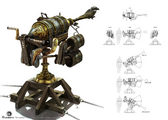 Concept art of the Greek Fire cannon.
 -
 Concept art of the Greek Fire mechanism.
 -
Ezio using Greek Fire in the Revelations mobile game.
-
 Greek fire used during a Den Defense.


.jpg)

References
| |||||||||||||||||||||||||||||||||||||