


Girolamo Savonarola: Difference between revisions
imported>Kaloneous Credit to Rapnoize for the awesome find! |
|||
| Line 73: | Line 73: | ||
* Savonarola was mentioned in Machiavelli's ''The Prince'', where his failure was used as a reference in the sixth chapter of the treatise.<ref>Machiavelli wrote: "Moses, Cyrus, Theseus and Romulus would have been unable to have their constitutions obeyed for so long a time if they had been unarmed, as was the case in our own day with '''Fra' Girolamo Savonarola''', who failed with his new laws as soon as the multitude no longer believed in them. He had no way to keep them faithful to what they had believed, or to force the unbelievers to believe."</ref> | * Savonarola was mentioned in Machiavelli's ''The Prince'', where his failure was used as a reference in the sixth chapter of the treatise.<ref>Machiavelli wrote: "Moses, Cyrus, Theseus and Romulus would have been unable to have their constitutions obeyed for so long a time if they had been unarmed, as was the case in our own day with '''Fra' Girolamo Savonarola''', who failed with his new laws as soon as the multitude no longer believed in them. He had no way to keep them faithful to what they had believed, or to force the unbelievers to believe."</ref> | ||
* Savonarola was the only assassination target in ''[[Assassin's Creed II]]'' that was obligatory for Ezio to kill (outside of the memory corridor) with his right Hidden Blade. | * Savonarola was the only assassination target in ''[[Assassin's Creed II]]'' that was obligatory for Ezio to kill (outside of the memory corridor) with his right Hidden Blade. | ||
* Savonarola is one of the only characters not to belong to either [[Assassins]] or [[Templars]]. | |||
* During ''[[Assassin's Creed: Brotherhood|Assassin's Creed Brotherhood]]'', [[heralds]] mentioned Savonarola in a warning to his remaining followers, advising them to either conform with the Church or face inquisition. | * During ''[[Assassin's Creed: Brotherhood|Assassin's Creed Brotherhood]]'', [[heralds]] mentioned Savonarola in a warning to his remaining followers, advising them to either conform with the Church or face inquisition. | ||
Revision as of 04:44, 27 August 2012
- "Why are you here?! Why do you disturb me?! You should be cleansing your homes, cleansing your SELVES!"
- ―Savonarola, after a mob swarms the Palazzo Pitti.[src]
Girolamo Savonarola (21 September 1452 – 23 May 1498) was a Dominican friar and the leader of Florence from 1494 to 1498. Despite having great ambitions, most men found him lacking the ability to be a great leader.
In 1488, Savonarola managed to obtain the Apple of Eden, and recognizing its powers, he took it with him to Florence. There, he used the artifact to instigate the Bonfire of the Vanities, hoping to cleanse the city of everything he regarded as evil, such as art and wealth.
Biography
Savonarola was born in the city of Ferrara, where at a young age, he took a moral stance against the corrupt clergy present in Renaissance Italy.
In 1475, Savonarola studied at Santo Spirito and became a Dominican friar, and in 1482, he was dispatched to Florence, considered "the city of his destiny" by his order. During the 1480s, he made little impression, and was often called a poor public speaker. Seven years later, in 1487, he departed from Florence to be back in Bologna.
Battle of Forlì
A year later, Savonarola resided in Forlì for some time, where he caught wind of the existence of the Apple of Eden after passing by the Orsi brothers, who were conversing with Caterina Sforza. He eavesdropped on the conversation, and from then on, he kept a close eye on the Orsi pair.[1]

As Checco Orsi was killed by Ezio Auditore da Firenze, he stabbed the Assassin in the left side of his lower abdomen, and as Ezio fell to the ground due to his wound, before he lost consciousness, Savonarola appeared and took the Piece of Eden from him.[1]
Bonfire of the Vanities
- Main article: Bonfire of the Vanities
After the King of France drove Piero de' Medici from Florence in 1494, Savonarola used the Apple he had stolen to take over Florence. After uniting the city under his banner, he started to destroy all Renaissance art pieces and books, due to his desire to revert the city back to Medieval times.[1]
When Rodrigo Borgia, Pope Alexander VI and the Grand Master of the Templar Order, found out that Savonarola had the Apple of Eden in his possession, he sent several troops of his Papal army to retrieve it, though with no success.[1]

Meanwhile, Ezio Auditore returned to Florence in 1497 and started making plans to overthrow Savonarola, in order to retrieve the Apple of Eden.[1]
Ezio concluded that Savonarola's rule was being forced upon the people by his nine lieutenants, who were suppressing the Florentines. With this in mind, Ezio assassinated all nine of them, who were all either lured into serving Savonarola or were being controlled by the Apple. Once this had been been achieved, his fellow Assassins, La Volpe and Paola, began to encourage the people to fight for themselves. Eventually, Savonarola's grip over Florence was lost.[1]
Soon after, an angry mob gathered in front of Savonarola's residence, the Palazzo Pitti, in order to stand up against him. In response, Savonarola tried to control the mob with the Apple of Eden, but Ezio threw a knife at Savonarola's hand, which caused him to drop the Apple. With Savonarola powerless, the mob took him away, and a Templar guard fled with the Piece of Eden. Following this, Ezio chased after and killed the guard, coming into possession of the Apple again.[1]
Death

Savonarola was eventually taken by the Florentine citizens to his execution: being burned alive at the Piazza della Signoria. In an act of mercy, Ezio decided that nobody should die in such agony, and pushed through the crowd towards Savonarola. The Assassin then stabbed him in the neck with his Hidden Blade before the flames could reach him, ultimately ending his life.[1]
Savonarola's death greatly upset the Borgia family, as they were desperate to take the Apple of Eden for themselves, and it meant that the artifact was out of their reach.[2]
Lieutenants
The following individuals were Savonarola's followers:
- The Painter
- The Doctor
- The Preacher
- The Farmer
- The Condottiero
- The Merchant
- The Nobleman
- The Priest
- The Captain Guard
Final words
- Savonarola: It's you. I knew this day would come. Please, show mercy!
- Ezio: I have. Va' ora – che sia il tuo Dio a giudicarti. Requiescat in pace. (Go now – that you may be judged by your God. Rest in peace.)
Trivia
thumb|right|300px|Savonarola's first appearance.
- In 1488, Savonarola was missing his little finger, although the reason for this was unknown.
- During the memory "Godfather", Savonarola was seen passing by behind the Orsi brothers as they negotiated with Caterina Sforza.
- During the memory "A Warm Welcome", Savonarola could be seen next to the gate when Machiavelli and Caterina Sforza entered the city.
- Historically, Pope Alexander VI tolerated Savonarola's criticisms against the church, but after constant defiance, he had Savanarola hanged and burned at the stake.
- Savonarola's character seemed to be quite similar to that of Jubair al Hakim from Assassin's Creed. Both men believed that knowledge was the path to evil and sin, and both organized massive bonfires throughout their cities to burn books and other sources of knowledge that they believed corrupted society. The memories which resulted in their assassinations were also very similar, as both situations had the respective Assassins take down each of the target's lieutenants before actually confronting them, though for Jubair, killing his lieutenants was optional.
- In Assassin's Creed: Renaissance, Ezio shot Savonarola instead of stabbing him.
- The novel also stated that it was Niccolò Machiavelli who assisted Ezio in regaining the Apple from Savonarola, by throwing the knife that made the friar drop the Apple in front of the mob of civilians. However, the novel differed in that it did not include the brief chase between Ezio and the Agile guard who picked up the Apple, since Ezio recovered the artifact from the crowd once it was dropped.
- Savonarola was mentioned in Machiavelli's The Prince, where his failure was used as a reference in the sixth chapter of the treatise.[3]
- Savonarola was the only assassination target in Assassin's Creed II that was obligatory for Ezio to kill (outside of the memory corridor) with his right Hidden Blade.
- Savonarola is one of the only characters not to belong to either Assassins or Templars.
- During Assassin's Creed Brotherhood, heralds mentioned Savonarola in a warning to his remaining followers, advising them to either conform with the Church or face inquisition.
Gallery
-
Savonarola's database picture.
-
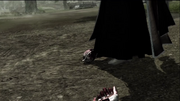 Savonarola approaching the Apple of Eden.
 -
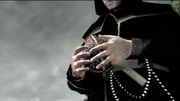 Savonarola with the Apple of Eden.
 -
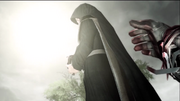 Savonarola stealing the Apple of Eden from Ezio.
 -
 Savonarola being carried away by an angry mob.
 -
 Ezio about to throw a knife to Savonarola's hand.
 -
 Savonarola concept art by Michel Thibault.
 -
 Savonarola promotional art by Michel Thibault.
 -
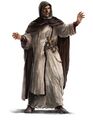 Original concept art for Girolamo Savonarola.


References
- ↑ 1.0 1.1 1.2 1.3 1.4 1.5 1.6 1.7 Assassin's Creed II
- ↑ Assassin's Creed: Project Legacy
- ↑ Machiavelli wrote: "Moses, Cyrus, Theseus and Romulus would have been unable to have their constitutions obeyed for so long a time if they had been unarmed, as was the case in our own day with Fra' Girolamo Savonarola, who failed with his new laws as soon as the multitude no longer believed in them. He had no way to keep them faithful to what they had believed, or to force the unbelievers to believe."