


Constantinople: Difference between revisions
imported>Amnestyyy And now its back :) |
imported>Amnestyyy m Reverted edits by Amnestyyy (talk | block) to last version by Slate Vesper |
||
| Line 31: | Line 31: | ||
An {{Wiki|1509 Istanbul earthquake|earthquake}} uncovered the Key hidden beneath Topkapı Palace. Two years later, after traveling to Masyaf to reveal his Assassin heritage, [[Ezio Auditore da Firenze|Ezio Auditore]], Mentor of the Italian Assassins, arrived in Constantinople to retrieve the other Keys before the Templars. His leadership enabled the Assassins to reclaim their [[Assassin Dens|dens]] from the Byzantines and liberated most of the shops from their control, much as he had in Rome, as well as training several Assassins to the rank of [[Master Assassin]], through the [[Eradication of the Byzantine agents|assassination]] of key Templar agents. However, when Selim took control of the throne, he banished Ezio from Constantinople, though allowed him one final visit to the city to sort out his affairs, by request of his son [[Suleiman I|Suleiman]].<ref name="Revelations">''[[Assassin's Creed: Revelations]]''</ref><ref name="Revelations novel">''[[Assassin's Creed: Revelations (novel)]]''</ref> | An {{Wiki|1509 Istanbul earthquake|earthquake}} uncovered the Key hidden beneath Topkapı Palace. Two years later, after traveling to Masyaf to reveal his Assassin heritage, [[Ezio Auditore da Firenze|Ezio Auditore]], Mentor of the Italian Assassins, arrived in Constantinople to retrieve the other Keys before the Templars. His leadership enabled the Assassins to reclaim their [[Assassin Dens|dens]] from the Byzantines and liberated most of the shops from their control, much as he had in Rome, as well as training several Assassins to the rank of [[Master Assassin]], through the [[Eradication of the Byzantine agents|assassination]] of key Templar agents. However, when Selim took control of the throne, he banished Ezio from Constantinople, though allowed him one final visit to the city to sort out his affairs, by request of his son [[Suleiman I|Suleiman]].<ref name="Revelations">''[[Assassin's Creed: Revelations]]''</ref><ref name="Revelations novel">''[[Assassin's Creed: Revelations (novel)]]''</ref> | ||
==Trivia== | ==Trivia== | ||
Revision as of 13:51, 18 March 2012
- "Many generations of men have ruled the city. But they have never subdued her. She always bounces back."
- ―Yusuf Tazim regarding Constantinople.[src]
Constantinople, also known as Kostantiniyye or Istanbul to its Turkish rulers, served as the capital for the Byzantine Empire, and later for the Ottoman Empire following the conquest of 1453, being the only pan-continental city in the world. During the Renaissance, it was Europe's largest and wealthiest city, consisting of four distinct districts; Constantine, Bayezid, Imperial, and Galata.
History
In 1204, the city was visited by the Mentor of the Levantine Assassins, Altaïr Ibn-La'Ahad, who had hopes of introducing the Assassin Brotherhood to the city. However, mass riots followed by the arrival of European Crusaders who sacked the city, forced him to retreat.[1]
In 1258, Niccolò and Maffeo Polo established an Assassins Guild in Constantinople, after returning from the Assassin Fortress of Masyaf, thus forming the Turkish Assassins branch. They hid the five Masyaf Keys given to them by Altaïr in the Yerebatan Cistern entered by a secret door in Polo's old trading post; the Maiden's Tower; and beneath the Forum of the Ox, Galata Tower and what would become Topkapı Palace.[2]
During the Renaissance, at some point between 1501 and 1507, the Doge of Venice, along with Sultan Bayezid II, sought to ally their considerable naval powers through a free trade treaty. However, the Templars were wary of any peace between the two, and became intent on interfering with their alliance. The Borgia dispatched a force of mercenaries to disrupt the agreement, but they were quickly intercepted by members of the Italian Assassins, who set their ship aflame before they could depart.[3][4]
By 1509, the Templars had started to relocate themselves to Constantinople due to their defeat in Italy and the disruption of their activities throughout Europe. The Templars formed a faction known as the Stewards of Byzantium and attempted to seize control of the city in the wake of Bayezid's absence, due to his civil war with his son Selim.
An earthquake uncovered the Key hidden beneath Topkapı Palace. Two years later, after traveling to Masyaf to reveal his Assassin heritage, Ezio Auditore, Mentor of the Italian Assassins, arrived in Constantinople to retrieve the other Keys before the Templars. His leadership enabled the Assassins to reclaim their dens from the Byzantines and liberated most of the shops from their control, much as he had in Rome, as well as training several Assassins to the rank of Master Assassin, through the assassination of key Templar agents. However, when Selim took control of the throne, he banished Ezio from Constantinople, though allowed him one final visit to the city to sort out his affairs, by request of his son Suleiman.[2][5]
Trivia
- In Assassin's Creed: Revelations, the city is slightly smaller than Rome was in Brotherhood, but it has more buildings, and is more densely populated.
- Alexandre Amancio, the Creative Director of the Assassin's Creed series, stated at E3 that Constantinople is a "really cool metaphor for Ezio meeting Altaïr", citing the fact that half of Constantinople was in Europe, and the other in Asia.
- It is also stated by Darby McDevitt that Constantinople would be a meaningful meeting of Ezio and Altaïr as the city itself was formerly under Christian control, then Muslim, which suits Altaïr and Ezio as the former hails from a Muslim culture in Syria and the latter hails from a Christian Italy.
Gallery
-
 Concept art of Constantinople.
 -
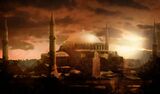 Artwork from Assassin's Creed: Project Legacy.
 -
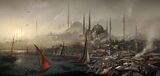 The port of Constantinople.
 -
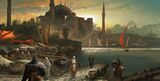 Concept art of Constantinople's Port
 -
 Ezio walks towards Hagia Sophia
 -
Constantinople port concept art.
-
 Ezio walking in Constantinople.
 -

-

-

-
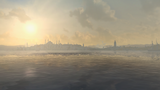 Constantinople as seen from the Bosphorus.


.jpg)


References
| |||||||||||||||||||||||||||||||||||||