


Cattedrale di Santa Maria del Fiore: Difference between revisions
imported>The Forgotten Fragment Minor |
imported>Slate Vesper No edit summary |
||
| Line 1: | Line 1: | ||
{{Era|AC2|ACE}} | {{Era|AC2|ACE}} | ||
{{WP-REAL|Florence Cathedral}} | {{WP-REAL|Florence Cathedral}} | ||
{{Landmarks Infobox | {{Landmarks Infobox | ||
|image = SMDFDB.png | |image = SMDFDB.png | ||
| Line 7: | Line 6: | ||
|location = [[San Giovanni District]], [[Florence]], [[Italy]] | |location = [[San Giovanni District]], [[Florence]], [[Italy]] | ||
|dateconstructed = 1296 CE - 1887 CE | |dateconstructed = 1296 CE - 1887 CE | ||
|functions = | |functions = Cathedral | ||
|features = [[Assassin Tombs|Assassin | |features = [[Assassin Tombs|Assassin Tomb]] ([[Iltani]]) | ||
|appearance = ''[[Assassin's Creed II]]''}} | |appearance = ''[[Assassin's Creed II]]''}} | ||
The '''Basilica di Santa Maria del Fiore''', '''Basilica of Saint Mary of the Flower''', and the '''Duomo''' | The '''Basilica di Santa Maria del Fiore''', known also as the '''Basilica of Saint Mary of the Flower''', and simply the '''Duomo''', was the largest cathedral located in [[Florence]]. | ||
==History== | ==History== | ||
| Line 16: | Line 15: | ||
Although {{Wiki|Arnolfo di Cambio}} designed the church in 1296, construction on the dome did not start until the beginning of the 15th century. | Although {{Wiki|Arnolfo di Cambio}} designed the church in 1296, construction on the dome did not start until the beginning of the 15th century. | ||
Once Cambio had died, none of the architects at that time had any idea how to construct such an enormous structure, since the use of buttresses was forbidden in Florence and mortar took several days to set. | |||
However, {{Wiki|Filippo Brunelleschi}}, an architect who lost an earlier bid to design the adjacent Baptistery doors, won a competition to build the dome, of which he outbid {{Wiki|Lorenzo Ghiberti}}, the same artist that he had lost to before. | However, {{Wiki|Filippo Brunelleschi}}, an architect who had lost an earlier bid to design the adjacent Baptistery doors, won a competition to build the dome, of which he outbid {{Wiki|Lorenzo Ghiberti}}, the same artist that he had lost to before. | ||
Filippo also invented machines to hoist bricks needed for the dome up to the workers, and was able to construct the entire dome without using centering. Using over four million bricks, Brunelleschi and his workers completed the dome in 1436. | Filippo also invented machines to hoist bricks needed for the dome up to the workers, and was able to construct the entire dome without using centering. Using over four million bricks, Brunelleschi and his workers completed the dome in 1436. | ||
In addition, Filippo won a second commission to build the lantern atop the dome, though he died in 1446 before | In addition, Filippo won a second commission to build the lantern atop the dome, though he died in 1446 before its completion; it was said that the lantern supposedly contained holy relics. | ||
===Pazzi conspiracy=== | ===Pazzi conspiracy=== | ||
In 1478, [[Lorenzo de' Medici]] and his brother, [[Giuliano de' Medici|Giuliano]], were attacked whilst attending High Mass, two years after [[Giovanni Auditore da Firenze | In 1478, [[Lorenzo de' Medici]] and his brother, [[Giuliano de' Medici|Giuliano]], were attacked whilst attending High Mass, two years after [[Giovanni Auditore da Firenze]]'s death marked the outbreak of the [[Pazzi Conspiracy|Pazzi conspiracy]]. Giovanni's son, [[Ezio Auditore da Firenze]], was amongst the crowd observing the [[House of Medici|Medici]] procession, and intervened when the Pazzi conspirators attempted to murder Lorenzo and Giuliano. | ||
While Giuliano was ultimately killed before Ezio could help, the Florentine noble was still able to assist Lorenzo fend off the conspirators, most notably an enraged [[Francesco de' Pazzi]]. After the conspirators fled, unsuccessful in their mission, Ezio helped to lead Lorenzo to the safety of his home, the [[Piazza del Popolo]]. | |||
===Bonfire of the Vanities=== | ===Bonfire of the Vanities=== | ||
In 1497, during the [[Bonfire of the Vanities]], one of [[Girolamo Savonarola]]'s lieutenants, a mesmerized [[Priest (Savonarola's lieutenant)|priest]], took to praying from the top of the | In 1497, during the [[Bonfire of the Vanities]], one of [[Girolamo Savonarola]]'s lieutenants, a mesmerized [[Priest (Savonarola's lieutenant)|priest]], took to praying from the top of the basilica's dome. As the priest was transfixed in prayer, Ezio stealthily scaled the church and assassinated him. | ||
==Trivia== | ==Trivia== | ||
*The church was the tallest point | *The church's peak was the tallest point in ''Assassin's Creed II'', although it had to scaled down for the game. | ||
*Missing from in front of the main entrance to the church was the {{Wiki|Florence Baptistery|Battistero di San Giovanni}}, which was built several hundred years before the events of the game. According to lead writer Corey May, this was due to technical limitations brought about by the "many unique textures on the Duomo and nearby [[Campanile di Giotto|bell tower]]." | **The church's side-tower, the Campanile di Giotto, contained the tallest [[View Points|view point]] in ''Assassin's Creed II''. | ||
*The facade was depicted as being partially incomplete, which was historically correct, though | *Missing from in front of the main entrance to the church was the {{Wiki|Florence Baptistery|Battistero di San Giovanni}}, which was built several hundred years before the events of the game. According to lead writer [[Corey May]], this was due to technical limitations brought about by the "many unique textures on the Duomo and [the] nearby [[Campanile di Giotto|bell tower]]." | ||
*A [[feather]] was located at | *The facade was depicted as being partially incomplete, which was historically correct, though its design matched that of the current one, which was not built until the 19th century. The original facade was never completed, and was dismantled in 1587. | ||
*The | *A [[feather]] was located at the basilica's pinnacle height. | ||
*The interior of the church was only accessible through entering the [[Assassin Tombs|Assassin Tomb]] of [[Iltani]]. | |||
*In ''[[Assassin's Creed: Embers]]'', | *In ''[[Assassin's Creed: Embers]]'', Ezio Auditore died of a heart attack in 1524, on a bench located just outside the Basilica di Santa Maria del Fiore. | ||
==Gallery== | ==Gallery== | ||
<gallery position="center" captionalign="center"> | <gallery position="center" captionalign="center"> | ||
Basilica di Santa Maria del Fiore Panorama.png|Basilica di Santa Maria del Fiore | 4604132759_3ef2f165ca.jpg|The Basilica's western facade | ||
Basilica di Santa Maria del Fiore Panorama.png|A panorama of the Basilica di Santa Maria del Fiore | |||
SantaMariaInt1.jpg| | SantaMariaInt1.jpg|A panorama of the Basilica's interior | ||
</gallery> | </gallery> | ||
==Reference== | ==Reference== | ||
*''[[Assassin's Creed II]]'' | *''[[Assassin's Creed II]]'' | ||
{{AC2}} | {{AC2}} | ||
[[Category:Florence]] | [[Category:Florence]] | ||
Revision as of 00:21, 5 May 2013
The Basilica di Santa Maria del Fiore, known also as the Basilica of Saint Mary of the Flower, and simply the Duomo, was the largest cathedral located in Florence.
History
Construction
Although Arnolfo di Cambio designed the church in 1296, construction on the dome did not start until the beginning of the 15th century.
Once Cambio had died, none of the architects at that time had any idea how to construct such an enormous structure, since the use of buttresses was forbidden in Florence and mortar took several days to set.
However, Filippo Brunelleschi, an architect who had lost an earlier bid to design the adjacent Baptistery doors, won a competition to build the dome, of which he outbid Lorenzo Ghiberti, the same artist that he had lost to before.
Filippo also invented machines to hoist bricks needed for the dome up to the workers, and was able to construct the entire dome without using centering. Using over four million bricks, Brunelleschi and his workers completed the dome in 1436.
In addition, Filippo won a second commission to build the lantern atop the dome, though he died in 1446 before its completion; it was said that the lantern supposedly contained holy relics.
Pazzi conspiracy
In 1478, Lorenzo de' Medici and his brother, Giuliano, were attacked whilst attending High Mass, two years after Giovanni Auditore da Firenze's death marked the outbreak of the Pazzi conspiracy. Giovanni's son, Ezio Auditore da Firenze, was amongst the crowd observing the Medici procession, and intervened when the Pazzi conspirators attempted to murder Lorenzo and Giuliano.
While Giuliano was ultimately killed before Ezio could help, the Florentine noble was still able to assist Lorenzo fend off the conspirators, most notably an enraged Francesco de' Pazzi. After the conspirators fled, unsuccessful in their mission, Ezio helped to lead Lorenzo to the safety of his home, the Piazza del Popolo.
Bonfire of the Vanities
In 1497, during the Bonfire of the Vanities, one of Girolamo Savonarola's lieutenants, a mesmerized priest, took to praying from the top of the basilica's dome. As the priest was transfixed in prayer, Ezio stealthily scaled the church and assassinated him.
Trivia
- The church's peak was the tallest point in Assassin's Creed II, although it had to scaled down for the game.
- The church's side-tower, the Campanile di Giotto, contained the tallest view point in Assassin's Creed II.
- Missing from in front of the main entrance to the church was the Battistero di San Giovanni, which was built several hundred years before the events of the game. According to lead writer Corey May, this was due to technical limitations brought about by the "many unique textures on the Duomo and [the] nearby bell tower."
- The facade was depicted as being partially incomplete, which was historically correct, though its design matched that of the current one, which was not built until the 19th century. The original facade was never completed, and was dismantled in 1587.
- A feather was located at the basilica's pinnacle height.
- The interior of the church was only accessible through entering the Assassin Tomb of Iltani.
- In Assassin's Creed: Embers, Ezio Auditore died of a heart attack in 1524, on a bench located just outside the Basilica di Santa Maria del Fiore.
Gallery
-
The Basilica's western facade
-
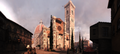 A panorama of the Basilica di Santa Maria del Fiore
 -
 A panorama of the Basilica's interior


Reference