

Library of Altaïr Ibn-La'Ahad: Difference between revisions
imported>Alientraveller it's the literal translation |
imported>M.C.Tales Replaced a category; removed a category; edited links. |
||
| Line 4: | Line 4: | ||
{{Quote|A library hidden beneath the stones of Masyaf. A sanctum full of invaluable wisdom.|[[Ezio Auditore da Firenze|Ezio Auditore]] regarding the library in 1511.|Assassin's Creed: Revelations}} | {{Quote|A library hidden beneath the stones of Masyaf. A sanctum full of invaluable wisdom.|[[Ezio Auditore da Firenze|Ezio Auditore]] regarding the library in 1511.|Assassin's Creed: Revelations}} | ||
[[File:Library door v.png|thumb|200px|The library's entrance.]] | [[File:Library door v.png|thumb|200px|The library's entrance.]] | ||
'''Altaïr's library''' was a hidden library beneath the fortress of [[Masyaf]] containing hundreds of books abundant with wisdom gained from the [[ | '''Altaïr's library''' was a hidden library beneath the fortress of [[Masyaf]] containing hundreds of books abundant with wisdom gained from the [[Second Apple|Apple of Eden]] by the legendary [[Assassins|Assassin]], [[Altaïr Ibn-La'Ahad]]. It was also the hiding place of a powerful weapon sought by [[Ezio Auditore da Firenze]] during the 16th century.<ref name="ACTSC">''[[Assassin's Creed: The Secret Crusade]]''</ref><ref name="ACR">''[[Assassin's Creed: Revelations]]''</ref> | ||
==History== | ==History== | ||
===Creation=== | ===Creation=== | ||
Sometime before 1257, Altaïr Ibn-La'Ahad [[Mentor]] of the [[Syrian Assassins]], had a library built over the gardens of Masyaf. When finally complete, the library served as a collection of all of the knowledge Altaïr had acquired from studying the Apple. More importantly however, Altaïr hid a weapon within his library, capable of ending the war between the Assassins and [[Templars]].<ref name="ACTSC" /> | Sometime before 1257, Altaïr Ibn-La'Ahad, [[Mentor]] of the [[Syrian Assassins]], had a library built over the gardens of Masyaf. When finally complete, the library served as a collection of all of the knowledge Altaïr had acquired from studying the Apple. More importantly however, Altaïr hid a weapon within his library, capable of ending the war between the Assassins and [[Templars]].<ref name="ACTSC"/> | ||
In a desire to keep the contents of his library safe from the hands of the Templars, Altaïr sealed it, only allowing its reopening through five separate [[Keys | In a desire to keep the contents of his library safe from the hands of the Templars, Altaïr sealed it, only allowing its reopening through five separate [[Masyaf Keys|keys]]. During the Mongol [[Fall of Masyaf|siege]] of Masyaf, Altaïr left the keys in the possession of [[Niccolò Polo|Niccolò]] and [[Maffeo Polo]], who later hid them in [[Constantinople]].<ref name="ACTSC"/> | ||
===Reopened=== | ===Reopened=== | ||
[[File:Eziodiscoversaltairsbody.jpg|thumb|left|Altaïr's corpse, discovered by Ezio]] | [[File:Eziodiscoversaltairsbody.jpg|thumb|left|Altaïr's corpse, discovered by Ezio]] | ||
By 1511 both the Templars and Assassins sought the five keys to discover the weapon locked within the library. The Assassin Ezio Auditore was able to recover all of the keys, and subsequently opened the library to discover its contents, or lack thereof. It held no books, scrolls or weapons as Ezio had previously thought; instead, he found only the remains of Altaïr himself, tightly holding a sixth and final [[memory seal]], the [[Second Apple| Masyaf Apple]] hidden in the background.<ref name="ACR" /> | By 1511 both the Templars and Assassins sought the five keys to discover the weapon locked within the library. The Assassin Ezio Auditore was able to recover all of the keys, and subsequently opened the library to discover its contents, or lack thereof. It held no books, scrolls or weapons as Ezio had previously thought; instead, he found only the remains of Altaïr himself, tightly holding a sixth and final [[memory seal]], the [[Second Apple|Masyaf Apple]] hidden in the background.<ref name="ACR"/> | ||
==Gallery== | ==Gallery== | ||
| Line 22: | Line 22: | ||
Door to Masyaf Library Concept.JPG|Concept art of the library door. | Door to Masyaf Library Concept.JPG|Concept art of the library door. | ||
Altairs Library Entrance Concept.JPG|Concept art of Ezio entering the library. | Altairs Library Entrance Concept.JPG|Concept art of Ezio entering the library. | ||
Ezio meets Altair by Gilles Beloeil.jpg|Concept art of Ezio meeting | Ezio meets Altair by Gilles Beloeil.jpg|Concept art of Ezio meeting Altaïr by [[Gilles Beloeil]]. | ||
103.jpg | 103.jpg | ||
</gallery> | </gallery> | ||
| Line 50: | Line 50: | ||
{{ACR}} | {{ACR}} | ||
[[Category:Masyaf]] | [[Category:Masyaf]] | ||
[[Category:Assassin's | [[Category:Assassin's Creed: Revelations Locations]] | ||
Revision as of 20:18, 12 December 2011

|
He who increaseth knowledge, increaseth sorrow. This article contains spoilers, meaning it has information and facts concerning recent or upcoming releases from the Assassin's Creed series. If you do not want to know about these events, it is recommended to read on with caution, or not at all. |

- "A library hidden beneath the stones of Masyaf. A sanctum full of invaluable wisdom."
- ―Ezio Auditore regarding the library in 1511.[src]
Altaïr's library was a hidden library beneath the fortress of Masyaf containing hundreds of books abundant with wisdom gained from the Apple of Eden by the legendary Assassin, Altaïr Ibn-La'Ahad. It was also the hiding place of a powerful weapon sought by Ezio Auditore da Firenze during the 16th century.[1][2]
History
Creation
Sometime before 1257, Altaïr Ibn-La'Ahad, Mentor of the Syrian Assassins, had a library built over the gardens of Masyaf. When finally complete, the library served as a collection of all of the knowledge Altaïr had acquired from studying the Apple. More importantly however, Altaïr hid a weapon within his library, capable of ending the war between the Assassins and Templars.[1]
In a desire to keep the contents of his library safe from the hands of the Templars, Altaïr sealed it, only allowing its reopening through five separate keys. During the Mongol siege of Masyaf, Altaïr left the keys in the possession of Niccolò and Maffeo Polo, who later hid them in Constantinople.[1]
Reopened
By 1511 both the Templars and Assassins sought the five keys to discover the weapon locked within the library. The Assassin Ezio Auditore was able to recover all of the keys, and subsequently opened the library to discover its contents, or lack thereof. It held no books, scrolls or weapons as Ezio had previously thought; instead, he found only the remains of Altaïr himself, tightly holding a sixth and final memory seal, the Masyaf Apple hidden in the background.[2]
Gallery
-
Altaïr at the library entrance.
-
 Concept art by Martin Deschambault.
 -
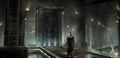 Concept art of the library door.
 -
 Concept art of Ezio entering the library.
 -
 Concept art of Ezio meeting Altaïr by Gilles Beloeil.


Trivia
- In the upper and lower area of the door there is some Arabic script written in the form of ancient Shi'r or Arabic Poetry. They read:
إتق دم البرئ - لآ شيء مطلق بل الكل ممكن
إختبئ وسط الأزحام - إختبئ وسط الأزحام
and
نحن من إتمنك - لأ تخن من إتمنك
Translation:
"Revere the blood of the innocent - Nothing is absolute, everything is possible
Hide in the midst of the crowds - Hide in the midst of the crowds"
and
"We are the ones who have entrusted you - Do not betray our trust"
References
| |||||||||||||||||||||||||||||||||||||