

Frontier: Difference between revisions
imported>Datu Hulyo No edit summary |
imported>Datu Hulyo No edit summary |
||
| Line 52: | Line 52: | ||
**However, Connor's notoriety is predetermined by specific areas of the Frontier. | **However, Connor's notoriety is predetermined by specific areas of the Frontier. | ||
*In the Monmouth region, a red enemy dot appears on the mini map inside a small building with injured men inside. However, the dot belonged to a woman who paced the inside of the building, and did not attack Connor. It is unknown why she was identified on the mini map. | *In the Monmouth region, a red enemy dot appears on the mini map inside a small building with injured men inside. However, the dot belonged to a woman who paced the inside of the building, and did not attack Connor. It is unknown why she was identified on the mini map. | ||
*During the events of ''[[The Tyranny of King Washington]]'', the Frontier is devastated, with the colonial settlements and farms ruined and abandoned, and the land littered with the dead bodies of slaughtered [[ | *During the events of ''[[The Tyranny of King Washington]]'', the Frontier is devastated, with the colonial settlements and farms ruined and abandoned, and the land littered with the dead bodies of slaughtered [[civilian]]s and Redcoats. Dead [[horse]]s can also be found. | ||
*The encampment at Valley Forge was inaccessible until Sequence 8, as the Continental Army had not yet made camp until 1778. | *The encampment at Valley Forge was inaccessible until Sequence 8, as the Continental Army had not yet made camp until 1778. | ||
Revision as of 07:32, 3 January 2025

|
Ezio, my friend! How may I be of service? This article is in desperate need of a revamp. Please improve it in any way necessary in order for it to achieve a higher standard of quality in accordance with our Manual of Style. |

The Frontier was a location generated by the Animus 3.0, representing the areas in the North American countryside visited by Haytham Kenway and Ratonhnhaké:ton.
During the Seven Years' War and subsequent American Revolutionary War, the countryside of Massachusetts, New York, Pennsylvania, and New Jersey was gradually being settled by colonial hunters and traders, as the fur pelts of American animals were in high demand in England and France.
Regions
The Frontier was split into twelve hunting grounds, each containing four different types of wildlife:
Black Creek
Located at the most north-western area of the Frontier, Black Creek contained hares, beavers, elk, and bobcats. It contained Fort Duquesne in Pennsylvania, and the Grand Temple in Turin, New York.
Concord
Located roughly in the center of the Frontier, Concord, Massachusetts, included hares, raccoon, beavers, and deer. A trading post was located on the western edge of town, on the road leading to Valley Forge.
Diamond Basin
The Diamond Basin hunting region was located north of Concord. It included cougars, deer, wolves, and beavers.
Great Piece Hills
Great Piece Hills was located in the north-east, just south of John's Town. It included hares, wolves, elk, and bobcats. Boston Light overlooked the eastern lake.
John's Town
Located at the most north-eastern area of the Frontier, John's Town in New York included hares, foxes, elk, and bears. It was the site of Sir William Johnson's homestead, Johnson Hall, and contained the route to the Davenport Homestead in Massachusetts.
Kanièn:keh
Located at the central northern area of the Frontier, the Kanièn:keh Nation Territory, or "Mohawk Valley", was the location of Kanatahséton. Game included hares, foxes, deer, and cougars.
Lexington
Located roughly in the center of the Frontier, west of Concord, Massachusetts, the town of Lexington included raccoon, hares, foxes, and deer. A trading post was located to the north, near an inn.
Monmouth
The Monmouth, New Jersey hunting ground included elk, raccoon, hares, and foxes. It was the location of the Fort Monmouth and a harbor. A trading post was located just north of the harbor, on the road leading to Troy's Wood.
Packanack
The Packanack hunting ground included hares, beavers, bobcats, and bears.
Scotch Plains
The Scotch Plains hunting ground included raccoon, deer, hares, and cougars. It contained the routes to Boston and New York, as well as Fort St-Mathieu.
Troy's Wood
The Troy's Wood hunting ground included hares, deer, elk, and wolves.
Valley Forge
The Valley Forge hunting ground included hares, beavers, raccoon, and elk. It was the site of the Continental Army's camp during the first half of 1778.
Trivia
- The Frontier represents the Northeast area of the United States. However, its depiction is a very fictionalized and compressed version of Massachusetts, Rhode Island, Connecticut, New York, Pennsylvania, and New Jersey. The big river in the middle possibly represents Hudson River.
- The Frontier is 1.5 times larger than Assassin's Creed: Brotherhood's Rome.
- The Frontier is the setting for about a third of the main storyline content for Assassin's Creed III.
- It is impossible to reduce notoriety in the Frontier.
- However, Connor's notoriety is predetermined by specific areas of the Frontier.
- In the Monmouth region, a red enemy dot appears on the mini map inside a small building with injured men inside. However, the dot belonged to a woman who paced the inside of the building, and did not attack Connor. It is unknown why she was identified on the mini map.
- During the events of The Tyranny of King Washington, the Frontier is devastated, with the colonial settlements and farms ruined and abandoned, and the land littered with the dead bodies of slaughtered civilians and Redcoats. Dead horses can also be found.
- The encampment at Valley Forge was inaccessible until Sequence 8, as the Continental Army had not yet made camp until 1778.
Gallery
-
 Concept art of wolves in the Frontier
 -
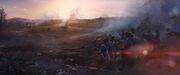 A battle in the Frontier
 -
 Concept art of a Frontier battlefield
 -
 Concept art of the Frontier by William Wu
 -
 Snow covered forest in the Frontier
 -
 The Frontier in Spring
 -
 Haytham Kenway and Charles Lee in the Frontier during winter
 -
 Young Ratonhnhaké:ton overlooking the Kanièn:keh territory
 -
 Connor in the Frontiersmen camp
 -
 Aerial view of Fort Monmouth
 -
 Fort St-Mathieu

.jpg)


References