


Cappella Sistina: Difference between revisions
imported>Slate Vesper mNo edit summary |
imported>Kaloneous m minor typo in image caption |
||
| Line 20: | Line 20: | ||
==Gallery== | ==Gallery== | ||
<gallery position="center" captionalign="center"> | <gallery position="center" captionalign="center"> | ||
Capella Sistine congregation.jpg|Congregation of Vatican | Capella Sistine congregation.jpg|Congregation of Vatican priests and monks. | ||
</gallery> | </gallery> | ||
Revision as of 04:53, 23 August 2012

The Cappella Sistina, or Sistine Chapel, was the chapel of the Pope in Rome, and center of the Catholic faith and Papacy.
History
Conception
Inspired by the architecture of Solomon's Temple, the Sistine Chapel is the most famous room in the Apostolic Palace, the official residence of the Pope.[1]
As the Pope's personal chapel, mass is frequently held inside, as are the Papal Conclaves, which occur after the Pope's death. The cardinals are locked inside the chapel and are not permitted to leave until a new Pope is elected.[1]
Renaissance
In 1492, Rodrigo Borgia became Pope Alexander IV, and moved into St. Peter's Basilica, of which the Sistine Chapel is a part. Seven years later, in 1499, Ezio Auditore infiltrated the chapel in order to assassinate Rodrigo Borgia and locate the Vault, which he had learned was built beneath the Basilica.[1]
After an arduous fight with Rodrigo, in which two Pieces of Eden were used, Ezio was tricked and stabbed by Rodrigo, who had used the Papal Staff's power to immobilize the Assassin, before Ezio promptly fell unconscious.[1]
Upon waking, Ezio pressed two hidden buttons at the back of the chapel, which opened the way into the Vault, a structure built by members of the First Civilization, whose entrance lay in a pit-like enclosure. It was at this entrance that Ezio would confront Rodrigo in a final, victorious fight.[1] Soon after the Assassin left the Vault, Mario Auditore appeared and beckoned him to leave the Capella Sistina, to which Ezio complied.[2]
Gallery
-
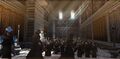 Congregation of Vatican priests and monks.

References
| |||||||||||||||||||||||||||||||||||||