

Art merchant: Difference between revisions
imported>Darman36 →Paintings: WP painting files, numeral seperator |
m Text replacement - " " to " " |
||
| (29 intermediate revisions by 15 users not shown) | |||
| Line 1: | Line 1: | ||
{{Era| | {{Era|Occupations}}{{WP-REAL|Art dealer}} | ||
[[File:ACB Art Merchant Shop.png|thumb|250px| | {{Update|''[[Assassin's Creed: Brotherhood]]''}} | ||
''' | [[File:ACB Art Merchant Shop.png|thumb|250px|A Roman art merchant's shop]] | ||
An '''art merchant''' is a person who buys and sells works of art. In [[Renaissance]] [[Italy]], art merchants were the primary [[Merchant|suppliers]] of two-dimensional drawn media, such as paintings and maps. With his apprentices, an art merchant could reproduce and sell decent copies of most works of art and drawings. They were still a raw trade, much like [[blacksmith]]s.<ref>''[[Assassin's Creed II]]''</ref><ref>''[[Assassin's Creed: Brotherhood]]''</ref> | |||
==Paintings== | ==Paintings== | ||
Each painting increased [[Monteriggioni]]'s value, with the higher the price, the higher the added value. Paintings sold by art merchants changed depending on what region they were in. Once purchased, they could be viewed at the [[ | Each painting increased [[Monteriggioni]]'s value, with the higher the price, the higher the added value. Paintings sold by art merchants changed depending on what region they were in. Once purchased, they could be viewed at the [[Villa Auditore]]'s second floor [[painting gallery]] while also providing some background information on the painting itself and its artist. Art merchants were not as common as blacksmiths or [[doctor]]s, but there was at least one situated in each city. | ||
{| width="70%" cellspacing="0" cellpadding="0" border="1" style="text-align:center" | {| width="70%" cellspacing="0" cellpadding="0" border="1" style="text-align:center" | ||
| Line 18: | Line 19: | ||
|- | |- | ||
|Florence | |Florence | ||
|''{{Wiki|The Baptism of Christ (Verrocchio)|Baptism of Christ}}'' | |''{{Wiki|The Baptism of Christ (Verrocchio and Leonardo)|Baptism of Christ}}'' | ||
|280ƒ | |280ƒ | ||
|[[Andrea del Verrocchio]] | |[[Andrea del Verrocchio]] | ||
|- | |- | ||
|Florence | |Florence | ||
|''{{Wiki|Primavera ( | |''{{Wiki|Primavera (Botticelli)|Primavera}}'' | ||
|2,950ƒ | |2,950ƒ | ||
|[[Sandro Botticelli]] | |[[Sandro Botticelli]] | ||
| Line 50: | Line 51: | ||
|''{{Wiki|Portrait of Francesco delle Opere|Francesco Delle Opere}}'' | |''{{Wiki|Portrait of Francesco delle Opere|Francesco Delle Opere}}'' | ||
|1,492ƒ | |1,492ƒ | ||
| | |[[Pietro Perugino]] | ||
|- | |- | ||
|[[Venice]] | |[[Venice]] | ||
| Line 63: | Line 64: | ||
|- | |- | ||
|Venice | |Venice | ||
|''{{Wiki|St | |''{{Wiki|St Sebastian (Antonello da Messina)|San Sebastian}}'' | ||
|163ƒ | |163ƒ | ||
|Antonello da Messina | |Antonello da Messina | ||
|- | |- | ||
|Venice | |Venice | ||
|''{{Wiki|St | |''{{Wiki|St Jerome in His Study (Antonello da Messina)|St-Jerome in his Study}}'' | ||
|4,300ƒ | |4,300ƒ | ||
|{{Wiki|Antonello da Messina}} | |{{Wiki|Antonello da Messina}} | ||
| Line 98: | Line 99: | ||
|- | |- | ||
|San Gimignano | |San Gimignano | ||
|{{Wiki|File:Ambrogio de Predis - Portrait of a Woman - WGA18378.jpg|Portrait of a Lady}} | |''{{Wiki|File:Ambrogio de Predis - Portrait of a Woman - WGA18378.jpg|Portrait of a Lady}}'' | ||
|525ƒ | |525ƒ | ||
|Leonardo da Vinci | |Leonardo da Vinci | ||
| Line 108: | Line 109: | ||
|- | |- | ||
|[[Forlì]] | |[[Forlì]] | ||
|''{{Wiki|The Birth of Venus | |''{{Wiki|The Birth of Venus}}'' | ||
|14,800ƒ | |14,800ƒ | ||
|Sandro Botticelli | |Sandro Botticelli | ||
|- | |- | ||
|Forlì | |Forlì | ||
|'' | |''{{Wiki|Jupiter and Io}}'' | ||
|6,969ƒ | |6,969ƒ | ||
|{{Wiki|Antonio da Correggio|Antonio Allegri da Corregio}} | |{{Wiki|Antonio da Correggio|Antonio Allegri da Corregio}} | ||
| Line 123: | Line 124: | ||
|- | |- | ||
|Forlì | |Forlì | ||
|''{{Wiki|Leda and the Swan}}'' | |''{{Wiki|Leda and the Swan (Leonardo)|Leda and the Swan}}'' | ||
|200ƒ | |200ƒ | ||
|Leonardo da Vinci | |Leonardo da Vinci | ||
| Line 148: | Line 149: | ||
|- | |- | ||
|Monteriggioni | |Monteriggioni | ||
|''{{Wiki|St. Francis in Ecstasy|St-Francis in Ecstasy}}'' | |''{{Wiki|St. Francis in Ecstasy (Bellini)|St-Francis in Ecstasy}}'' | ||
|581ƒ | |581ƒ | ||
|{{Wiki|Giovanni Bellini}} | |{{Wiki|Giovanni Bellini}} | ||
| Line 164: | Line 165: | ||
==Treasure maps== | ==Treasure maps== | ||
Treasure maps marked the location of [[treasure | Treasure maps marked the location of [[treasure chest]]s located all over [[Italy]]. Like paintings, treasure maps differed depending on what location they were bought at. Local art merchants in Florence, [[Tuscany]], [[Romagna]], and Venice possessed a map for each district that they covered. There was also another treasure map for Monteriggioni. Treasure maps for each district were unlocked after Ezio had visited the district at least once. | ||
{| width="70%" cellspacing="0" cellpadding="0" border="1" style="text-align:center" | {| width="70%" cellspacing="0" cellpadding="0" border="1" style="text-align:center" | ||
| Line 200: | Line 201: | ||
|500ƒ | |500ƒ | ||
|- | |- | ||
! | !Venice ([[Dorsoduro District|Dorsoduro]]) | ||
Venice ([[Dorsoduro District|Dorsoduro]]) | |||
|495ƒ | |495ƒ | ||
|- | |- | ||
| Line 216: | Line 216: | ||
==Trivia== | ==Trivia== | ||
*In ''[[Assassin's Creed II]]'', 8 out of the 30 paintings that were available for purchase were painted by Leonardo da Vinci. | *In ''[[Assassin's Creed II]]'', 8 out of the 30 paintings that were available for purchase were painted by Leonardo da Vinci. | ||
*In ''[[Assassin's Creed: Brotherhood]]'', all of the paintings that were available for purchase were painted by the | *In ''[[Assassin's Creed: Brotherhood]]'', all of the paintings that were available for purchase were painted by Raphael. | ||
*Art merchants shops featured paintings that could not be purchased; most notably, the portrait of [[Giuliano de' Medici]] by Sandro Botticelli was seen hanging prominently. | |||
*There was a typing mistake in the description of the painting "Resurrection of Christ." | *There was a typing mistake in the description of the painting "Resurrection of Christ." | ||
*Several paintings such as Albrecht Dürer's ''{{Wiki|Adam and Eve (Dürer)|Eve }}''or Raphael's ''{{Wiki|Young Man with an Apple (Raphael)|Young Man with an Apple}}'' were painted several years after the events of each game, so it would have been impossible for Ezio to buy the artwork or the replicas earlier in the games. | |||
*During [[modern times]], the building previously occupied by Monteriggioni's art merchant had been converted to an information kiosk. | *During [[modern times]], the building previously occupied by Monteriggioni's art merchant had been converted to an information kiosk. | ||
*In ''[[Assassin's Creed: Revelations]]'', art merchants were replaced by [[book | *In ''[[Assassin's Creed: Revelations]]'', art merchants were replaced by [[book shop]]s. | ||
==Gallery== | ==Gallery== | ||
<gallery captionalign="center" position="center | <gallery captionalign="center" position="center" widths="180"> | ||
AC2 Monteriggioni Art Merchant.png|Monteriggioni's art merchant | AC2 Monteriggioni Art Merchant.png|Monteriggioni's art merchant | ||
ACB Art Concept Storefront Artshop.jpg|Concept art of an art merchant's shop | |||
ACB Art Merchant Menu.png|An art merchant's inventory | ACB Art Merchant Menu.png|An art merchant's inventory | ||
</gallery> | </gallery> | ||
==Appearances== | |||
*''[[Assassin's Creed II]]'' {{1st}} | |||
*''[[Assassin's Creed: Brotherhood]]'' | |||
==References== | ==References== | ||
{{Reflist}} | |||
{{AC2}} | {{AC2}} | ||
{{ACB}} | {{ACB}} | ||
<!--[[uk:Торговці картинами]]--> | |||
[[uk:Торговці картинами]] | |||
[[Category:Occupations]] | [[Category:Occupations]] | ||
[[Category: | [[Category:Businesses]] | ||
Latest revision as of 00:28, 10 July 2026

|
Patience, brothers. Soon we will reveal the secrets of Assassin's Creed: Brotherhood. This article has been identified as being out of date. Please update the article to reflect recent releases and then remove this template once done. |

An art merchant is a person who buys and sells works of art. In Renaissance Italy, art merchants were the primary suppliers of two-dimensional drawn media, such as paintings and maps. With his apprentices, an art merchant could reproduce and sell decent copies of most works of art and drawings. They were still a raw trade, much like blacksmiths.[1][2]
Paintings[edit | edit source]
Each painting increased Monteriggioni's value, with the higher the price, the higher the added value. Paintings sold by art merchants changed depending on what region they were in. Once purchased, they could be viewed at the Villa Auditore's second floor painting gallery while also providing some background information on the painting itself and its artist. Art merchants were not as common as blacksmiths or doctors, but there was at least one situated in each city.
Treasure maps[edit | edit source]
Treasure maps marked the location of treasure chests located all over Italy. Like paintings, treasure maps differed depending on what location they were bought at. Local art merchants in Florence, Tuscany, Romagna, and Venice possessed a map for each district that they covered. There was also another treasure map for Monteriggioni. Treasure maps for each district were unlocked after Ezio had visited the district at least once.
| City (District) | Cost |
|---|---|
| Florence (Santa Maria Novella) | 160ƒ |
| Florence (San Marco) | 150ƒ |
| Florence (San Giovanni) | 395ƒ |
| Apennine Mountains | 150ƒ |
| Monteriggioni | 285ƒ |
| Tuscany (San Gimignano) | 245ƒ |
| Tuscany (Countryside) | 175ƒ |
| Romagna (Forlì) | 260ƒ |
| Romagna (Countryside) | 235ƒ |
| Venice (San Marco) | 500ƒ |
| Venice (Dorsoduro) | 495ƒ |
| Venice (San Polo) | 550ƒ |
| Venice (Cannaregio) | 995ƒ |
| Venice (Castello) | 485ƒ |
Trivia[edit | edit source]
- In Assassin's Creed II, 8 out of the 30 paintings that were available for purchase were painted by Leonardo da Vinci.
- In Assassin's Creed: Brotherhood, all of the paintings that were available for purchase were painted by Raphael.
- Art merchants shops featured paintings that could not be purchased; most notably, the portrait of Giuliano de' Medici by Sandro Botticelli was seen hanging prominently.
- There was a typing mistake in the description of the painting "Resurrection of Christ."
- Several paintings such as Albrecht Dürer's Eve or Raphael's Young Man with an Apple were painted several years after the events of each game, so it would have been impossible for Ezio to buy the artwork or the replicas earlier in the games.
- During modern times, the building previously occupied by Monteriggioni's art merchant had been converted to an information kiosk.
- In Assassin's Creed: Revelations, art merchants were replaced by book shops.
Gallery[edit | edit source]
-
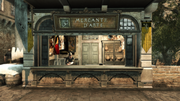 Monteriggioni's art merchant
 -
 Concept art of an art merchant's shop
 -
 An art merchant's inventory


Appearances[edit | edit source]
- Assassin's Creed II (first appearance)
- Assassin's Creed: Brotherhood
References[edit | edit source]
| |||||||||||||||||||||||||||||||||||||