

Nymph

|
Patience, brothers. Soon we will reveal the secrets of Assassin's Creed: Odyssey. This article has been identified as being out of date. Please update the article to reflect recent releases and then remove this template once done. |

A nymph is a lesser female spirit in the Greek and Roman mythologies.
Usually a nymph is attached to a certain place or terrain. Sometimes they form at least part of the retinue of a god or a goddess, for example Dionysos and Artemis. They can also be found in the company of the Greek god Pan.
Known nymphs[edit | edit source]
- Anemone[1]
- Circe[2]
- Echo[3]
- Kallisto
- Keroessa[4]
- Korykia[5]
- Lalaia[6]
- Melaina[7]
- Minthe[8]
- Syrinx[9]
- Thetis
- Thoosa[10]
Variants[edit | edit source]
Influence[edit | edit source]
In the Greek myths, numerous places were associated with the nymphs. Of special note is the Cave of the Nymphs in Ithaka, which Odysseus visited on his return home, according to Homer's Odyssey,[14] as well as the Cave of Ionides in Elis, which was revered as the dwelling place of a group of water nymphs called Ionides.[12] In Phokis, the village of Lalaia was named after the nymph of the same name,[17] near the spring which bore the name of her father Kephisos.[18]
During the Peloponnesian War, a woman living alone among pigs, wild boars, and lions on Atoll Point of Paros Island claimed to be one of the Oceanids, introducing herself to the Spartan misthios Kassandra as "Circe of the Oceanids".[16]
In Constantinople, the Great Nymphaeum was built in honor of the nymphs.[19]
Furthermore, Ercole Massimo's family was said to have originated from the union of Herakles and an unnamed nymph.[20]
Figures of other cultures, like the Brittonic Sabrina,[21] were reimagined as nymphs due to the exportation of Greco-Roman culture.
Gallery[edit | edit source]
-
 Nymphs by a Fountain, a painting by Peter Lely
 -
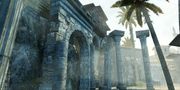 A view of the Great Nymphaeum


Appearances[edit | edit source]
- Assassin's Creed: Brotherhood - The Da Vinci Disappearance (first mentioned)
- Assassin's Creed: Revelations (mentioned only)
- Assassin's Creed: Syndicate (mentioned only)
- Assassin's Creed: Origins (mentioned only)
- Assassin's Creed: Odyssey (mentioned only)
- Discovery Tour: Ancient Greece (mentioned only)
- Assassin's Creed: Valhalla (mentioned only)
References[edit | edit source]
- ↑ Assassin's Creed: Syndicate – Database: Anemone
- ↑ Assassin's Creed: Odyssey – Wine for the Swine
- ↑ Assassin's Creed: Syndicate – Database: Daffodil
- ↑ Assassin's Creed: Revelations – Database: Constantinople
- ↑ Assassin's Creed: Odyssey – Korykian Cave
- ↑ Assassin's Creed: Odyssey – Phokis: Lalaia
- ↑ Phobos
- ↑ Assassin's Creed: Odyssey – A Godless Blight
- ↑ Assassin's Creed: Odyssey – Pan's Flute
- ↑ Assassin's Creed: Odyssey –Odyssey Into the Past
- ↑ Discovery Tour: Ancient Greece – Obsidian Islands: "The Golden Apples of the Hesperides"
- ↑ 12.0 12.1 Assassin's Creed: Odyssey – Historical Locations: "Elis: Cave of Ionides"
- ↑ Assassin's Creed: Origins – Halo of the Huntress
- ↑ 14.0 14.1 Assassin's Creed: Odyssey – Historical Locations: "Ithaka: Cave of the Nymphs"
- ↑ Assassin's Creed: Odyssey – Nereides Monument
- ↑ 16.0 16.1 Assassin's Creed: Odyssey – Wine for the Swine
- ↑ Assassin's Creed: Odyssey – Historical Locations: "Phokis: Lalaia"
- ↑ Assassin's Creed: Odyssey – Historical Locations: "Phokis: Kephisos Spring"
- ↑ Assassin's Creed: Revelations – Database: Great Nymphaeum
- ↑ Assassin's Creed: Brotherhood – The Da Vinci Disappearance – Database: Ercole Massimo
- ↑ Assassin's Creed: Valhalla – Clues and Riddles