


Griffin (mythology)

|
Ezio, my friend! How may I be of service? This article has a lot of room for expansion. Please improve it with additional information in accordance with the Manual of Style |

The griffin is a mythical beast found in multiple mythologies. It's an amalgam of a lion and an eagle, with the most common variant having the body, legs, and tail of the former, and the head and wings of the latter.
In time, griffins became a symbol of strength and vigilance,[1] and as such, they were a favored decorative element in the making of arms and armor.[2]
Mythology[edit | edit source]
In myths, griffins were often depicted as guarding treasure which more often than not belonged to the gods.[1]
Influence[edit | edit source]
Minoan civilization[edit | edit source]
The Minoans revered the griffin, and as such, it was a common motif in their wall-paintings. The Minoan griffin, however, lacked wings.[2]
Achaemenid empire[edit | edit source]
The Persian Achaemenid Empire had their own versions of the griffin. Though still a combination of a lion and an eagle, the Persian griffin sometimes was merely a winged lion, and sometimes had horns on its head. Nonetheless, the creature was emblazoned on their shields and even some of their weapons. As the Order of the Ancients backed the empire, some of these arms ended up in the Order's hands.
Ancient Greece[edit | edit source]
In the 5th century BCE, Lokris, a region of Greece, had taken the head of a griffin as their emblem, honoring their hero, Ajax whose shield bore a griffin on its interior.[1] A griffin, flanked on both sides by Pegasos, also adorned the helmet of the Statue of Athena which stood atop Athens' Akropolis.[2]
During the Peloponnesian War, likenesses of a griffin adorned the helmet commonly used by mercenaries, as well as an Athenian breastplate, and the pommel of a sword. Miniature griffins also adorned a certain bow. Furthermore, a mercenary took 'The Griffin' as his epithet; the spear he used was claimed by his daughter, gaining also the epithet 'The Patricidal'.[2]
In addition to these arms and armor, a member of The Silver Vein branch of the Cult of Kosmos was known as The Silver Griffin. As the Silver Vein was dedicated to the accumulation and distribution of riches, the name was a good fit for one of their number.[3]
Ancient Egypt[edit | edit source]
In the 1st century BCE Egypt, a bow in Egypt was named after the creature, bearing its likenesses upon its limbs.[4]
Modern era[edit | edit source]
By modern times, "Griffin" was also a popular given name. A 21st century Assassin was named after the creature.[5]
Gallery[edit | edit source]
-
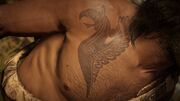 A griffin tattooed on a bandit's chest
 -
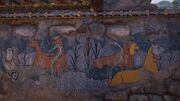 A Minoan mural of a griffin, antelopes, and lions
 -
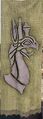 The banner of Lokris
 -
 A Spartan soldier with a belt adorned with griffins
 -
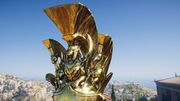 A griffin on the helmet of the Athenian Statue of Athena


Appearances[edit | edit source]
- Assassin's Creed: Origins (mentioned only)
- Assassin's Creed: Odyssey (artwork only)
- Legacy of the First Blade (artwork only)
- Discovery Tour: Ancient Greece (mentioned only)