

Basilica di Santa Croce
The Basilica of Santa Croce (Italian: Basilica di Santa Croce) is the principal Franciscan church in Florence. The church is also the burial place of several notable individuals including Michelangelo, Galileo, and Niccolò Machiavelli.[1]
History[edit | edit source]
Conception and Papal conflict[edit | edit source]
The largest Franciscan church in the world, the Basilica of Santa Croce contains frescos by Giotto di Bondone and a chapel in the cloister designed by Filippo Brunelleschi that is considered one of the masterpieces of Renaissance architecture.[2][3]
In 1322, the Pope declared that the Franciscans' vow of poverty was illegal and that Christ had, in fact, owned property and wanted his followers to own property. This meant that the Franciscans were forced to collect money and land, which would in turn go to the Pope.[2][3]
Renaissance[edit | edit source]
In 1476, Ezio Auditore assassinated Uberto Alberti during an unveiling of Andrea del Verrocchio's most recent work at the basilica.[4]
Around 1501, the Assassin Lo Sparviero rushed to the Santa Croce Plaza to deal with a ruffian harassing a civilian. He assassinated the ruffian and the oncoming guards before making his escape, climbing to the top of the nearby cathedral.[5]
The inventor Leonardo da Vinci regularly met with one of his friends near Santa Croce, but one one occassion, he was stalked by members of a counter-Assassin group called the Crows, as well as corrupt Medici guards seeking to "arrest" him. Sensing the danger, Leonardo used a signal taught to him by Ezio to summon Lo Sparviero, who was on watch duty nearby and protected him from his assailants.[6][7]
Later, around 1506, the basilica was forcefully taken over by Borgia soldiers, who locked down its courtyard. After one of the priests, Father Pio, informed Niccolò Machiavelli of the situation, he sent Lo Sparviero to investigate. Discovering that a Crow messenger was set to deliver a letter to the courtyard, Lo Sparviero caused a commotion by killing Vittorio, an undercover Templar agent. He then intimidated the messenger into giving him his letter, which detailed the Crows' plan to attack the Assassins in Rome.[8][9]
Modern times[edit | edit source]
In 2012, while Desmond Miles explored his ancestor Ezio Auditore's genetic memories in the Animus, a glyph left by Clay Kaczmarek could be found on the basilica.[10]
In 2016, the Basilica of Santa Croce was used as a simulated location by Abstergo Entertainment for their Identity Project. Like most of the simulated locations in the Project, the church had two aesthetic variations, and as such, could be utilized during daytime and during a storm.[11]
Gallery[edit | edit source]
-
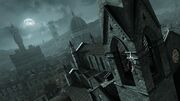 Ezio climbing the church at night
 -
 Database image of the basilica in Assassin's Creed: Identity
 -
 Concept art of the basilica in Assassin's Creed: Identity


Appearances[edit | edit source]
- Assassin's Creed II (first appearance)
- Assassin's Creed: Identity
References[edit | edit source]
- ↑
 Santa Croce, Florence on Wikipedia
- ↑ 2.0 2.1 Assassin's Creed II – Database: Santa Croce
- ↑ 3.0 3.1 Assassin's Creed: Identity – Database: Santa Croce (Identity)
- ↑ Assassin's Creed II – Judge, Jury, Executioner
- ↑ Assassin's Creed: Identity – Prologue (Identity)
- ↑ Assassin's Creed: Identity – Vengeful Eyes
- ↑ Assassin's Creed: Identity – Niccolò Machiavelli's journal – Entry #3: "Vengeful Eyes"
- ↑ Assassin's Creed: Identity – A Dangerous Trade
- ↑ Assassin's Creed: Identity – Niccolò Machiavelli's journal – Entry #9: "A Dangerous Trade"
- ↑ Assassin's Creed II
- ↑ Assassin's Creed: Identity – Contracts
| |||||||||||||||||||||||||||||||