

Charles Dickens
Charles John Huffam Dickens (1812 – 1870) was an English novelist and social critic, regarded as the greatest novelist of the Victorian era.
Biography[edit | edit source]
Early life[edit | edit source]
Charles Dickens was born in Portsmouth, England, as the second of eight children. His peaceful childhood changed in the summer of 1824 when his father John Dickens was arrested, forcing Charles to stop his education to work in Warren's Blacking Warehouse. After paying off his father's debt, his mother suggested he continue his work.[1]
He eventually finished his education and started to work at the law office of Ellis and Blackmore. Inspired by the theater plays in the city, he began his writing career by creating Oliver Twist, A Christmas Carol, and Great Expectations. His work became successful and brought him fame, and even Queen Victoria was pleased with his literature. Dickens was also interested in the supernatural and joined Cambridge's Ghost Club.[1]
Working with the Assassins[edit | edit source]
- "Here we are in the world's most advanced city, yet its citizens are so in thrall to the supernatural they leave themselves vulnerable to charlatans! Which is why I joined 'The Ghost Club', the first society in the world to look systematically at the phenomenon. Because truth, like a spirit, must be cajoled, before it will reveal itself!"
- ―Charles Dickens explaining his interest in the supernatural to the Frye twins, 1868.[src]-[m]

At some point in 1868, Dickens bumped into the Assassins Jacob Frye, Evie Frye, and Henry Green in Whitechapel.[2] Later, he welcomed the Frye twins as members of the "Ghost Club", and together they investigated local mysteries with supposed paranormal causes.[3]
For their first official Ghost Club investigation, the twins were tasked by Dickens to uncover the truth behind the terrorizing demon Spring-heeled Jack. The demon, as the twins soon discovered, was merely a violent cultist in disguise. They tracked down the impersonator to their workshop and eliminated the cult.[3]
The Ghost Club later solved a string of mysterious robberies wherein the townsfolk suspected a demon's work. The Frye twins tracked down the man responsible, Enzio Capelli, who was skilled in hypnotism.[4] However, they were hypnotized themselves and were ordered to perform thefts, until Dickens re-hypnotized them.[5]
The Club's investigation continued at 50 Berkeley Square, where Dickens retold the horror tales of a weeping girl's specter, the spirit of a screaming woman, and the disappearance of owners James Jasper and his nephew Edward. As they entered the residence, they were greeted with running children, whom they questioned. The children revealed a secret passage leading to a treasure in the house, giving the Frye twins a key. There, they discovered levers for scaring people and killed Jasper, now a madman and the one responsible for his home's "haunting". Dickens found the truth interesting and decided to adapt it for a novel.[6]

Another investigation involved examining a broken carriage in a junkyard, where Dickens spoke of haunted stories regarding the object. The Frye twins suspiciously got drowsy and slept beside the carriage, dreaming of love letters and a woman named Elizabeth. Though Dickens was curious to learn what had happened, the Assassins did not speak of it.[7]
The twins' last case involved the resurgence of Spring-heeled Jack. They pursued Jack, but he managed to evade them, performing a Leap of Faith while doing so. Later, the Ghost Club met in a pub to toast to their success in debunking superstition, though Evie acknowledged the possibility of something supernatural in their world.[8]
Later life and death[edit | edit source]
By 1869, Dickens wrote farewell readings in England, Scotland, and Ireland and began work on his final novel, The Mystery of Edwin Drood. However, in June 1870, he suffered a stroke and died the following day, leaving the novel unfinished. He was buried in the Poet's Corner of Westminster Abbey.[1]
Trivia[edit | edit source]
- During the memory "Recollection", Dickens mistook Enzio Capelli's name as Ezio, alluding to Ezio Auditore da Firenze's name.
Gallery[edit | edit source]
-
 Concept art of Dickens
 -
 Dickens speaking with Evie
 -
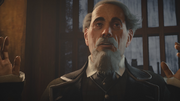 Dickens expressing his thoughts
 -
 Dickens returning to his drink
 -
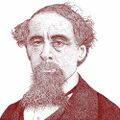 Charles Dickens in Who's In Your Blood?


Appearances[edit | edit source]
- Assassin's Creed: Syndicate (first appearance)
- XIXth Century Search Engine
- Assassin's Creed Roleplaying Game (mentioned only)
References[edit | edit source]
- ↑ 1.0 1.1 1.2 Assassin's Creed: Syndicate – Database: Charles Dickens
- ↑ Assassin's Creed: Syndicate – Somewhere That's Green
- ↑ 3.0 3.1 Assassin's Creed: Syndicate – Spring-Heeled Jack
- ↑ Assassin's Creed: Syndicate – Hell's Bells
- ↑ Assassin's Creed: Syndicate – Recollection
- ↑ Assassin's Creed: Syndicate – 50 Berkeley Square
- ↑ Assassin's Creed: Syndicate – Dead Letters
- ↑ Assassin's Creed: Syndicate – The Terror of London