

Archer

An archer, in a broad sense, is any individual armed with a bow. In a military context, archers are soldiers specifically trained in the use of the bow, who provide ranged support to those armed with melee weapons. For this reason, archers have been a virtually ubiquitous component of most armies throughout human history, until the advent of firearms.
Historically, city garrisons regularly utilized archers who patrolled rooftops and watched for possible enemies below. They usually initiated attacks against any intruder they noticed above ground. A well placed arrow could knock down an Assassin from a rooftop.
Once provoked by an enemy approaching within a meter or so, an archer would cease firing arrows, and draw his sword or blunt weapon. Though accurate and deadly from a distance, archers did not pose a serious threat in close combat. However, large groups of archers were capable of holding off an Assassin, with some attacking from close-range and others from a distance.
History[edit | edit source]
Classical Greece[edit | edit source]
During the Greco-Persian Wars and subsequent Peloponnesian War, both the Persian and Athenian armies relied on archers. At the Battle of Thermopylae in 480 BCE, many of the Spartans lead by King Leonidas I were cut down by volleys of Persian arrows.[1]
In the Peloponnesian War, the Spartans never used archers, as they considered the bow to be the weapon of cowards. By contrast, the Athenians regularly deployed archers in their armies. Bows were also the weapon of choice for sailors in the Athenian and Persian navies, and for pirates.[1]
Ptolemaic Egypt[edit | edit source]

Bows were a common weapon of choice in Egypt since the Old Kingdom. By the Ptolemaic era, both Egyptian and Roman soldiers employed archers in their armies. Additionally, infantrymen, cavalrymen and charioteers carried bows as one of their weapons.[2]
During his hunt of the Order of the Ancients, the Medjay and co-founder of the Hidden Ones, Bayek of Siwa, used a variety of bows as part of his arsenal, and was able to carry two bows on him at times. Bayek's wife and fellow Mentor of the Hidden Ones, Aya of Alexandria, also used a bow.[2]
Abbasid Caliphate[edit | edit source]
In the 9th century, the Abbasid Caliphate had archers patrol the rooftops of Baghdad and guard important locations, such as the Great Garrison and the Qasr Salih. Elite archers known as marksmen could detect and shoot at Enkidu, the eagle companion of the Hidden One Basim ibn Ishaq, if they caught him flying overhead, forcing Basim to deal with the marksmen before Enkidu could resume his reconnaissance.[3]
Anglo-Saxon England[edit | edit source]
The bow was a popular weapon of choice for Anglo-Saxons, Picts, and Vikings during the late 9th century. Archers were stationed on rooftops or the walls of cities and fortresses throughout England and Norway. The Order of the Ancients member Avgos Spearhand, also known by his moniker of "The Arrow", was quite skilled with the bow.[4]
High Middle Ages[edit | edit source]

At the time of the Third Crusade, archers were stationed on the rooftops of every city, and on top of large wooden watch towers in the Kingdom. They usually guarded important areas or people, and strictly enforced the city's laws against civilians being up on the rooftops. The Templar Talal was also particularly skilled in archery, and had his own contingent of archers as his personal guard.[5]
Templar archers were not as hostile as those in Acre, Jerusalem, or Damascus, and would usually only provoke a fight if the Assassin had already been exposed and was being pursued.[6]
Renaissance[edit | edit source]
Archers took advantage of two varieties of ammunition within the Renaissance: ordinary arrows, and fire-tipped ones. Though the former was widely used, the latter was only notably used in three instances: attacking the horse-drawn carriage of Ezio Auditore da Firenze and Leonardo da Vinci in the Apennine Mountains, shooting down the Flying Machine both as Ezio infiltrated the Palazzo Ducale,[7] and during the Battle for Forlì.[8] Aside from attacking passing Assassins, archers also hunted down pickpockets or Borgia messengers, should they cross their patrol.[7] This would oddly still apply to Borgia-allied archers, such as those in Rome before the liberation of said city.[9]

In Rome, crossbowmen and arquebusiers, each with superior weaponry, largely replaced and took on the role of archers. However, unlike archers, they did not possess a close combat weapon alongside their crossbows or firearms. Instead, they would use their weapon to parry blows, or keep their distance to continue firing. Archers could only be found guarding the Borgia War Machines; attacking the stolen Machine Gun from rooftops, the Naval Cannon from aboard ships, and the Bomber from archer towers.[9]
Upon building his own guild of Assassins, Ezio trained each of his apprentices in archery. Upon his signal, a group of them could fire a flurry of arrows at an indicated target; an action that was often referred to as an "Arrow Storm."[9]
Behind the scenes[edit | edit source]
In Assassin's Creed, archers of Acre were the only guards that wore hoods. Additionally, Saracen archers are portrayed using the same longbows as the Crusaders. Historically, Muslim armies used the composite bow, as it was the preferred bow of choice for fighting in the desert both on foot and on horseback. While the longbow is also a plausible choice of weapon for the Crusader archers, most armies on crusade would have been equipped with crossbows, as they were favored throughout Medieval Europe for their simplicity. [citation needed]
In Assassin's Creed II, two variations of archers could be found in assassination missions, Elite archers and Captain archers, each with trademark headgear and fighting capabilities. Captain archers were also seen in the memories "Honorable Thief" and "Everything Must Go", although the archers in the latter memory were actually thieves wearing the customary head wraps. Additionally, the garrisons of Florence, Forlì, and Rome also have archers in their armies. Historically, in Renaissance Italy, only the Venetians were able to train infantry archers, due to their trade networks with the Eastern Mediterranean and the Islamic world. The other Italian city-states used crossbowmen, the finest of which came from Genoa. [citation needed]
Gallery[edit | edit source]
-
 An Athenian archer
 -
 An Athenian marksman
 -
 A bandit archer
 -
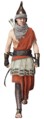 A Ptolemaic archer
 -
 An Abbasid archer
 -
 An Abbasid marksman
 -
 An Anglo-Saxon archer
 -
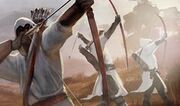 A team of Assassin archers


Appearances[edit | edit source]
- Assassin's Creed (first appearance)
- Assassin's Creed: Altaïr's Chronicles
- Assassin's Creed: Bloodlines
- Assassin's Creed II
- Assassin's Creed II: Discovery
- Assassin's Creed: Project Legacy
- Assassin's Creed: Brotherhood
- Assassin's Creed: Origins
- Assassin's Creed: Odyssey
- Assassin's Creed: Valhalla
- Assassin's Creed: Mirage
- Assassin's Creed: Nexus VR