

Hanging

Hanging is the suspension of a person by a noose around their neck. It has been a common capital punishment since medieval times in numerous countries. The first known account of execution by hanging was in Homer's Odyssey, and it is also a common method of suicide.[1]
Description[edit | edit source]
The majority of hanging executions were done on a constructed wooden platform, commonly referred to as the gallows. Connected to a series of pulleys was a lever which, when pulled by the executioner, would open a trap door below prisoners' feet. The sudden drop would snap their neck, in most cases killing them instantly, but in some cases they would instead suffocate.[2] After the Pazzi conspiracy, Medici followers hanged the bodies of the conspirators on the Palazzo della Signoria as a warning.[3]

Being hung from a tree branch was another method, with the Assassins Edward Kenway,[4] Adéwalé,[5] and Ratonhnhaké:ton,[6] as well as the Templar Shay Cormac, using rope darts to forcibly hang opponents from trees or other elevated positions.[7] The Assassin Aveline de Grandpré used a variant of this technique which involved a whip, hanging the target for a few seconds.[8]
In 1747, after being captured by British soldiers in Zwolle, the Templar Haytham Kenway and the mercenary Tom Smith were mistaken for deserters and sentenced to hang. Haytham escaped but was too late to stop Smith's execution, preventing him from interrogating the mercenary about his sister Jennifer Scott's kidnapping.[9]
During the French Revolution, angry revolutionary mobs hanged aristocrats from lamp-posts in Paris. One of the first victims was the Controller-General of Finances Joseph Foullon de Doué, whom the mob tried to hang three times before beheading him.[10]
During the Autumn of Terror in 1888, the rogue Assassin and serial killer Jack the Ripper kept two prison hulks at Deptford to hide the people he held prisoner. Chief Warden John Billingsworth had the habit of hanging the prisoners for his own sadistic pleasure.[11]
Notable executions[edit | edit source]
- Giovanni Auditore (29 December 1476), an Assassin falsely accused of treason[2][12]
- Federico Auditore (29 December 1476), Giovanni's son, also falsely accused[2][12]
- Petruccio Auditore (29 December 1476), Giovanni's son, also falsely accused[2][12]
- William Kidd (23 May 1701), hanged for piracy[13]
- Alexander Dolzell (1715), hanged for piracy[14]
- Stede Bonnet (10 December 1718), hanged for piracy[15]
- Jack Rackham (18 November 1720), hanged for piracy[15]
- Tom Smith (17 July 1747), hanged for deserting his post in the British Army[9]
Behind the scenes[edit | edit source]
Hanging was first seen in the cinematic trailer for Assassin's Creed in 2007, however it never made it into the final game.
Gallery[edit | edit source]
-
 Concept art of the House of Auditore's execution
 -
 Livia's hanged body
 -
 Edward Kenway saving a pirate from hanging
 -
 Ratonhnhaké:ton hanging a Redcoat with a rope dart
 -
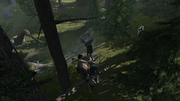 Ratonhnhaké:ton hanging a poacher


Appearances[edit | edit source]
- Assassin's Creed (promotional material only)
- Assassin's Creed II (first appearance)
- Assassin's Creed: Brotherhood
- Assassin's Creed: The Fall (mentioned only)
- Assassin's Creed III
- Assassin's Creed III: Liberation
- Assassin's Creed: Forsaken
- Assassin's Creed: Initiates
- Assassin's Creed IV: Black Flag
- Assassin's Creed: Black Flag
- Assassin's Creed: Pirates (mentioned only)
- Assassin's Creed: Memories (mentioned only)
- Assassin's Creed: Rogue
- Assassin's Creed: Unity
- Assassin's Creed: Syndicate (mentioned in Database entry only)
- Assassin's Creed: Identity (mentioned in Database entry only)
- Assassin's Creed: Shadows (mentioned in Database entry only)
References[edit | edit source]
- ↑
 Hanging on Wikipedia
- ↑ 2.0 2.1 2.2 2.3 Assassin's Creed II – Last Man Standing
- ↑ Assassin's Creed II – Farewell Francesco
- ↑ Assassin's Creed IV: Black Flag
- ↑ Assassin's Creed IV: Black Flag – Freedom Cry
- ↑ Assassin's Creed III
- ↑ Assassin's Creed: Rogue
- ↑ Assassin's Creed III: Liberation
- ↑ 9.0 9.1 Assassin's Creed: Forsaken
- ↑ Assassin's Creed: Unity – Database: Joseph Foullon de Doué
- ↑ Assassin's Creed: Syndicate – Jack the Ripper – Prisoners
- ↑ 12.0 12.1 12.2 Assassin's Creed: Identity – Database: Palazzo Della Signoria
- ↑ Assassin's Creed: Memories – Card: "William Kidd"
- ↑ Assassin's Creed: Black Flag – Chapter 21
- ↑ 15.0 15.1 Assassin's Creed IV: Black Flag – To Suffer Without Dying