


User:Nostalgia AC/Sandbox

|
"Information learned is more valuable than information given" This article is currently being reworked by Nostalgia AC as part of their apprenticeship. We ask that edits to this article are only minor or grammatical in nature until this warning is removed in order to not disrupt the major revamp. Should you have any questions regarding the revamp, please contact the apprentice at work's Mentor. |
Florence (Italian: Firenze) is a major city located in northern Italy. The city was home to the notable Auditore family during the late 15th century, as well as four districts: Santa Maria Novella, San Giovanni, San Marco, and Oltrarno.[1]
During the 15th century, the city was ruled by the venerable Lorenzo de' Medici, a member of the powerful Medici dynasty. However, the city later evolved into a dark age with the Bonfire of the Vanities, under the leadership of the mad monk, Girolamo Savonarola.[1]
History
Early development
Florence was founded during the Roman era, in the year 59 BCE, although it would be some 1,400 years before it developed into one of Italy's most important cities. During the Renaissance, the Medici family governed the city and had a focus on the arts and sciences, as well as an intricate banking system.

The city was also home to some of Italy's most notable figures, including Leonardo da Vinci, Sandro Botticelli, Michelangelo, Niccolò Machiavelli, and the infamous Auditore family.[2][1]
At some point after the year 1291, the Assassin Domenico Auditore and his son came to live in Florence, and adopted the name of Auditore. Under the guise of the Auditore, they quickly assimilated themselves into the city's nobility and became a well-respected and well-known family throughout Florence.[2][1]
The city flourished during the reign of Lorenzo de' Medici, and during this rule great artists, philosophers, and others contributed to the city's development. Various architectural marvels blessed the streets of Florence, such as Santa Maria Novella, Piazza della Signoria, the Duomo, and the Ponte Vecchio. Despite its beauty, however, Florence did have enemies, like most other cities in the region.[1]
Medici alliances
- Main article: Giovanni's travels

One of the Medici's foremost defenses against these enemies was the Assassin Giovanni Auditore da Firenze, who worked on behalf of Lorenzo de' Medici up until 1476. After the assassination of Galeazzo Maria Sforza, Lorenzo dispatched Giovanni to Milan to investigate. While surveying the crime scene, Giovanni discovered a Venetian coin in the possession of Giovanni Andrea Lampugnani, and immediately left for Venice.[1][3]
After obtaining a courier's letter in Venice, Giovanni returned to Florence where he shared the letter with Lorenzo de' Medici, Gonfalonierie Uberto Alberti, and a monk, Antonio Maffei. The monk translated the letter for Uberto, but the Gonfalonierie kept the translation to himself, and forced another monk to recreate the letter, claiming they were unable to decipher it. After duplicating the letter, Uberto gave it to Giovanni, who delivered it as the Templars had originally planned.[3]
After following the letter and confronting the Templar ringleaders in Rome, Giovanni returned to Florence, injured from his travels. However, Giovanni's rest was quickly interrupted when Father Maffei arrived at his home with a few guards, demanding Giovanni come with them. Giovanni sent his eldest son, Federico, to stall Antonio, and successfully escaped.[3]
Auditore execution
- Main article: Auditore execution
The presence of the Assassin in Florence soon proved problematic for the Templars, who sought control of the city. In response, the Templars organized the execution of Giovanni and his sons Federico and Petruccio, for the crime of treason. The Templars also attempted to have Ezio, another one of Giovanni's sons, arrested, but he managed to evade the guards.[1]

After this dilemma, Templar Grand Master Rodrigo Borgia and the Pazzi family, whom were also Templars, began to make plans to usurp control of the city, and to bring down the strong Medici family that had ruled Florence for so long.[1]
Birth of an Assassin
- Ezio: "And why are you going to teach me how to kill?"
- Paola: "I'm not. I'm going to teach you how to survive."
- —Ezio questions Paola's abilities.[src]
After the execution of his father and brothers, Ezio met with Annetta, a servant of his family. Annetta informed him that she had taken his sister, Claudia, and mother Maria to her sister's house near the Duomo.
Upon arriving, Ezio was surprised to learn that it was a brothel ran by Annetta's sister, Paola. Ezio talked with Paola briefly, and mentioned that he intended to assassinate Uberto Alberti as vengeance for unjustly executing his family. However, Paola interrupted Ezio, and told him that he was not a killer, but that she could turn him into one.
After their brief conversation, Paola met with Ezio, and instructed the Assassin on how to blend within a crowd. The two then took a walk around the exterior of the brothel, with Ezio blending constantly to avoid being noticed by guards. The two eventually concluded their walk and returned to the brothel, where Paola next taught Ezio how to steal.

Paola taught Ezio how to steal from citizens, and also to disappear once he had successfully stolen from a person. As a test, Paola ordered Ezio to steal from a few people in the vicinity of the brothel. After Paola had finished her instruction with the Assassin, she told him to go and see Leonardo da Vinci, a family friend and local artist so that he could repair his hidden blade. Ezio was at first skeptical to meeting Leonardo, believing he was no more than just a painter, but Paola convinced him to meet Leonardo.
Ezio made his way through the streets of Florence, and eventually reached Leonardo's small workshop. He knocked on Leonardo's door, and was greeted by a concerned Leonardo. The two then discussed the affairs of Ezio's family, before Ezio asked Leonardo if he could repair his hidden blade. Leonardo then studied the blade's design, before concluding that he could not repair the blade without its original plans. However, Leonardo noticed Ezio's Codex page, and began to decipher it, telling Ezio to wait, despite his confusion.
After a while, Leonardo finished deciphering the Codex page, and used its plans to successfully repair the blade. Da Vinci then handed over the hidden blade, and began to explain it to Ezio. While they were conversing, however, a guard interrupted them with loud poundings on the door, demanding Leonardo let him in.

Leonardo told Ezio to wait, and opened the door. The guard confirmed he was Leonardo, and led him to the adjacent courtyard, and began to violently interrogate him.
While the guard kicked Leonardo on the ground, demanding answers, Ezio emerged from the workshop and entered the courtyard. He silently approached the guard from behind, and assassinated him, saving his friend. Leonardo then thanked Ezio, and told him to put the body inside with the other ones given to him by the city for research. After disposing of the body with the others, Ezio thanked Leonardo again, before departing from his workshop.
Vengeance
Once he had finished training with Paola and had gotten his hidden blade repaired, Ezio tailed the traitorous Gonfaloniere and former family friend, Uberto Alberti. Ezio made his way to the rooftop of a small building overlooking the square in front of the Basilica di Santa Croce, where he witnessed Uberto arguing with Lorenzo de' Medici. The two were in a heated discussion about each other's power and its usage. However, their discussion ended abruptly as Uberto entered the Santa Croce cloister to attend an unveiling of Verrochio's latest work.
Ezio then began to make his way across the rooftops, and hired a group of courtesans to accompany him. He made his way to the front arch, and used his courtesans to distract the brutes guarding the entrance. With the guards out of the way, Ezio entered the small party, and began to search for his target

After surveying the area and locating Uberto, Ezio utilized his new skills and blended with the various groups of nobles. He was eventually noticed by Uberto, however, and was forced to assassinate the traitor in plain sight. In his final conversation, Uberto told Ezio that he would have done the same to save the ones he loved, to which Ezio replied harshly that he had. The Assassin then stepped away from the Gonfalonierie's body, and proclaimed that his family still existed to a group of attending nobles.
Pazzi Conspiracy
- Rodrigo: "Gentlemen. Tomorrow, a new sun rises over Firenze. May the Father of Understanding guide us"
- All: "May the Father of Understanding guide us"
- —The Templar conspirators bidding each other farewell after their meeting.[src]
Once he returned to Florence in 1478 after assassinating Vieri de' Pazzi in San Gimignano, Ezio met with his old friend, Leonardo da Vinci. Ezio told Leonardo of how he needed to see someone while in the city, but Leonardo quickly hushed him and directed him to the Mercato Vecchio, where he could find the fox.[1]

Ezio located La Volpe in the Mercato, but was pick pocketed by a thief before he could talk to the fox. The Assassin pursued his target, and eventually cornered him on a rooftop. As Ezio threatened the thief, however, La Volpe himself emerged next to Ezio, and introduced himself. La Volpe then informed Ezio that he could give him all the information he needed once the Assassin was ready to go, and handed him his money pouch back before leaving.[1]
Ezio met up later that night with La Volpe, and the two traversed the rooftops and made their way to Santa Maria Novella. Once there, Volpe explained to Ezio that the meeting was to take place under the church, before wishing Ezio good luck and leaving. The Assassin then followed Volpe's information, and made his way under the church.[1]
After making his way through the church using a system of intricate levers, Ezio found himself in a large open room with two large doors leading out of the room. The Assassin then stealthily assassinated a couple of patrolling guards, and made his way up to a small balcony overlooking the room. Next, he pulled another lever, opening the doors loudly. At the sight of the door's opening, several guards emerged and began to search the room furiously. Ezio performed a Leap of Faith down from the balcony, and then picked off the guards one by one. After defeating all of the guards, he began to walk towards the gate, where an agile guard stood. However, the guard immediately began to flee to the other guard post, leaving the Assassin with no choice but to pursue him.[1]

Ezio chased the guard in a lengthy sequence, but eventually silenced him before he could alert the other guards. He then proceeded to the guard outpost, and killed the guards who had been sitting at a table. After slaying the guards, he climbed up to a small alcove where he activated yet another lever. The lever lifted the gate and led him down a tight hallway. Along the side of this hallway was a small window, which Ezio used to spy on the Templar meeting.[1]
While observing the Templar meeting, Ezio witnessed five Templars discussing a plot to kill Lorenzo de' Medici and obtain the Florentine throne. One of the Templars described that they had numerous weapons for the operation, as well as the support of the Pope, Sixtus IV. The Templars talked about morning mass at the Duomo, and how they would strike then. After promising Rodrigo that they would not fail in their operation, the conspirators ended their meeting, saying that a new sun would rise over Florence tomorrow.[1]
After collecting a Assassin's seal from the tomb of Darius, Ezio departed from underneath the church, and emerged near the city waterfront. Ezio met with La Volpe on a nearby bench, and the two concluded that the Templar conspirators planned to kill Lorenzo de' Medici and his brother, Giuliano de' Medici in the morning at the Duomo. Ezio then set out for the church to prevent the attacks.[1]

Once at the Duomo the next morning, Ezio blended with the crowd, and observed Lorenzo and his brother walk towards the church and wave gleefully at the spectators. However, before Ezio could act, Bernardo Baroncelli ran at Giuliano and stabbed him in the chest, knocking him over. After getting up, Francesco de' Pazzi and Bernardo both attacked Giuliano, and killed him after slashing and stabbing him furiously. Lorenzo was saved only by the timely arrival of the only citizen remaining in attendance, Ezio Auditore.[1]
Ezio brought Lorenzo back to his home, the Palazzo Medici, where he received medical attention from his loyal servant, Angelo Ambrogini. Once there, Lorenzo asked Ezio why he had helped him, and the Assassin explained that he too had lost family members to the Pazzi, and identified himself as Ezio Auditore. Lorenzo immediately explained to Ezio how he knew Ezio's father, and that Giovanni had understood honor and loyalty and had been a good man. Then, out of nowhere, a guard rushed in and informed the group that Francesco de' Pazzi was leading a battalion behind the Palazzo della Signoria, and that their supporters would be killed if Francesco took over the building. Lorenzo then told Ezio that he needed to help save their city, and Ezio departed for the Palazzo.[1]

The Assassin navigated the city, and eventually made his way to the rooftops across from the Palazzo della Signoria. Francesco, who was on top of one of the ramparts, called out to Ezio, and demanded his guards slay him. However, Ezio climbed up one of the Palazzo's sides, and then scaled some scaffolding in order to reach the top level which Francesco was on. The Assassin moved in for the kill, and Francesco pleaded for his guards, before jumping off the front of the building, only to land safely in a haystack.[1]
Once Ezio saw his target leap from the building, he immediately followed suit and began to pursue him. He chased Francesco across the Florentine rooftops, and eventually assassinated him. Afterwards, fellow Templar conspirator and head of the Pazzi family, Jacopo de' Pazzi, went to the Palazzo in an attempt to calm down the clamorous citizens. However, Jacopo witnessed a group of citizens tie a noose around Francesco's neck and drape him over the front of the Palazzo. Upon seeing his nephew's dangling body, Jacopo fled the city on his horse.[1]
Bonfire of the Vanities
- Main article: Bonfire of the Vanities

After Lorenzo de' Medici's death in 1492, the city gradually began to decline under the new leadership of Lorenzo's son, Piero de' Medici. Piero was not a man of the people like his father, and was not popular with Florence's citizens. Two years into Piero's rule, in 1494, the Dominican friar Girolamo Savonarola took control of the city and exiled Piero after picking up the Apple of Eden from Ezio Auditore's wounded body in Forlì.[4]
After losing the Apple, the Assassins identified its new owner as Savonarola, and headed for Florence. Ezio Auditore and Niccolò Machiavelli met in the Oltrarno District in 1497, where they discussed how to topple Savonarola's rule, and formulated a plan in which they would assassinate each of Savonarola's nine corrupted lieutenants. After this meeting ended, Ezio left to assassinate the first of Savonarola's nine lieutenants, the Painter.[4]
The Painter
Ezio made his way through the city to a small bonfire which the Painter was hosting. Once arriving there, Ezio heard the Painter speak about how artistic tools were actually those of the Devil's. The Painter also spoke about how he was deceived by the Devil in his speech, and how each citizen needed to dedicate themselves to Savonarola, the prophet.

After his speech, Ezio observed the Painter closely, and assassinated him. In his final words, the Painter told Ezio how he was sorry, and that even though he had been controlled by the Apple, he still blamed himself for his actions.[4]
The Captain Guard
After assassinating the Painter, Ezio made his way to a small courtyard. Once inside of the courtyard, Ezio was greeted by the Captain Guard, who labeled him as a challenger, falling into Savonarola's trap created to kill any who opposed him. After his brief speech, guards descended from the rooftops and attacked the Assassin.
While Ezio fended off the attacking guards, the Captain Guard exclaimed that the Assassin was but a rebel seeking fame and glory, and that he would fail, like the other opposers had. However, Ezio eventually defeated the guards, and climbed the scaffolding the Captain Guard was standing on, and assassinated him. During his final conversation with Ezio, the Captain Guard told Ezio he wished he had been stronger so he could have resisted Savonarola's deception.[4]
The Nobleman
As Ezio entered the market district of the city, he was greeted by the Nobleman standing on top of a roof of a building across from him. Ezio argued briefly with the Nobleman about power and control in the city, but then the Nobleman began to free-run across the rooftops in order to warn Savonarola.
Ezio pursued the Nobleman, who immediately called for guards while being chased. However, Ezio caught up the lieutenant, and silenced him before he could reach Savonarola. In his final words, the Nobleman attempted to justify his behavior by claiming that he was a victim of the Apple, but Ezio explained to him that he made a choice and allowed himself to be controlled by the Apple.[4]
The Priest

While walking around the city, Ezio noticed the third of Savonarola's lieutenants, the Priest, praying on top of the Basilica di Santa Maria del Fiore. The Assassin then began to make his way up the side of the church, assassinating guards on his way up.
Upon reaching the top of the church, Ezio assassinated the entranced Priest. In his last conversation, the Priest claimed that he thought Savonarola had preached the word of God, and that he wanted badly to believe him.[4]
The Merchant
For his next target, Ezio made his way down to the Florentine waterfront, where he observed the Merchant residing on a ship just offshore. The Merchant was busy ordering his men to secure crates and speaking of how he would withhold food from any of those who opposed Savonarola.
Ezio made his way onto the ship, assassinating guards on the docks and patrolling guards on the ship. After clearing the ship of all but the Merchant himself, the Assassin struck the Merchant from the deck just above him. In his final words, the Merchant remained true to his beliefs, stating that "sometimes the people must be told what to think."[4]

The Doctor
At the Ospedale degli Innocenti, one of Savonarola's lieutenants, the Doctor, refused to provide medical treatment for those who opposed Savonarola. He believed their contrasting views brought their illnesses upon them, and denied them any medical attention.
While Ezio navigated his way through the small crowd, he overheard the Doctor speaking of how the citizens needed to accept Savonarola as their leader, and to stop supporting the Medici. However, Ezio assassinated the Doctor, and ended his unjust rules for medical treatment. In his final conversation, the Doctor told Ezio that he killed a healer, but admitted that he had grown intoxicated with the power he had commanded.[4]
The Farmer
In a rural area of Florence, the Farmer had stopped supplying the city with hay, believing that those who opposed Savonarola considered him low-class. The Farmer ordered his guards to keep a watchful eye over the hay and to stay observant. While patrolling with his guards, the Farmer remarked that without the basic source of hay, the rebellions would quell and the opposers will stand down.
As the farmer moved about the area, Ezio moved into strategic positions within hay bales, waiting to strike. At last Ezio moved into the open from the hay bales, and assassinated the Farmer. In his last conversation, the Farmer claimed that he became fed up of the insults directed at him, and only desired respect.[4]
The Condottiero
The Condottiero closed down the Ponte Vecchio, and placed his mercenaries at both sides of the bridge, blocking passageway along the bridge. The Condottiero claimed it would be reopened when the people of Florence accepted Savonarola as their new leader. He also shouted angrily that the citizens had but one duty, to submit to Savonarola, and that the city was theirs, and therefore resistance was pointless.
Ezio Auditore made his way towards the balcony on which the Condottiero was speaking on, and eliminated the guards protecting him. He then assassinated the Condottiero, and in turn, reopened the Ponte Vecchio. In his final conversation, he was asked by Ezio as to why he chose to be charmed by Savonarola, and the Condottiero claimed he wanted more than just nobility in the city.[4]
The Preacher
At a Florentine church, the Preacher was spewing a corrupted sermon to the Florentine people. The Preacher said that they all had to rid themselves of their material pleasures, and that this was not known to him until his "eyes were opened" by Savonarola.
While the Preacher continued his sermon, Ezio made his way onto the top of the church. However, before Ezio could strike, the Preacher began to flee from the Assassin. Though the Preacher nearly outrun Ezio, he was unable to outlast the Assassin and was eventually killed by Ezio. In his final words, the Preacher admitted that he was not under the control of the Apple, but had actually already believed all that he himself had said.[4]
After Ezio assassinated each of Savonarola's nine lieutenants, La Volpe, Paola, and Machiavelli rallied the citizens in front of the Palazzo Pitti. Once they had gathered, Savonarola emerged from his palazzo, and demanded to know as to why the crowd had convened at his home. He also remarked that they all should be cleansing themselves and their houses. However, after Savonarola continued to fail at taming the rowdy crowd, he raised the Apple and told the people that they would do as he commanded, and submit to him. Ezio then hurled a throwing knife at the monk, injuring his hand and causing him to drop the Apple. A Borgia guard picked up the Apple though, and began to flee with it. However, Ezio managed to assassinate the guard after a lengthy chase across the rooftops.[4]
Once he had obtained the Apple again, Ezio made his way to the Palazzo della Signoria, where a group of citizens had been taking Savonarola. At the Palazzo, an angry mob of citizens had tied Savonarola to a stake, and were prepared to burn him. However, Ezio ran up on stage and stabbed Savonarola in the cheek, claiming no one deserved to die in such pain. After ending Savonarola's suffering, Ezio made a speech to the crowd.[4]

In his speech, the Assassin described how the loss of his loved ones filled his mind with thoughts of vengeance, but the guidance of a few strangers taught him to look past his instincts. He then informed the crowd that they did not need anyone to tell them what to do, and that everyone needed to follow their own path. Lastly, he informed the crowd not to follow him, or anyone else, before walking of stage to meet his fellow Assassins.[4]
Affiliations with the Roman Assassins Guild
During the early 15th century, Ezio Auditore sent his apprentices from the Roman Assassins Guild to Florence various times to complete several contracts. The contracts all varied in their details, but most were basic missions, such as delivering reports, stealing weapons, or delivering forged pardons. These missions usually gave the guild anywhere from 400 to 1000 florins, but the apprentices themselves gained little experience from these minor tasks.[5]
Return to Florence
Sometime in the 1520s, an elderly Ezio Auditore returned to Florence with his new wife, Sofia Sartor, and their two children, Flavia Auditore and Marcello Auditore. The family moved into a villa in the Florentine countryside, tending to the vineyards next to their house. However, Ezio believed that he was being hunted, and so he had other Assassins stay with him at his home, most notably Shao Jun, a Chinese female Assassin.[6]
Database entry
Founded by Julius Caesar in 59 B.C.E., Florentia, as it was called by the Romans, quickly became a center of commerce.
After the sacking of Rome, in the 5th Century, the Ostrogoths took over. Under their rule, the city was constantly under attack from the Byzantines, who sent the population level below 1,000. The Lombards came to power in the 6th Century, ending the Byzantine assaults.
Florence grew to a population of 80,000 in the 14th Century, of which 25,000 were working in the wool industry. In 1378, a major revolt of the lower class led to the wool combers rising up and seizing the government of the city. Their progressive, radical democracy lasted for less than 2 months before the upper classes seized control once more, but the revolt so terrified the rich, that a century later it was still discussed in hushed tones, much as the 1960s hippy movement is today.
The Albizzi family became the de facto rulers after the revolt. Worried about the rise of the Medici family, who were newly rich bankers rapidly gaining influence in Florence, Maso and Rinaldo Albizzi imprisoned Cosimo de' Medici and exiled him in 1433. But Cosimo gained influence behind the scenes, and rose to power in 1434, exiling the entire Albizzi family except for Luca, who had been loyal to Cosimo. Luca Albizzi joined the Signoria, the ruling body of Florence, as Gonfaloniere, succeeding Cosimo's old friend Ilario Auditore in 1442.
Under the Medici family, which built impressive public buildings and supported such luminaries as Michelangelo, Leonardo and Botticelli, the Renaissance began with Florence securely at its center.[1]
Landmarks
- Santa Maria Novella District
- Mercato Vecchio
- Santa Maria Novella
- Basilica di San Lorenzo

- San Marco District
- Bottega di Leonardo a Firenze
- Palazzo Medici
- Ospedale degli Innocenti
- Basilica di Santa Croce
- San Giovanni District
- Palazzo della Signoria
- Santa Trinita
- Palazzo Auditore
- Oltrarno District
- Palazzo Pitti
Assassination targets
- Uberto Alberti; Gonfaloniere of Florence (DNA Sequence 2)
- Francesco de' Pazzi; Patriarch of the powerful Pazzi family (DNA Sequence 4)
- Girolamo Savonarola; Mad monk in control of Florence during the Bonfire of the Vanities (DNA Sequence 13)
Trivia
- The Battistero di San Giovanni is missing from the front of the main entrance to the Santa Maria del Fiore, despite being built several hundred years before the events of the game.
- Florence appears in Assassin's Creed: Brotherhood as a multiplayer location, and is a location that Ezio can send his Apprentices to for contracts.
- Florence also appears in four of the Cristina Memories, the suppressed memories of Ezio's past.
- During the Bonfire of the Vanities sequence, the sky over Florence becomes covered by dark clouds, in contrast to how it used to be bright and vibrant during the Medici's rule.
- Florence is featured as a city in the Mediterranean Defense mini-game in Assassin's Creed: Revelations.
Gallery
-
A map of Florence.
-
 Ezio surveying the area from atop a view point.
 -
 Ezio killing a guard along a Florentine rooftop.
 -
Florence, as seen from a bird's eye view.
-
Ezio fleeing from guards in a typical Florentine street.
-
Florence, as it appears in the Assassin's Creed: Brotherhood multiplayer.
-
A map of Florence in the Assassin's Creed: Brotherhood multiplayer.
-
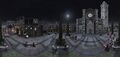 A panoramic view of the city streets.
 -
An older Ezio in Florence with fellow Assassin Shao Jun.


References
- ↑ 1.00 1.01 1.02 1.03 1.04 1.05 1.06 1.07 1.08 1.09 1.10 1.11 1.12 1.13 1.14 1.15 1.16 1.17 1.18 1.19 Assassin's Creed II
- ↑ 2.0 2.1 Assassin's Creed II: Auditore Family Crypt
- ↑ 3.0 3.1 3.2 Assassin's Creed: Lineage
- ↑ 4.00 4.01 4.02 4.03 4.04 4.05 4.06 4.07 4.08 4.09 4.10 4.11 4.12 4.13 Assassin's Creed II: Bonfire of the Vanities
- ↑ Assassin's Creed: Brotherhood
- ↑ Assassin's Creed: Embers
| |||||||||||||||||||||||||||||||||||||