

Monteriggioni

|
Ezio, my friend! How may I be of service? This article is in desperate need of a revamp. Please improve it in any way necessary in order for it to achieve a higher standard of quality in accordance with our Manual of Style. |
Monteriggioni is a city in and commune of Tuscany, Italy, featuring in Assassin's Creed II and Assassin's Creed: Brotherhood. Built in the 13th Century by the overlords of Siena, Monteriggioni was actively involved in the defense of Tuscany against Florentine attempts to gain more territory. At the front of this conflict was the Auditore family who became the city's rulers and protectors. They constructed Monteriggioni's famous walls, which can still be seen today. The Auditore also built the centerpiece of the town, the Villa Auditore.
History
In 1290, Domenico Auditore founded the Villa Auditore and quite possibly Monteriggioni itself. Domenico and his son used Monteriggioni as a base of operations in their silent war against the Templars. In 1296, Domenico built the Auditore Family Crypt in the city. He hid the armor of Altaïr Ibn-La'Ahad in a vault under the villa, which could only be unlocked by Assassin seals that were lost through time.
In 1454, Mario Auditore was made sole ruler of Monteriggioni when his brother, Giovanni Auditore, moved to Florence. The city had been very frequently attacked by Florence, which caused Monteriggioni to fall into disrepair.
In 1476, Mario's nephew, Ezio Auditore da Firenze, took shelter in Monteriggioni and later became the city's biggest investor and co-ruler with Mario. For over twenty years, Monteriggioni prospered. In 1499, Cesare Borgia led an attack on Monteriggioni that included the use of cannons, which heavily reduced the city's population and wealth. However, the city was rebuilt again and the Auditore continued their control over it.
The town withstood many attacks from Florence, as the Medici wanted to control Tuscany, until the city was betrayed in 1554 by Giovannino Zeti, the keeper of the garrison and a Florentine exile, who was allowed to return to Florence in exchange for the keys. However, due to the Auditore's good relations with the Medici, they were allowed to continue their leadership over it.
In 2012, Desmond Miles, Lucy Stillman, Shaun Hastings and Rebecca Crane, modern day Assassins, set up a temporary hideout in the sanctuary beneath the Villa Auditore.

Renovations
In his adventures, Ezio discovered the Auditore Family Villa in the city of Monteriggioni, perched atop a Tuscan hill. The city had become run down and was badly in need of repair

when he first arrived. The Villa became Ezio’s domain, and through time, he was able to invest in renovations, bringing the city back to its former glory. Ezio decorated the villa with famous renaissance paintings, a collection of his weapons and armor, and stored a variety of collected objects. Also flags are added to buildings, changing from the Auditore symbol to the Assassin's logo when the villa is fully renovated.
A list of what Ezio will be able to improve/add to the Villa :
- A bank (which will grant a great boost in the Villa's fame) at the cost of 1500 florins for the first renovation, 5000 for the second and 9000 for the third one. It does nothing else.
- A Doctor. There is no need to "buy" the doctor as his shop is already open. However, the player can renovate his shop two times at the cost of 3000 and 5000 florins.
- A Tailor at the cost of 1000 florins. The subsequent renovations cost 2500 and 5000 florins.
- A Blacksmith. Similar to the doctor, the Blacksmith is already open. It is still possible to renovate the shop two more times for 7000 and 12000 florins.
- An Art Merchant for 1000 florins. 5000 and 8000 florins are respectively for the second and third renovations.
- Restore the Church (for a fame's boost similar to the one obtained with the bank) at the the cost of 4000 florins.
- Restore the Well (another fame boost) at the cost of 4000 florins.
- Add a Thieves' Guild (fame boost) at the cost of 3000 florins.
- Add a Brothel (fame boost) at the cost of 3000 florins.
- Add Military Barracks (fame boost) at the cost of 3000 florins.
- Reopen the Mine (fame boost) at the cost of 4000 florins.
Gameplay
Any and every improvement to the city will help develop the local economy, rewarding the player with periodic income, which can be reinvested in the city or used elsewhere in the game. Renovations usually add treasure chests to the renovated area. For however much you spend on renovations, you will be paid back 10% of the investment per 20 minutes. For example, if you renovate the well for 4000 florins, your periodic income generated from the town will increase by 400.
Furthermore any renovations for the four "active" shops (art merchant, blacksmith, doctor and tailor) will allow the player a discount up to the 15% (with three renovations) of the item's original price
There is a chest inside the Villa, in the same room where you decide on renovations, that will store the money your investments earn you. It receives a deposit (deposit varies based on total investment amount) every 20 minutes, but has a limit on how much it can hold. If you let it fill, any excess will be lost to Claudia. For this reason, it's recommended to return to the Villa to empty it periodically. It is set up to where the chest will be full after 4 deposits (every 1 hour and 20 minutes).
Throughout the city, Ezio can find eight statuettes of some of the gods worshipped in ancient Rome. Each pair of statuettes belong to a pedestal, and every completed pedestal rewards Ezio with a hefty 2,000 florin reward.
If a player earns enough Uplay points, they can also unlock the Auditore Family Crypt, another secret location that reveals more about the Auditore family and its humble origins.
Gallery
-
Map of Monteriggioni
-
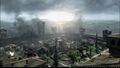 Siege of Monteriggioni
 -
Siege of Monteriggioni
-
Modern day Assassins in the Sanctuary.
-
 Ezio riding through a besieged Monterrigioni.
 -
Shaun and Desmond arguing in the Sanctuary.


