

Genghis Khan
- "A dark tide rises to the east – an army of such size and power that all the land is made quick to worry. Their leader is a man named Temujin, who has adopted the title Genghis Khan. He sweeps across the lands, conquering and subsuming all who stand in his way."
- ―Altaïr Ibn-La'Ahad's Codex, page 29.[src]
Genghis Khan (ᠴᠢᠩᠭᠢᠰᠬᠠᠭᠠᠨ; c. 1162 – 1227), born Temüjin (ᠲᠡᠮᠦᠵᠢᠨ), was the founder and first Great Khan of the Mongol Empire, which he ruled from 1206 until his death.
Utilizing a Sword of Eden, Genghis Khan established what would later become the largest contiguous empire in history.[1]
Biography
Early life
Temüjin was born circa 1162 in the Khentii Mountains within the territories of the Khamag Mongol, to Yesügei a chieftain of the Borjigin clan and his principal wife Hö'elün from the Olkhonud clan.[2]
Rise to power
At a later point in his life, Temüjin obtained a Sword of Eden,[1] and used its abilities to eventually found the Mongol Empire in 1206 and ruled it as Genghis Khan.[2]
By the year 1217, the Levantine Assassins' Mentor Altaïr Ibn-La'Ahad correctly suspected that Genghis Khan's rise to power was due in part to a Sword of Eden. Thus, Altaïr, his wife Maria, and his son Darim traveled to Mongolia intending to assassinate Khan and retrieve the Piece of Eden.[3]
By 1221, following a two year invasion,[2] Genghis Khan had control of the Silk Road trade route, bringing it under one cohesive political environment.[4]
Death

In August 1227, Altaïr and his allies located Genghis Khan in Xingqing around the time his Mongol forces were besieging the city; the Mongolian Assassin Qulan Gal shot Genghis Khan's horse with an arrow, dismounting the Mongol Emperor and providing Darim the chance to kill him[5] with a crossbow bolt.[6]
Legacy
Genghis Khan's grandson, Hülegü Khan, later destroyed most of the Assassins' strongholds in the Levant after a failed attempt on his life in 1256, effectively erasing the Levantine Assassins' power.[7]
After his death, a literary work on Genghis Khan and his family was written. A copy of the work was later purchased by Ezio Auditore in Constantinople in the 16th century.[8]
In 2016, Rebecca Crane estimated that Genghis Khan likely had sixteen million living descendants.[9]
Gallery
-
 Genghis Khan utilizing the Sword of Eden in combat
 -
 Genghis Khan leading his Mongol army
 -
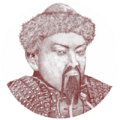 Potrait of Genghis Khan as shown in Who's In Your Blood?
 -
 Genghis Khan admiring the Sword of Eden in his possession
 -
 Genghis Khan calling for aid
 -
 The Khan fleeing with his men
 -
 The Khan's body after his assassination


Appearances
- Assassin's Creed II (first mentioned)
- Assassin's Creed: The Secret Crusade (mentioned only)
- Assassin's Creed: Revelations (mentioned only)
- Assassin's Creed: Initiates (mentioned only)
- Assassin's Creed IV: Black Flag (mentioned only)
- Assassin's Creed: Memories (first appearance)
- Assassin's Creed: Last Descendants – Tomb of the Khan (mentioned only)
- Assassin's Creed film (appears in promotional material only)
- Assassin's Creed: Reflections
- Echoes of History (mentioned only)
- Assassin's Creed Roleplaying Game – Forging History (mentioned only)
References
- ↑ 1.0 1.1 Assassin's Creed: Memories
- ↑ 2.0 2.1 2.2
 Genghis Khan on Wikipedia
- ↑ Assassin's Creed: The Secret Crusade – Chapter 48
- ↑ Who's In Your Blood?
- ↑ Assassin's Creed: The Secret Crusade – Chapter 50
- ↑ Assassin's Creed: Reflections – Issue #2
- ↑ Assassin's Creed Encyclopedia
- ↑ Assassin's Creed: Revelations
- ↑ Assassin's Creed: Last Descendants – Tomb of the Khan – Chapter 6
| |||||||||||||||||||||||||