
Frontier

|
Ezio, my friend! How may I be of service? This article is in desperate need of a revamp. Please improve it in any way necessary in order for it to achieve a higher standard of quality in accordance with our Manual of Style. |

The Frontier was a vast area of countryside located in the northeast United States. It played host to several battles of the French and Indian War and the American Revolutionary War.
The Frontier consisted mostly of wilderness inhabited by a variety of animals, and hunting regions split up the land, in which different types of game could be tracked and killed.
While Boston and New York City were the primary settlements located near the Frontier, the countryside itself also contained several small Native American and European settlements. These included the towns of Lexington, Concord, Charlestown, and the Kanien'kehá:ka village, Kanatahséton. Small logging, fishing, and mining posts could also be located.
As the Revolutionary War waged on, the condition of the towns would change as a consequence of the battles. At different times, battalions of men could be found readying for a charge, or injured soldiers could be spotted.
Regions
The Frontier was split into twelve hunting grounds. Each region contains four different types of wildlife:
Black Creek
Located at the most north-western area of the Frontier, Black Creek contained hares, cougars, elk and bobcats.
Concord
Located roughly in the center of the Frontier, Concord included hares, raccoon, beavers and deer.
Diamond Basin
The Diamond Basin hunting region was located north of Concord. It included cougars, deer, wolves and beavers.
Great Piece Hills
Great Piece Hills was located in the north-east, just south of John's Town. It included hares, wolves, elk and bobcats.
John's Town
Located at the most north-eastern area of the Frontier, John's Town included hares, foxes, elk and bears.
Kanièn:keh
Located at the central northern area of the Frontier, Kanièn:keh included hares, foxes, deer and cougars.
Lexington
Located roughly in the center of the Frontier, west of Concord, Lexington included raccoon, hares, foxes and deer.
Monmouth
The Monmouth hunting ground included elk, raccoon, hares and foxes.
Packanack
The Packanack hunting ground included hares, beavers, bobcats and bears.
Scotch Plains
The Scotch Plains hunting ground included raccoon, deer, hares and cougars.
Troy's Wood
The Troy's Wood hunting ground included hares, deer, elk and wolves.
Valley Forge
The Valley Forge hunting ground included hares, beavers, raccoon and elk.
Trivia
- The Frontier was 1.5 times larger than Assassin's Creed: Brotherhood's Rome, making it the largest map in the Assassin's Creed series to date.
- The Frontier was the setting for about a third of the main storyline content for Assassin's Creed III.
- It was impossible to reduce notoriety in the Frontier.
- The entrance to the Grand Temple could be found in the far north of the Frontier, in the Black Creek region.
- In the Monmouth region, a red enemy dot appeared on the mini map inside a small building with injured men inside. However, the dot belonged to a woman who paced the inside of the building, and did not attack Connor. It is unknown why she was identified on the mini map.
- During the events of The Tyranny of King Washington, the Frontier was littered with the dead bodies of slaughtered Redcoats and other civilians. Dead horses could also be found.
Gallery
-
 Concept art of wolves in the Frontier
 -
 Connor traversing the Frontier
 -
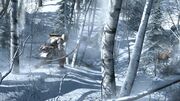 Connor in the Frontier stalking a deer with his bow in hand
 -
 Connor navigating a Frontier canal
 -
Connor entering a Continental camp in the Frontier
-
 A battle in the Frontier
 -
 Snow covered forest in the Frontier
 -
 The Frontier in Spring
 -
 Concept art of a Frontier battlefield
 -
 Concept art of the Frontier by William Wu
 -
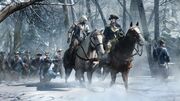 Connor riding with George Washington through the Frontier
 -
 Connor in conflict with British soldiers in the Frontier

.jpg)
.jpg)

.jpg)


.jpg)
.jpg)

Reference