

Florence Nightingale
- "It takes a long time to change things. But I'm not going anywhere, Miss Frye."
- ―Florence Nightingale speaking to Evie Frye, 1868.[src]
Florence Nightingale (12 May 1820 – 1910) was an English social reformer and the founder of modern nursing.
One of the creators of modern medicine, Nightingale popularized nurses. She became known as The Lady with the Lamp for walking the battlefields of the Crimean War and caring for the wounded by lamplight.
Biography
Early life
Driven by faith and conviction at a young age, Florence Nightingale wanted to become a nurse when she was still a child, however, her parents disapproved of the idea. She would tell her associates that she received a message from God when she was 17, telling her to become a nurse.
Florence trained herself in nursing and worked at the front lines during the Crimean War in 1854, assembling and organizing a total of 38 volunteer nurses and 15 nuns.
She eventually returned home in 1855 and established a program to train nurses, the Nightingale fund. She also published the Notes on Nursing, a journal for training nurses and founded the Nightingale Training School in St. Thomas's Hospital in 1859 and 1860 respectively.
Working in the Lambeth Asylum
In 1868, Florence Nightingale worked as a doctor in the Lambeth Asylum shortly after the assassination of Dr. John Elliotson. During this time, defective and fraud tonics and medicine were sold to the townsfolk. Nightingale catered the needs of the poor and the children.
Sometime in 1868, she aided the Assassin Evie Frye and the woman's ill child accomplice, Clara O'Dea. Nightingale requested Evie to recover the needed supplies for the cure.
After the encounter, Nightingale distributed authentic medicine and even petitioned for regulations to be placed.
Later life
She advocated for women's rights and better sanitation in London and India for the rest of her life. She eventually died on 13 August 1910 in her sleep at age 90.
Trivia
- Nightingale was one of the first people to have her voice recorded and preserved.
Gallery
-
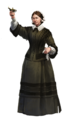 Concept art of Nightingale

Reference