


Darius


Darius was a member of the Persian branch of the Assassin Order during the Achaemenid Dynasty.
In the 5th century BCE, the Templars supported the reigns and conquests of the Achaemenid kings Darius I and his son Xerxes I.[1] Using a newly-created weapon named the hidden blade, which would later become the Assassins' iconic weapon, Darius personally assassinated King Xerxes I.[2]
By the Renaissance, Darius' remains were transferred to the Santa Maria della Visitazione in Florence, Italy, where his body lay with an Assassin Seal needed to get access to the armor of Altaïr Ibn-La'Ahad hidden inside the sanctuary in Monteriggioni. In 1478, his sarcophagus was opened by Ezio Auditore da Firenze, who took the Seal and later obtained the armor.[2]
Trivia
- Darius was the first known user of the hidden blade.
- Darius had all ten fingers, as seen on the picture on the right. Whether this is artistic license or oversight is unknown.
- Unlike most other Assassins, Darius had his hidden blade on his right arm.
- His tomb lies within the catacombs of Santa Maria Novella in Florence.
- It is hinted that Darius might have been Xerxes' son. In reality, Xerxes was assassinated by Artabanus, the commander of the royal bodyguard and the most powerful official in the Persian court, with the help of a eunuch, Aspamitres. Greek historians give contradicting accounts of events. According to Ctesias (in Persica 20), Artabanus then accused the crown prince Darius, Xerxes' eldest son, of the murder and persuaded another of Xerxes' sons, Artaxerxes, to avenge the patricide by killing Darius. But according to Aristotle (in Politics 5.1311b), Artabanus killed Darius first and then killed Xerxes. After Artaxerxes discovered the murder, he killed Artabanus and his sons.
Gallery
-
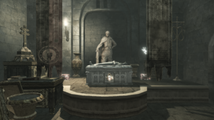 The sarcophagus of Darius.
 -
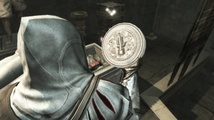 The Seal of Darius.
 -
Darius's insignia.


References