

Charles Dickens

|
He who increaseth knowledge, increaseth sorrow. This article contains spoilers, meaning it has information and facts concerning recent or upcoming releases from the Assassin's Creed series. If you do not want to know about these events, it is recommended to read on with caution, or not at all. |
- "Should you ever be in the mood for a tale or two, you can always find me where the ale is warm and tempers are hot!"
- ―Charles Dickens, 1868.[src]

Charles John Huffam Dickens (7 February 1812 – 9 June 1870) was an English writer and social critic, regarded as the greatest novelist of the Victorian era.
Biography
Early life
Charles Dickens was born on Portsmouth as the second of eight children. His peaceful childhood changed in the summer of 1824 when his father John Dickens was arrested. Charles was forced to stop his education to work in Warren's Blacking Warehouse. After paying off his father's debt, his mother suggested to continue his work.
He eventually finished his education and Dickens started to work at the law office of Ellis and Blackmore. Charles was inspired by the theater plays in the city and he began his writing career creating Oliver Twist, A Christmas Carol, and Great Expectations. His work became successful and brought him fame, and even the Queen Victoria was pleased with his literature. Dickens was also interested in the supernatural and joined the Cambridge's Ghost Club.
Working with the Assassins
At some point in 1868, he bumped into the Assassins Jacob Frye, Evie Frye, and Henry Green in Whitechapel. Later, Dickens welcomed the Frye twins as members of the "Ghost Club", and together they investigated local mysterious with supposed paranormal causes.
For their first official Ghost Club investigation, the twins were tasked by Dickens to uncover the truth behind the terrorizing demon Spring-Heeled Jack. The demon, however, as the twins discovered, was merely a violent cultist in disguise. They tracked down the impersonator through their workshop and eliminated the cult.
On such investigation involved examining a broken carriage in the junkyard, in which he spoke of haunted stories regarding the object. Jacob suspiciously got drowsy and slept beside the carriage, only to dream of love letters and a woman named Elizabeth. Though Dickens was curious of what happened, the Assassin did not speak of it.
Their investigation continued on 50 Berkeley Square as Dickens retold the horror tales of a weeping small girl's specter, a spirit of a screaming young woman, and the owners James Jasper and his nephew Edward's sudden disappearance. The pair was greeted with running children whom they chased and questioned. The children revealed a secret passage leading to a treasure in the house, giving Evie a key. There, they discovered levers for scaring people and killed James Jasper, now a madman and the one responsible for the scaring. Dickens found the truth interesting and decided to adapt it for a novel.
Later life
By 1868 to 1869, Charles Dickens wrote farewell readings in England, Scotland, and Ireland and woked with his final novel, The Mystery of Edwin Drood. However, in June 1870, Dickens suffered a stroke and died the following day, leaving the novel unfinished. He was buried in the Poet's Corner of Westminster Abbey.
Gallery
-
 Promotional art of Dickens
 -
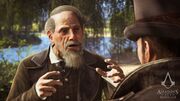 Dickens speaking with Jacob


Reference