


George Washington


|
He who increaseth knowledge, increaseth sorrow. This article contains spoilers, meaning it has information and facts concerning recent or upcoming releases from the Assassin's Creed series. If you do not want to know about these events, it is recommended to read on with caution, or not at all. |
- "The time is now near at hand, which must determine whether Americans are to be free men or slaves. Our cruel and unrelenting enemy leaves us only the choice of brave resistance or the most abject submission. We have, therefore, to resolve to conquer or die!"
- ―George Washington before a battle with the British Army.[src]
George Washington (1732 – 1799) was the commander of the Continental Army in the American Revolutionary War from 1775 to 1783, and served as the first President of the United States from 1789 to 1797.
Washington served during the French and Indian War with the British and Edward Braddock and came across a Templar named Haytham Kenway. Although he attempted to prevent it, Kenway managed to assassinate Braddock.[1]
The British burned a Mohawk village during the war, killing many villagers, including Kaniehti:io, the mother of Ratonhnhaké:ton, who was Haytham's son.[1]
Both prior to and during the course of the American Revolution, Washington became an associate of Ratonhnhaké:ton, now known as Connor, who had become an Assassin. Connor helped the Continental Army with preventing an assassination plot on Washington and executing the assassinations of British soldiers and helped discover the treason of Benedict Arnold.[1]
With Haytham's urging, Connor later discovered Washington's involvement with the burning of his village and the current plan to attack it, with the intent to prevent Mohawk attacks on the Continental Army. Connor soon withdrew his assistance to the Continentals, but eventually aided them to win the war.[1]
At some point, Washington also came into possession of an Apple of Eden.[2]
Biography
Seven Years' War
Battle of the Monongahela
During the Seven Years' War, George Washington was involved in the French and Indian War, the North American conflict. On July 9, 1755, in what would later become known as the Battle of the Monongahela, George Washington rode with Edward Braddock along a road amidst a wooded area.[1]
Suddenly, their forces were attacked by Indians and a Templar named Haytham Kenway, who was disguised as a British soldier. Haytham attempted to assassinate Braddock, but was interrupted by Washington, who shot his horse from under him.[1]
As Washington readied to fire a shot into Haytham, he was distracted by Kaniehti:io, letting Haytham pursue and kill Braddock. Washington managed to rally a retreat of the remaining forces.[1]
Burning of Kanatahséton
In 1760, to prevent attacks from Mohawk forces, the British burned the village of Kanatahséton, killing many natives including Kaniehti:io. Haytham's young son Ratonhnhaké:ton had been absent at the time, but returned in time to witness the death of his mother.[1]
American Revolutionary War
Commander-in-chief
On June 16, 1775, George Washington was appointed Commander-in-chief of the Continental Army by the Continental Congress in Philadelphia. Present at the time of his acceptance was Ratonhnhaké:ton. Washington delivered a speech declaring his gratitude and regarding his task and how he felt he did not equal to the command he had been granted.[1]
After Washington's speech, Ratonhnhaké:ton, now known as Connor, was introduced to Washington by Samuel Adams. Following his acceptance, Washington took note of the disappointment of Charles Lee, who had wished to be appointed Commander-in-chief himself. Washington bid farewell to Adams and Connor and went to calm Lee from his frustrations.[1]
Assassination plot
On June 17, 1775, at the Battle of Bunker Hill, Connor discovered a plot to assassinate Washington from a letter he retrieved from the body of John Pitcairn, masterminded by Charles Lee. Connor soon wanted to inform Washington of the plot, as well as let him know of Templar presence, but his mentor Achilles persuaded him from it.[1]
Achilles introduced Connor to Benjamin Tallmadge, who revealed that Thomas Hickey had helped plan the plot. Connor journeyed to New York with Benjamin, where they soon found Hickey. Connor pursued Hickey through New York until the two were arrested and taken to a prison, where Charles Lee and Haytham Kenway moved Hickey from his cell.[1]
Connor nearly found a way to escape from prison, but it was revealed to be a trap by Haytham, Lee and Hickey, who informed Connor that he'd be executed the next day. When he awoke the next morning, Connor was taken to the gallows, where a large crowd, including Washington was in attendance.[1]
However, with the help of Achilles, Connor managed to escape and kill Hickey. Washington left and began his journey back to Philadelphia.[1]
Connor's resignation
Washington eventually met with Connor once again in 1777 at Valley Forge. Washington informed Connor of a traitor by the name of Benjamin Church and informed him of missing supply caravans. Washington ordered Connor to find Church and put a stop to his actions.[1]
During his mission, Connor came upon his father, Haytham, who he worked with to further complete his mission, as Church had also let the Templars down. Eventually, the two located Church and he was soon assassinated.[1]
When Connor returned to Washington with Haytham, Haytham revealed that troops Washington was with during the French and Indian war were responsible for the burning of his village in 1760 that killed his mother and a new plan to stop his Mohawk village from aiding the British.[1]
After Haytham and Washington confronted each other, Connor angrily called for the argument to cease. Connor told Washington and Haytham not to follow or oppose him and soon left to stop the plans from being carried through, intending to cease his helping of the Continental Army.[1]
After the Revolution
Connor met with Washington in New York after the war was over. The general was thinking about retiring to Mount Vernon, but Connor felt that Washington should continue to lead the country in peacetime as well as war. The two also played a game of bocce.[1]
Trivia
- In the alternate-history DLC for Assassin's Creed III, The Tyranny of King Washington, Washington succumbs to the temptation of power and declares himself King of America. Over the course of three installments, Connor must confront a man who was once his friend, and dethrone him at any cost.[3]
Gallery
-
Washington's concept art.
-
George Washington concept illustration.
-
 Concept art of Connor and Washington in the Frontier.
 -
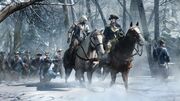 Connor and Washington riding on horseback through the Frontier.
 -
Washington at the Battle of Long Island.
-
 King George Washington.

.jpg)


References