Welcome to Assassin's Creed Wiki! Log in and join the community.


Tuscany: Difference between revisions
Jump to navigation
Jump to search
imported>Vatsa1708 m Reverted edits by Linkpogo (talk | block) to last version by Assassino96 |
imported>The Crimson Eagle m →Trivia: Yet more past tense changes. |
||
| Line 25: | Line 25: | ||
==Trivia== | ==Trivia== | ||
*In ''[[Assassin's Creed II]]'', Tuscany was coupled to San Gimignano as one area on the map, but [[Monteriggioni]] is also classed as part of Tuscany. | *In ''[[Assassin's Creed II]]'', Tuscany was coupled to San Gimignano as one area on the map, but [[Monteriggioni]] is also classed as part of Tuscany. | ||
*This | *This was the only location in Assassin's Creed II without a special Animus introduction. | ||
==Gallery== | ==Gallery== | ||
Revision as of 16:59, 29 July 2012

Tuscany (Italian: Toscana) is a region in central Italy. It is known for its beautiful landscapes, its rich artistic legacy and vast influence on high culture. Tuscany is widely regarded as the true birthplace of the Italian Renaissance, and has been home to some of the most influential people in the history of arts and science, such as Dante, Botticelli, Michelangelo, and Leonardo da Vinci.
It housed many beautiful cities such as Florence and Siena, in addition to small communes such as Monteriggioni and San Gimignano. Ezio Auditore lived in Florence until his father and brothers were executed, and was forced to relocate to Monteriggioni.
Trivia
- In Assassin's Creed II, Tuscany was coupled to San Gimignano as one area on the map, but Monteriggioni is also classed as part of Tuscany.
- This was the only location in Assassin's Creed II without a special Animus introduction.
Gallery
-
 A map of Tuscany.
 -
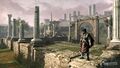 The Roman Amphitheater in Tuscany.
 -
 Florence.
 -
 Siena as it appears in Assassin's Creed: Brotherhood.


Source
| |||||||||||||||||||||||||||||||||||||