

Sanctuary of Delphi: Difference between revisions
imported>Darman36 |
imported>Darman36 No edit summary |
||
| Line 4: | Line 4: | ||
The '''Sanctuary of Delphi''', or simply '''Delphi''', is best known as the ancient home of an [[Pythia|Oracle of Apollo]]. Located on the slopes of [[Grand Mount Parnassos|Mount Parnassos]] in [[Phokis]], [[Greece]], the sanctuary houses the [[Temple of Apollo, Delphi|Temple of Apollo]] where people sought an audience with the Pythia. | The '''Sanctuary of Delphi''', or simply '''Delphi''', is best known as the ancient home of an [[Pythia|Oracle of Apollo]]. Located on the slopes of [[Grand Mount Parnassos|Mount Parnassos]] in [[Phokis]], [[Greece]], the sanctuary houses the [[Temple of Apollo, Delphi|Temple of Apollo]] where people sought an audience with the Pythia. | ||
Due to the Oracle's presence, as well as for being regarded as the 'Navel of the World', the Sanctuary of Delphi housed many gifts brought by people either seeking or thanking for the Pythia's guidance. These included, but were not limited to, the monuments of [[Monument of Epigones|Epigones]]<ref name="Epigones">''[[Assassin's Creed: Odyssey]]'' – [[Historical Locations | Due to the Oracle's presence, as well as for being regarded as the 'Navel of the World', the Sanctuary of Delphi housed many gifts brought by people either seeking or thanking for the Pythia's guidance. These included, but were not limited to, the monuments of [[Monument of Epigones|Epigones]]<ref name="Epigones">''[[Assassin's Creed: Odyssey]]'' – [[Historical Locations]] – Phokis: "Monument of Epigones"</ref> and [[Monument of Militiades|Militiades]],<ref name="Militiades">''Assassin's Creed: Odyssey'' – [[Historical Locations]] – Phokis: "Monument of Militiades"]]</ref> the [[Naxian Sphinx]],<ref name="Sphinx">''Assassin's Creed: Odyssey'' – [[Historical Locations]] – Phokis: "Naxian Sphinx"]]</ref> the [[Korkyraean Bull]],<ref name="Bull">''Assassin's Creed: Odyssey'' – [[Historical Locations]] – Phokis: "Korkyraean Bull"]]</ref> and [[Tripods of the Deinomenids]].<ref name="Tripod">''Assassin's Creed: Odyssey'' – [[Historical Locations]] – Phokis: "Tripod of the Deinomenids"</ref> | ||
==History== | ==History== | ||
===Mythology=== | ===Mythology=== | ||
King [[Laios]] of [[Thebes, Greece|Thebes]] was on his way to the Sanctuary when he met his son [[Oedipous]], who slew him.<ref name="Grave of Laios">''Assassin's Creed: Odyssey'' – [[Historical Locations | King [[Laios]] of [[Thebes, Greece|Thebes]] was on his way to the Sanctuary when he met his son [[Oedipous]], who slew him.<ref name="Grave of Laios">''Assassin's Creed: Odyssey'' – [[Historical Locations]] – Phokis: Grave of Laios]]</ref> | ||
===Dark period=== | ===Dark period=== | ||
In the late 7th century BCE, [[Battus I of Cyrene|Battus I]] of [[Thera]] visited the sanctuary to seek advice on various matters, including one on his home, which had been plagued with a severe drought with no rain for seven years. The Pythia gave him a prophecy, tasking him to travel to [[Libya]] to establish a city on advice from Apollo. Following her advice, Battus led a group of Therans to Libya, founding the city of [[Cyrene]] and the colony of [[Cyrenaica]].<ref name="Cyrene">''[[Discovery Tour: Ancient Egypt]]'' – [[ | In the late 7th century BCE, [[Battus I of Cyrene|Battus I]] of [[Thera]] visited the sanctuary to seek advice on various matters, including one on his home, which had been plagued with a severe drought with no rain for seven years. The Pythia gave him a prophecy, tasking him to travel to [[Libya]] to establish a city on advice from Apollo. Following her advice, Battus led a group of Therans to Libya, founding the city of [[Cyrene]] and the colony of [[Cyrenaica]].<ref name="Cyrene">''[[Discovery Tour: Ancient Egypt]]'' – [[Tours: The Founding of Cyrene]]: "Cyrene"</ref> | ||
===Archaic period=== | ===Archaic period=== | ||
| Line 26: | Line 26: | ||
Assassin's Creed Odyssey The Secrets of Delphi Uncovered Ubisoft NA | Assassin's Creed Odyssey The Secrets of Delphi Uncovered Ubisoft NA | ||
ACOd-Phokis-SanctuaryofDelphi-eve.jpg|The sanctuary in the evening | ACOd-Phokis-SanctuaryofDelphi-eve.jpg|The sanctuary in the evening | ||
ACOD Sanctuary of Delphi Concept Art.jpg|Concept Art of the Sanctuary of Delphi | |||
DTAG - Sanctuary of Apollo Aquarelle.png|Sanctuary of Apollo at Delphi, aquarelle by Albert Tournaire (1862-1958) / 1894 (Modern period) | |||
</gallery> | </gallery> | ||
| Line 33: | Line 33: | ||
*''[[Assassin's Creed: Origins]]'' {{Mo}} | *''[[Assassin's Creed: Origins]]'' {{Mo}} | ||
*''[[Assassin's Creed: Odyssey]]'' {{1st}} | *''[[Assassin's Creed: Odyssey]]'' {{1st}} | ||
*''[[Discovery Tour: Ancient Greece]]'' | |||
*''[[Echoes of History]]'' {{Mo}} | *''[[Echoes of History]]'' {{Mo}} | ||
Revision as of 18:57, 5 July 2022
- "The Sanctuary of Delphi. The gods themselves watch over this land."
- ―Kassandra visiting the sanctuary, 431 BCE.[src]

The Sanctuary of Delphi, or simply Delphi, is best known as the ancient home of an Oracle of Apollo. Located on the slopes of Mount Parnassos in Phokis, Greece, the sanctuary houses the Temple of Apollo where people sought an audience with the Pythia.
Due to the Oracle's presence, as well as for being regarded as the 'Navel of the World', the Sanctuary of Delphi housed many gifts brought by people either seeking or thanking for the Pythia's guidance. These included, but were not limited to, the monuments of Epigones[1] and Militiades,[2] the Naxian Sphinx,[3] the Korkyraean Bull,[4] and Tripods of the Deinomenids.[5]
History
Mythology
King Laios of Thebes was on his way to the Sanctuary when he met his son Oedipous, who slew him.[6]
Dark period
In the late 7th century BCE, Battus I of Thera visited the sanctuary to seek advice on various matters, including one on his home, which had been plagued with a severe drought with no rain for seven years. The Pythia gave him a prophecy, tasking him to travel to Libya to establish a city on advice from Apollo. Following her advice, Battus led a group of Therans to Libya, founding the city of Cyrene and the colony of Cyrenaica.[7]
Archaic period
In 480 BCE, King Leonidas I of Sparta consulted the Pythia at the sanctuary. Along with the Pythia, several members of the Cult of Kosmos warned Leonidas about waging war with King Xerxes I of Persia, who had begun an invasion of Greece. Leonidas defied the Pythia and the Cult, calling for Dienekes to ready his men for battle.[8]
Classical period
Decades later during the Peloponnesian War, Leonidas' granddaughter Kassandra visited the Sanctuary as well at the suggestion of her friend Barnabas.[9] During the time in the sanctuary, Kassandra became acquainted with residents such as Auxesia and Koragos,[10] as well as reunited with a former Kephallonia friend, Photios.[11]
Behind the scenes
According to Greek legend, the sanctuary was named at the behest of the god Apollo, who appeared to the priests in the shape of a dolphin.[12]
Gallery
-
 The sanctuary in the evening
 -
 Concept Art of the Sanctuary of Delphi
 -
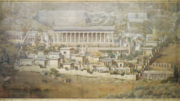 Sanctuary of Apollo at Delphi, aquarelle by Albert Tournaire (1862-1958) / 1894 (Modern period)


Appearances
- Assassin's Creed: Origins (mentioned only)
- Assassin's Creed: Odyssey (first appearance)
- Discovery Tour: Ancient Greece
- Echoes of History (mentioned only)
References
- ↑ Assassin's Creed: Odyssey – Historical Locations – Phokis: "Monument of Epigones"
- ↑ Assassin's Creed: Odyssey – Historical Locations – Phokis: "Monument of Militiades"]]
- ↑ Assassin's Creed: Odyssey – Historical Locations – Phokis: "Naxian Sphinx"]]
- ↑ Assassin's Creed: Odyssey – Historical Locations – Phokis: "Korkyraean Bull"]]
- ↑ Assassin's Creed: Odyssey – Historical Locations – Phokis: "Tripod of the Deinomenids"
- ↑ Assassin's Creed: Odyssey – Historical Locations – Phokis: Grave of Laios]]
- ↑ Discovery Tour: Ancient Egypt – Tours: The Founding of Cyrene: "Cyrene"
- ↑ Assassin's Creed: Odyssey – Bully the Bullies
- ↑ Assassin's Creed: Odyssey – Consulting a Ghost
- ↑ Assassin's Creed: Odyssey – Age Is Just a Number
- ↑ Assassin's Creed: Odyssey – Photios's Pre-Tirement
- ↑
 Delphi on Wikipedia