Welcome to Assassin's Creed Wiki! Log in and join the community.

Providence: Difference between revisions
Jump to navigation
Jump to search
imported>Trever09 |
imported>Masterforger Deleted misinformation in Trivia |
||
| Line 11: | Line 11: | ||
*As per Ubisoft's way of playing with the times, this ship is not typical of the era, as it is extremely large and lavish for a trading vessel. | *As per Ubisoft's way of playing with the times, this ship is not typical of the era, as it is extremely large and lavish for a trading vessel. | ||
*The ''Providence'' appears to have three decks, much like the larger warships of the time, though Haytham can only access the open upper deck and the deck immediately below it. | *The ''Providence'' appears to have three decks, much like the larger warships of the time, though Haytham can only access the open upper deck and the deck immediately below it. | ||
==Gallery== | ==Gallery== | ||
Revision as of 19:18, 6 December 2012


The Providence was a British trading vessel during the French and Indian War, which was captained by Samuel Smythe.
The ship was constructed in 1748, and made several trips between Britain and the North American colonies. It also made infrequent visits to the West Indies and carried goods like tea, molasses and cloth. Accompanying this, the Providence was also equipped with a cannon, which was mainly used as protection against pirates. One of its owners, Reginald Birch, was also the Grand Master of the Templars.
As such, Birch's fellow Templar Haytham Kenway boarded the Providence for his trip to Boston in 1754, through Birch's influence.
Trivia
- As per Ubisoft's way of playing with the times, this ship is not typical of the era, as it is extremely large and lavish for a trading vessel.
- The Providence appears to have three decks, much like the larger warships of the time, though Haytham can only access the open upper deck and the deck immediately below it.
Gallery
-
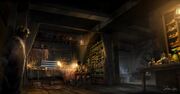 Concept art of the doctor's cabin by Max Qin.
 -
 Alternate concept art of the doctor's cabin by Max Qin.
 -
 Concept art of the ship's kitchen by Max Qin.
 -
 Concept art of the ship's living quarters by Max Qin.


Reference