

Ponte Vecchio: Difference between revisions
imported>Vatsa1708 m Changed image with proper one. Removed second image since only the character was visible.. |
imported>Uditore mNo edit summary |
||
| Line 1: | Line 1: | ||
{{era|ac2}} | {{era|ac2}} | ||
{{WP-REAL}} | {{WP-REAL}} | ||
[[File:Www.totalvideogames.com_AC2_S_094_Florence_PonteVecchio_69742_size_655_1500.jpg|thumb|315px|Ponte Vecchio]] | {{WPlocations}} | ||
[[File:Www.totalvideogames.com_AC2_S_094_Florence_PonteVecchio_69742_size_655_1500.jpg|thumb|315px|Ponte Vecchio.]] | |||
The '''Ponte Vecchio''' (English: '''Old Bridge''') was the primary crossing of the [[Wikipedia:Arno|Arno River]] within the city walls of [[Florence]] during the Renaissance. | The '''Ponte Vecchio''' (English: '''Old Bridge''') was the primary crossing of the [[Wikipedia:Arno|Arno River]] within the city walls of [[Florence]] during the Renaissance. | ||
| Line 26: | Line 27: | ||
==References== | ==References== | ||
{{reflist}} | {{reflist}} | ||
{{ACII}} | {{ACII}} | ||
[[Category:Florence]] | [[Category:Florence]] | ||
[[Category:Landmarks]] | [[Category:Landmarks]] | ||
Revision as of 01:45, 17 October 2011
The Ponte Vecchio (English: Old Bridge) was the primary crossing of the Arno River within the city walls of Florence during the Renaissance.
In 1476, the bridge was the site of a large street fight between the friends of Ezio Auditore da Firenze and of Vieri de' Pazzi, who had recently developed a strong rivalry over the issues involving their fathers. Two years later, Ezio met with the ruler of Florence, Lorenzo de' Medici, here to discuss the Pazzi Conspiracy.[1]
In 1498, the bridge was blockaded by one of the followers of Girolamo Savonarola, who would demand payment for passage.[2]
Database Entry
This famous bridge spans the Arno at it[sic] narrowest point. The original version was presumably constructed by the Romans, but the first written records only appear in 996.
Two previous incarnations of the bridge were swept away in floods before the present structure was built in 1345. A tower was built at the southeast corner to defend it.
The bridge consists of three segmental arches. It has always had shops lining the central passageway, a feature which seems extraordinary now but was common during the Renaissance.
At first, butchers took up residence there, but over time they were pushed out by jewellers, souvenir shops and creepy teenagers chaining locks to the bridge's railing and throwing the keys into the river in a bid for eternal love, not realizing that the locks will be cut off later that day by disgruntled polizia.
Everlasting, indeed.[1]
Gallery
-
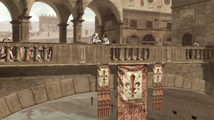 Ezio and Lorenzo talking at the Ponte Vecchio
.png)

References