Welcome to Assassin's Creed Wiki! Log in and join the community.


Palazzo Pitti: Difference between revisions
Jump to navigation
Jump to search
imported>Freddy Rodriguez Adding categories |
imported>Amnestyyy m removing category |
||
| Line 3: | Line 3: | ||
[[File:Palazzo_Pitti.jpg|thumb|right|The Palazzo Pitti]] | [[File:Palazzo_Pitti.jpg|thumb|right|The Palazzo Pitti]] | ||
The '''Palazzo Pitti''' is a building in the [[Oltrarno District|Oltrarno]] district of [[Florence]]. | The '''Palazzo Pitti''' is a building in the [[Oltrarno District|Oltrarno]] district of [[Florence]]. [[Girolamo Savonarola]] took up residence here after taking over Florence in 1494, and lived there until the people of Florence, hating his anti-materialist laws, finally burned him at the stake on May 23 1498.<ref name="bonfire">''[[Assassin's Creed II]]'' - [[Bonfire of the Vanities (DLC)|Bonfire of the Vanities]]</ref> | ||
==Database Entry== | ==Database Entry== | ||
| Line 17: | Line 17: | ||
{{ACII}} | {{ACII}} | ||
[[Category:Assassin's Creed II DLC]] | [[Category:Assassin's Creed II DLC]] | ||
[[Category:Landmarks]] | [[Category:Landmarks]] | ||
[[Category:Florence]] | [[Category:Florence]] | ||
Revision as of 19:47, 21 August 2011

The Palazzo Pitti is a building in the Oltrarno district of Florence. Girolamo Savonarola took up residence here after taking over Florence in 1494, and lived there until the people of Florence, hating his anti-materialist laws, finally burned him at the stake on May 23 1498.[1]
Database Entry
Intended as a grand display of wealth by Luca Pitti, the Pitti Palace was left incomplete when Luca ran out of money and died in 1472. The severe Roman-style architecture is reminiscent of the craggy stone arches of the ancient imperial aqueducts found outside Rome.[1]
References
Gallery
-
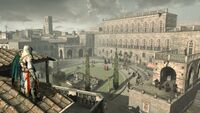 Ezio overlooking the Palazzo Pitti.
