


Painting gallery: Difference between revisions
imported>Smoke3723 Added citations |
imported>Nostalgia AC Added some portraits of targets - why were they removed? |
||
| Line 10: | Line 10: | ||
===Gallery=== | ===Gallery=== | ||
<gallery widths="160" position="center" captionalign="center" captiontextcolor="#ffffff" bordersize="medium"> | <gallery widths="160" position="center" captionalign="center" captiontextcolor="#ffffff" bordersize="medium"> | ||
Emilio Barbarigo portrait.jpg|[[Emilio Barbarigo]]. | |||
RodrigoPainting.jpg|[[Rodrigo Borgia]]. | |||
Uberto.jpg|[[Uberto Alberti]]. | |||
Francesco.jpg|[[Francesco de' Pazzi]]. | |||
VieriPainting.jpg|[[Vieri de' Pazzi]]. | |||
Adoration of the Magi - By Leonardo.png|''Adoration of the Magi'', by [[Leonardo da Vinci]]. | Adoration of the Magi - By Leonardo.png|''Adoration of the Magi'', by [[Leonardo da Vinci]]. | ||
Annucation.jpg|''Annunciation'', by Leonardo da Vinci. | Annucation.jpg|''Annunciation'', by Leonardo da Vinci. | ||
Revision as of 21:38, 27 November 2011
- "I have created a small gallery in the Villa. Monteriggioni's artists are always welcome to study them."
- ―Mario Auditore to Ezio Auditore about the Villa's gallery in 1454.[src]
The painting gallery was an area where paintings purchased by Ezio Auditore were stored and showcased. A gallery was first present in the Villa Auditore, and later another was created in the Tiber Island headquarters.
Villa Auditore
At some point during 1454, Mario Auditore created a painting gallery in the Villa, taking advantage of his brother's connections in Florence to import fine art.[1] From 1476 to 1499, Ezio gathered various pieces of Renaissance artwork from art merchants in several different cities, which were displayed in the villa's painting gallery. These paintings were the works of many prominent artists.[2]
Gallery
-
 Adoration of the Magi, by Leonardo da Vinci.
 -
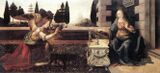 Annunciation, by Leonardo da Vinci.
 -
 Baptism of Christ, by Andrea del Verrocchio.
 -
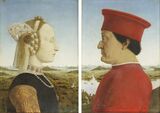 Battista and Federico, by Piero della Francesca.
 -
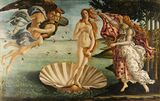 Birth of Venus, by Sandro Botticelli.
 -
 Eve, by Albrecht Dürer.
 -
 Federico da Montefeltro, by Pedro Berruguete.
 -
 Francesco delle Opere, by Pietro Perugino.
 -
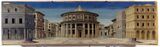 Ideal City, by Francesco di Giorgio Martini and Piero della Francesca.
 -
 Jupiter and Io, by Antonio Allegri da Correggio.
 -
 La Fornarina, by Raphael.
 -
 Lady with an Ermine, by Leonardo da Vinci.
 -
 Leda and the Swan, by Leonardo da Vinci.
 -
 Madonna and Child, by Filippo Lippi.
 -
 Pallas and the Centaur, by Sandro Botticelli.
 -
 Portrait of a Musician, by Leonardo da Vinci.
 -
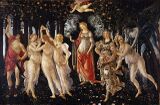 Primavera, by Sandro Boticelli.
 -
 Sacred and Profane Love, by Titan.
 -
Saint Chrysogonus, by Michele Giambono.
-
 Saint Jean Baptiste, by Leonardo da Vinci.
 -
 San Sebastian, by Antonelloda Messina.png.
 -
 Simonetta Vespucci, by Piero de Cosimo.
 -
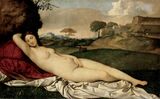 Sleeping Venus, by Giorgione.
 -
 St-Francis in Ecstasy, by Giovanni Bellini.
 -
 St-Jerome, by Leonardo da Vinci.
 -
 St-Jerome in his study, by Antonello da Messina.
 -
 Three Graces, by Raphael.
 -
 Venus and the Mirror, by Mabuse.
 -
 Venus Rising, by Titian.


Tiber Island headquarters
After having obtained an old storeroom on Tiber Island from Fabio Orsini, the Assassin Order re-decorated a room to house a painting gallery. Ezio once again gathered paintings, sold by art merchants throughout Rome - all of which were the works of Raphael. Additionally, portraits of primary assassination targets were displayed in the same gallery.[3]
Gallery
-
 Raphael's Marriage of the Virgin
 -
 Raphael's St. George
 -
 Raphael's Madonna Solly
 -
 Raphael's Vision of a Knight
 -
 Raphael's Mond Crucifixion
 -
 Raphael's Angel
 -
 Raphael's St. Michael
 -
 Another Raphael painting titled Angel
 -
 Raphael's Christ Blessing
 -
 Raphael's St. Sebastian
 -
 Raphael's Resurrection of Christ
 -
 Raphael's Portrait of Pietro Bembo
 -
 Raphael's Self Portrait
 -
 Raphael's Madonna del Cardellino
 -
 Raphael's Young man with an apple


.jpg)


References
| |||||||||||||||||||||||||||||||||||||